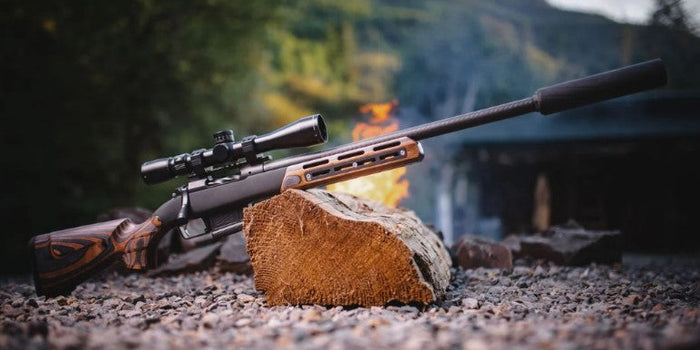
A modern adjustable chassis solves problems that a traditional hunting stock was never designed to solve. Length of pull can be adjusted without spacers. Comb height can be changed to match different optics. Accessory mounting can be built into the fore-end. These features make adjustable chassis systems useful across precision rifle, range, and supported-shooting applications.
Yet slim hunting stocks still matter because a hunting rifle solves a different field problem. A hunting rifle is carried, slung, shouldered, and moved through terrain far more than it is adjusted. The stock has to work in the hand, against the shoulder, across clothing, through brush, inside blinds, and from improvised field positions.
The design objective is not maximum adjustment. It is clean carry, natural mount, and repeatable field handling.

A Hunting Rifle Is Carried Far More Than It Is Fired
A precision-oriented rifle is often configured for bipods, tripods, barricades, or shooting mats. A hunting rifle spends much of its life in the shooter’s hands or over a shoulder. During a hunt, the rifle must move through brush, steep terrain, fences, packs, slings, tree stands, and confined spaces such as blinds. Hunters may carry a rifle for hours before taking a single shot.
That means the stock becomes a carrying interface before it becomes a shooting interface. A slim fore-end, rounded wrist, and traditional grip geometry reduce interference where the rifle is held most often. They allow the support hand to close more naturally around the stock instead of working around wide rails, flat fore-ends, or protruding accessories. The design objective is not maximum adjustability. It is minimum interference.
That same design philosophy appears in purpose-built hunting stocks such as the WOOX Elegante Sporter, where a slim forend and traditional grip geometry prioritize field carry while an integrated aerospace-grade aluminum mini-chassis supports action fitment beneath the walnut stock.
Slim Profiles Reduce Snag Points
External rails, stops, and protruding features can create snag points when a rifle moves through vegetation, packs, slings, or confined spaces. Competition-oriented rifles often use ARCA rails, barricade stops, external weight systems, and wider fore-ends to support positional shooting. Those features have a clear purpose in the right setting.
In dense cover, tight blinds, or steep terrain, the same external geometry can add bulk without improving how the rifle moves through the field. A slim hunting stock reduces external surfaces where they can interfere with field handling. Rounded edges move through brush with less opportunity to catch vegetation, slings, packs, or clothing.
A narrow fore-end also fits naturally into the support hand while carrying the rifle. That matters because field movement is not always clean. A hunter may need to shift the rifle from sling carry to hand carry, move through brush, climb into a blind, or shoulder the rifle from a tight position. The stock should not fight those movements.
Natural Grip Geometry Still Matters
Adjustability changes rifle fit. Grip geometry changes how the rifle is controlled.
Traditional hunting stocks position the firing hand at an angle that supports carrying, quick mounting, and offhand shooting. The wrist can remain more relaxed during long movement because the hand is not forced into the nearly vertical position common on some competition chassis. The difference becomes most obvious when the rifle must be mounted after hours of carrying.
A hunting grip should let the hand find the same position without conscious correction. If the grip forces the wrist, stretches the trigger finger, or requires the hand to shift before the shot, the stock has introduced a variable before live fire begins. That is why many modern field-oriented stocks still preserve some traditional hunting geometry even when they include modern internal structure. Field use still rewards natural handling.
Less Bulk Can Make the Rifle Easier to Carry and Index
Rifle balance depends on weight distribution, not total weight alone. Reducing bulk around the fore-end and wrist changes how the rifle is carried, shouldered, and indexed in the hands.
The result can be a rifle that feels easier to carry, mount, and index in the hands without relying only on reduced overall weight. For a hunting rifle, cross-sectional dimensions matter because the stock is carried and handled for hours before it is fired. A slim fore-end can reduce hand fatigue. A rounded grip can make the rifle easier to control during movement. A smooth exterior can reduce interference with packs, slings, jackets, brush, and blinds. Those characteristics are not outdated. They are field-specific.
Hunters Need Consistency More Than Constant Adjustment
Adjustable chassis excel when one rifle serves multiple shooters, multiple optics, multiple positions, or multiple shooting disciplines. For many hunting rifles, the setup is different.
Once eye relief, optic height, sling position, clothing, and shooting position are established, the goal shifts from repeated adjustment to repeated consistency. Every mount should place the shooter’s eye behind the optic in the same position without conscious correction. Repeatable rifle fit becomes more valuable than continual adjustment. That is why many traditional hunting stocks prioritize fixed geometry with carefully developed comb height, grip angle, fore-end shape, and length of pull.
Fixed geometry encourages the same head position, shoulder placement, and firing-hand relationship every time the rifle is mounted. For most hunting rifles, repeatability rather than continual adjustment is the engineering objective.
Supported Field Positions Still Matter
Slim hunting stocks are not only for offhand shooting. A field rifle still has to settle on packs, shooting sticks, blind rails, fallen logs, and natural supports. The difference is that a hunting stock has to balance support with carry.
A stock built only for supported shooting may feel stable from a rest but bulky in the hand. A stock built only for carry may feel excellent while walking but give limited contact on improvised support. Different hunting stocks solve that balance in different ways.
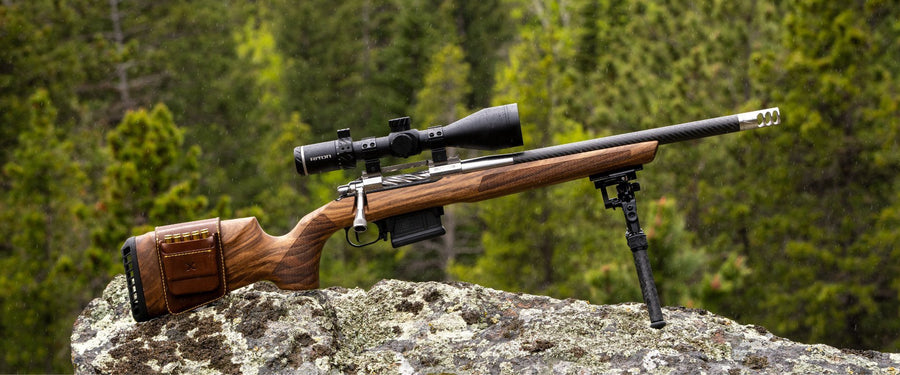
The WOOX Elegante Sporter emphasizes traditional hunting priorities: slim forend, traditional grip geometry, light carry feel, and field handling.
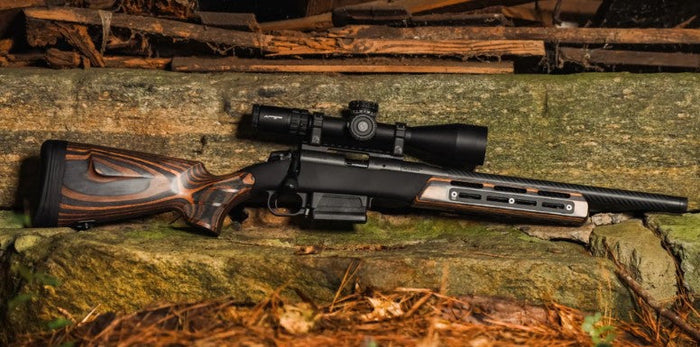
The WOOX Elegante Hybrid moves further toward supported field positions with a vertical grip, flat-bottom forend, negative comb, and integrated aerospace-grade aluminum mini-chassis for hunters who spend more time shooting from rests, bags, or other support.
Both remain hunting-stock decisions. They are not attempts to turn a field rifle into a full competition chassis.
Material Choice Still Shapes the Hunting Experience
The same emphasis on handling extends beyond geometry to the materials used to build the stock. Hunting stock materials are often discussed as wood versus aluminum, but the better engineering question is how each material contributes to the finished rifle.
Material affects how the rifle feels in the hand, how it carries, how it mounts, and how the receiver is supported inside the stock. Rather than forcing a choice between wood and metal, WOOX assigns each material a defined role.
The WOOX Elegante Sporter applies that approach through selected Claro American Walnut and an integrated aerospace-grade aluminum mini-chassis. The walnut forms the primary handling surfaces: fore-end, grip, comb, and shoulder contact.
The mini-chassis supports action fitment beneath the stock. Each material does a different job. The walnut belongs to the shooter-facing interface. The mini-chassis belongs to the internal support structure.
That division of roles lets Elegante preserve the handling character of a traditional hunting stock while adding modern support beneath the action.
Adjustable Chassis Did Not Replace Slim Hunting Stocks
Adjustable chassis expanded what rifles can do. They expanded fit adjustment, modularity, and accessory compatibility across a wider range of shooting applications.
Slim hunting stocks retained something equally important: narrow grip geometry, smooth exterior surfaces, clean carry, and predictable unsupported handling. Those characteristics suit the conditions of a hunt.
A field rifle has to be carried through terrain, mounted from awkward positions, slung over clothing, and used from whatever support the field provides. That is a different design problem from building a rifle around a barricade, bag, bench, or mat. Slim hunting stocks remain relevant because hunting rifles solve different engineering problems than competition rifles.
Adjustable chassis expanded what rifles can do, but they did not replace the handling priorities that define a field rifle: carry, mount, balance, and clean movement through real terrain. A slim hunting stock is not outdated because it lacks external adjustment. It exists because a hunting rifle has a different job.
The rifle must carry cleanly, mount naturally, avoid unnecessary snag points, and return to the same position when the shot opportunity appears. Adjustable chassis systems are valuable when the rifle needs modularity, repeated fit changes, accessory mounting, or positional competition support.
Slim hunting stocks remain valuable when the rifle needs to move through the field without excess bulk. For WOOX, the point is not nostalgia. It is material and geometry doing their assigned work: selected Claro American Walnut where the hunter touches the rifle, an aerospace-grade aluminum mini-chassis where the action needs support, and stock geometry shaped around how a field rifle is actually carried, mounted, and used.
FAQs
Why do hunters still use slim hunting stocks?
Hunters still use slim hunting stocks because they can reduce external bulk, carry naturally in the hand, and move more cleanly through brush, blinds, packs, and uneven terrain. A hunting rifle spends much of its life being carried, so stock geometry has to work before the shot is ever taken.
Are adjustable chassis better than traditional hunting stocks?
Not always. Adjustable chassis provide fit adjustment, accessory mounting, and modularity, which can be valuable for precision shooting and supported positions. Slim hunting stocks prioritize clean carry, natural mount, reduced bulk, and repeatable field handling.
Do slim hunting stocks improve rifle handling?
Slim hunting stocks can make a rifle easier to carry, mount, and control in the field by reducing external bulk and allowing the support hand to close naturally around the fore-end. They do not automatically improve the rifle, but they can better match field-use priorities.
What is the difference between a hunting stock and a chassis?
A hunting stock usually focuses on carry, natural mount, smooth exterior geometry, and field handling. A chassis system usually emphasizes rigid structure, adjustment, modularity, accessory mounting, and supported shooting positions. Some modern WOOX hunting stocks combine traditional hunting geometry with an internal mini-chassis for action support.
Is an adjustable chassis worth it for hunting?
It depends on how the rifle is used. Hunters who frequently shoot from supported positions may benefit from some chassis-style features. Hunters covering long distances or moving through brush, blinds, and uneven terrain may prefer the lighter feel, slimmer profile, and natural ergonomics of a hunting stock.
What makes the WOOX Elegante different from a full adjustable chassis?
The WOOX Elegante series keeps the field-rifle focus: selected Claro American Walnut, hunting-oriented geometry, and an integrated aerospace-grade aluminum mini-chassis for action fitment. It is built around carry, mount, and field handling rather than maximum external adjustment.