Brand-new gear tells you what it was designed to do. A few seasons in the field tell you whether the design actually worked.
That difference matters.
A rifle can feel right at the bench and become awkward after several hours on a sling. A knife that looked ideal on paper may turn out to have more blade than the work requires. An accessory that seemed essential when the rifle was assembled may spend three seasons adding weight before finally coming off.
Used equipment has been tested against real habits instead of imagined ones.
That is the sense in which some hunting gear gets better with age. Steel does not improve simply because five seasons passed. Walnut does not become structurally better because the stock collected a few marks. Mechanical parts do not become more precise through wear.
What can improve is the complete relationship between the hunter and the equipment. Fit becomes familiar. The setup gets refined. Maintenance becomes more specific. Natural materials develop their own surface character, and unnecessary pieces slowly disappear.
Time does not automatically improve good gear. It reveals whether the gear was good in the first place.
Age and Wear Are Two Different Things
There is nothing useful about keeping equipment in service simply because it is old.
A cracked stock is damaged. A loose axe head needs attention. A knife with a rounded edge needs sharpening. Corrosion on working steel is not made more acceptable by calling it patina.
Gear ages well when normal evidence of use develops without compromising the tool.
On a walnut rifle stock, the areas around the grip and fore-end may take on a slightly different sheen through years of handling. A shallow field mark may remain visible without affecting the stock. A wooden axe handle may darken where hands repeatedly contact it.
Those changes are very different from a crack, failed finish, loose hardware, or wood left repeatedly exposed to moisture.
The point is not to preserve working equipment in untouched condition. It is to understand which changes belong to normal use and which ones require maintenance.

A Hunting Rifle Usually Changes Less Than the Hunter Does
The dimensions of a rifle do not slowly reshape themselves around the person carrying it. The owner learns the rifle.
After enough time in the field, you know where the balance sits with the usual optic installed and how the rifle hangs from its sling. You know how the stock feels with a hunting jacket on instead of range clothing. The support hand finds its place naturally, and the rifle comes into the shoulder without requiring much thought.
Some of that familiarity is simply repetition. Some of it comes from small changes made after actual use.
The sling gets shortened or lengthened. An optic position is adjusted. Something attached to the rifle comes off because it never justified the extra weight. A different rest or field position changes how the fore-end is used.
Eventually, the rifle is no longer built around what the owner expected to need. It is built around what the owner actually uses.
Familiarity cannot rescue poor engineering. A badly fitted stock does not improve because the hunter becomes accustomed to being uncomfortable. But when the underlying geometry is right, repeated use makes a good setup easier to work with.
Walnut Records Use in Its Own Way
Walnut is particularly good at showing time because every stock begins differently.
The grain, tone, figure, mineral character, and contrast already belong to the wood before machining begins. A machine can repeat an inlet or external dimension; it cannot reproduce a grain pattern.
Field use adds another layer.
The stock may develop small handling marks and subtle changes in the finish around the areas touched most often. With appropriate care, those changes can give the stock more individual character without affecting its mechanical purpose.
That does not mean walnut should be left alone simply because wear looks interesting. Wood still reacts to moisture. Finish condition matters. A stock that has seen prolonged wet weather should be dried properly and inspected. Exposed wood, failed finish, or structural damage should be addressed rather than allowed to become part of the story.
Good aging comes from use and care together.
The same principle applies to High Grade walnut. WOOX selects High Grade material in very limited quantities for qualities that include figure, grain character, tone, density, balance, and structural suitability. The rarity belongs to the original blank; field use adds a history that grading could never provide.
High Gradedoes not make the rifle more accurate. It simply means the stock began with a particularly uncommon piece of natural material.
The Important Parts Should Not “Age In”
Some surfaces can change through use. Mechanical interfaces should not.
The action support inside a stock should remain correct. Hardware should stay secure. A barrel channel should not begin making unintended contact and be treated as though the rifle is merely developing character.
The same rule applies to other field tools. A knife handle may feel more familiar over time, but the edge still needs to remain serviceable. A wooden axe handle can develop visible handling wear, but the head must remain secure and the handle structurally sound.
This distinction matters because hunting equipment often combines parts intended to behave very differently.
The surface where the hunter interacts with the tool may acquire character.
The part responsible for mechanical function should continue doing its job.
Modern Construction Lets Different Materials Do Different Work
That division of responsibility is one reason modern walnut stocks are interesting.
The WOOX Elegante Sporter uses selected Claro American Walnut around an integrated aerospace-grade aluminum mini-chassis and is listed at approximately 30 ounces.
The two materials are not trying to perform the same job.
Walnut forms the exterior the hunter holds, shoulders, and carries. It can develop the visible history of a natural material through use. The aluminum mini-chassis provides the internal structural interface around the action.
That is a more useful way to think about modern stock construction than treating walnut and aluminum as opposing philosophies.
Use each material where it makes sense.
It also challenges the assumption that a real walnut stock automatically has to be heavy. Finished stock weight depends on geometry, internal structure, hardware, dimensions, and the amount of material used—not simply whether the exterior is wood or synthetic.
A Knife Gets Better Mostly Because the Owner Gets Better With It
A good hunting knife can feel more useful after several seasons, but the steel did not acquire experience.
The owner did.
You learn the amount of blade you actually need, how the handle behaves with cold or wet hands, how the steel responds to the sharpening method you use, and which jobs are better left to a different tool.
That familiarity removes uncertainty.
The WOOX Bad Boy Hunter uses a compact D2 fixed blade with American Walnut or Micarta handle options. On the walnut version, repeated use can leave visible handling character on the natural material. The blade has a different requirement: it still needs to be cleaned, dried, inspected, and sharpened appropriately.
A familiar knife is useful because the owner already understands its limits.
That is more valuable than expecting one blade to become better at every possible task simply because it has been carried for years.
An Axe Leaves Less Room for Romantic Thinking
Axes make the difference between wear and neglect obvious.
The head needs to remain secure. The handle needs to be sound. The edge needs to suit the work. Corrosion needs to be controlled.
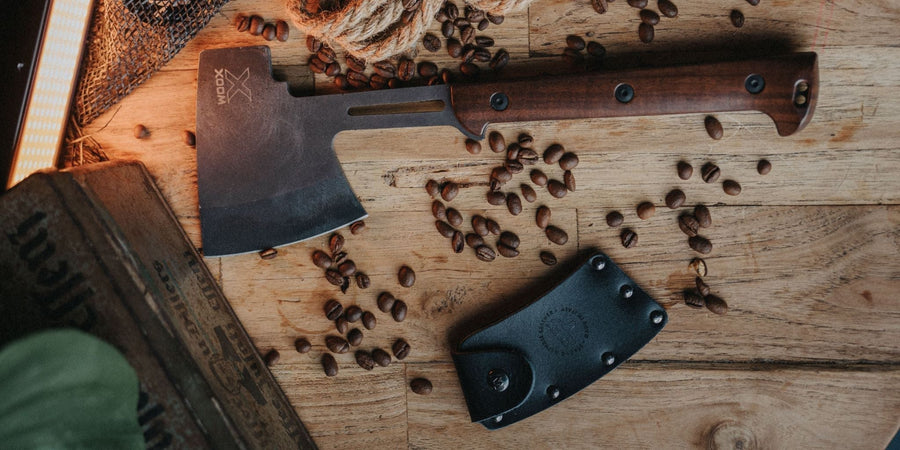
The WOOX TERRA uses a machined 4140 steel head, differential heat treatment, a convex working edge, and either American Walnut or Micarta handle configurations. With a walnut handle, normal use can alter the surface in the areas most often gripped without changing the mechanical purpose of the tool.
A well-used axe may look better to its owner after several years because those marks came from actual work. That only remains true while the tool is mechanically sound.
Once the handle is damaged or the head becomes loose, the issue is no longer age. It is maintenance.
Leather Can Settle Into Use, but It Still Has Limits
Leather can also change through regular field use.
Depending on the leather, finish, construction, and conditions, a sheath or cover may become somewhat more compliant and show visible handling wear. Color can vary in high-contact areas, and a new piece that initially feels stiff may settle into the equipment it was designed to carry. None of that means leather improves indefinitely.
Stitching can fail. Retention can change. Repeated moisture can create problems. A cover that no longer safely protects the edge or holds the tool correctly has moved past useful aging.
The same question applies to every material in the kit: has normal use changed its appearance while leaving its function intact? If function has been compromised, repair or replacement takes priority over character.
Experience Usually Removes Gear
One of the most useful things time does to hunting equipment has nothing to do with patina.
It simplifies the setup.
New rifles and new packs tend to accumulate possibilities. An accessory gets attached because it might help. A second knife goes into the pack because it weighs very little. Another tool gets carried because there is a chance it might be needed.
After several hunts, those ideas have evidence behind them.
Some survive.
Others do not.
A rifle accessory that never solves a real problem eventually comes off. A second knife that duplicates the first stays home. An axe may become a permanent part of a camp setup but stop going on shorter hunts where no chopping work is expected.
The rifle itself often becomes cleaner as the owner learns what actually helps.
This may be the most practical way good gear gets better with age. The equipment is no longer built around every possible scenario. It has been edited by experience.
There is less on it, but more of what remains has earned its place.
A Season Is a Better Test Than a Specification Sheet
Specifications matter. They help determine whether a product belongs in the conversation at all.
But they cannot tell you everything.
A rifle can be lightweight and still feel poorly balanced. A stock can offer adjustment that the hunter never uses. A knife can use excellent steel and still be the wrong size for the jobs it is given. An axe can be beautifully made and unnecessary for the particular hunt.
Time exposes those mismatches.
That is why equipment that has been used for several hunting seasons can feel more complete than something brand new. The owner has had enough opportunities to find the irritating details and enough time to correct the ones that can be corrected.
Good design survives that process.
Poor decisions become harder to ignore.
Maintenance Gets More Specific With Use
New equipment often receives generic care because the owner has not yet learned where attention is actually needed.
A stock gets more oil because it is walnut. A knife gets sharpened because it has been used once. A tool receives maintenance because the calendar says the season ended rather than because its actual condition requires it.
Experience usually makes maintenance more restrained.
The owner learns which parts of the rifle see the most weather and where the finish should be inspected first. The knife tells you through use when the edge is no longer performing as it should. The axe handle gets checked in the areas that actually take load and contact.
Walnut is a good example. More product is not automatically better care. Finish type, current condition, exposure, and actual wear matter more than simply adding oil because the stock is made of wood.
Good maintenance becomes less about routine for its own sake and more about understanding the individual tool.
Many Polymer and Composite Stocks Age Differently, Not Poorly
There is no need to make walnut look better by making synthetic stocks sound worse.
Many polymer and composite stocks are chosen specifically because they require less attention around environmental moisture and surface maintenance than wood. That is a genuine advantage.
They simply age differently.
A walnut stock makes handling and surface wear more visually obvious because natural grain and finish are part of its appearance. A synthetic stock may preserve a much more consistent surface while still accumulating scratches or other evidence of use.
Neither approach is inherently better.
The question is what the hunter wants from the material.
Some want the lowest possible maintenance burden. Others enjoy working with a natural material that changes visibly through years of ownership.
Both can be good hunting tools.
What Actually Gets Better With Time?
The answer is narrower than the phrase suggests.
Familiarity improves because the owner learns how the rifle, knife, or axe behaves under real conditions. Setup improves because accessories and adjustments that do not help are eventually removed or changed. Maintenance improves because it becomes based on the condition of the actual tool rather than generic assumptions.
Natural materials can also become more individual. Walnut, wood handles, and some leather goods can develop visible handling character while remaining fully functional.
None of those improvements come from age alone.
They come from use.
Time simply gives the owner enough opportunities to learn what works.
What Definitely Does Not Get Better With Time
Mechanical problems deserve less romance.
Cracks, corrosion, loose hardware, failed finishes, damaged action interfaces, unsafe sheaths, split handles, and cutting edges that have been neglected are not signs that equipment has developed character.
They are things to inspect, maintain, repair, or replace as appropriate.
Permanence does not mean refusing to replace a part that has reached the end of its service life. It means not discarding the rest of a sound tool simply because one component requires attention.
That difference becomes increasingly important as equipment stays in service longer.
The Goal Is to Keep Gear Sound, Not New
A hunting rifle used regularly will eventually stop looking untouched. So will a knife or axe. That is expected. The better goal is to keep the equipment mechanically sound while allowing normal use to remain visible.
A walnut stock can show years of handling while its finish is still properly maintained. A wooden handle can carry signs of work while remaining structurally sound. A knife can have been sharpened many times while still retaining appropriate working geometry.
This is what useful aging looks like. The gear is no longer exactly as it left the shop, but nothing important has been allowed to deteriorate simply for the sake of preserving a story. Over time, the tool becomes increasingly specific to the person using it.
That is difficult to manufacture. It has to happen outside.
Frequently Asked Questions
Does hunting gear really get better with age?
Some hunting gear becomes better suited to its owner through familiarity, refined setup, maintenance knowledge, and normal material aging. Age itself does not improve mechanical performance. Damaged or worn components still need appropriate maintenance, repair, or replacement.
Does walnut get better as it gets older?
A properly maintained walnut stock can develop more individual surface character through years of handling and use. The wood does not automatically become stronger because it is older. Moisture exposure, finish condition, fit, and structural integrity still need to be monitored.
What is the difference between patina and damage?
Normal surface changes caused by handling and age can add character without affecting function. Damage compromises the material or operation of the tool. Cracks, corrosion, failed finish, loose hardware, and structural problems should not be treated as desirable patina.
Why do older hunting rifles sometimes feel better?
Familiarity is often the main reason. Over time, the owner learns the rifle's balance, sling position, stock geometry, and handling characteristics and may refine the setup based on actual field use.
Does an older rifle become more accurate?
Not simply because of age. Accuracy depends on barrel condition, action, ammunition, optic, stock or support interface, installation, environmental conditions, and the shooter. Greater familiarity may help the shooter use the rifle more consistently, but mechanical wear can also reduce performance.
Can an older walnut rifle stock be refinished?
Depending on its construction, finish, and condition, a sound walnut stock may receive appropriate finish maintenance or be refinished. Structural damage, poor fit, and moisture problems should be addressed separately rather than hidden under a new finish.
Do wooden knife and axe handles improve with use?
Wood handles can develop visible handling character and may feel increasingly familiar to the owner. They still need to remain structurally sound. Cracks, looseness, or other damage should be addressed rather than treated as desirable aging.
How can hunting gear last longer?
Use each tool for the work it was designed to perform, inspect it after hard or wet use, control moisture, maintain cutting edges appropriately, address loose or damaged parts early, and use material-specific maintenance instead of applying the same routine to every piece of equipment.
What Time Is Good For
Time is useful because it removes assumptions. After enough seasons, you know whether the stock carries well. You know which rifle accessories actually help. You know whether the knife earns its place in the kit and whether the axe belongs on that particular hunt.
The equipment becomes simpler because the field has already made the decisions.
Walnut picks up the evidence of handling. Steel needs maintenance. Leather changes. The hunter learns what needs attention and what does not. None of that makes an old tool automatically better than a new one. It does make a good tool better known. For hunting equipment, that can be worth a great deal.
Built to be handed down to those who come next.