Synthetic stocks solved a lot of problems. They are tolerant of weather, generally require little surface maintenance, and can be manufactured with a high degree of consistency. For a rifle that will spend its life getting wet, knocked around in a truck, or carried through country where careful maintenance is unlikely, that practicality is hard to argue with.
Yet walnut is still here. Not hanging on as decoration. Not limited to rifles that never leave a safe. Hunters are still putting wood on rifles they intend to carry.
The interesting question is not whether walnut can beat synthetic material at being synthetic. It cannot, and it does not need to.
The better question is why a hunter, knowing that an easier option exists, would still choose wood. The answer has less to do with nostalgia than it first appears.
Wood Was Never Chosen for Rifle Stocks by Accident
Walnut has spent a long time around sporting rifles because it is unusually well suited to work that demands both strength and complex machining.
American black walnut has a particularly well-documented history in rifle and shotgun stocks. Properly seasoned walnut machines cleanly, holds detailed shapes well, accepts finish, and offers useful strength through sections of a stock that can become surprisingly thin.
Claro walnut has its own history in gunstocks and fine woodworking and is the material WOOX specifies for the Elegante line. But saying “walnut” does not tell you whether a particular piece of wood belongs on a rifle.
That decision starts before machining.
A stock blank has to be read.
Where does the grain travel?
What happens through the wrist?
How does it move around the action area?
Is the blank stable?
Is the figure simply dramatic, or is the underlying grain suitable for the shape that will eventually be cut from it?
Those questions matter more than whether a blank photographs well.
A piece of walnut can be beautiful and still be the wrong piece of walnut for a stock.
That distinction is part of the craft.
Figure Gets Attention. Grain Has to Do the Work.
Anyone looking at high-grade walnut will notice figure first.
Curl, feather, contrast, darker lines, shifting depth when the stock catches light—those are the things that make one blank stop you while another does not.
But a stock maker has to look underneath the spectacle.
Grain flow matters in any object that will be cut into a complex shape and asked to remain sound through years of use. The narrow wrist of a rifle stock is an obvious example. A visually dramatic blank with poorly oriented grain is not automatically a better choice than a quieter blank with more appropriate structure.
This is also why there is no machine-perfect definition of a “beautiful” stock.
Walnut grows rather than being molded.
Two blanks can come from the same species, receive the same machining operations and finish, and still end up looking completely different.
That variation is not a manufacturing inconsistency.
It is the material.
What High Grade Walnut Actually Means
High Grade deserves a little restraint because the term is easy to misuse.
High-grade wood does not make a rifle inherently more accurate.
It does not turn an unsuitable rifle setup into a suitable one.
And it should not be presented as though a higher visual grade automatically means greater mechanical performance.
Its value is rarity.
Within WOOX’s High Grade selection process, walnut is judged for characteristics such as figure, tone, grain character, density, balance, structural integrity, and the overall quality of the individual blank. Under WOOX’s own standard, fewer than four percent of harvested blanks qualify for its Grade Fancy American Walnut selection.
That scarcity matters because figure cannot simply be ordered into existence.
A manufacturer can repeat a molded texture.
It can repeat a paint color.
It can repeat a hydro-dipped pattern.
It cannot grow the same walnut blank twice.
For a hunter interested only in function, that distinction may have little value. Fair enough.
For someone building a rifle they expect to keep for decades, selecting the individual piece of wood can become part of selecting the rifle itself.
That is the point of High Grade.
Not more accuracy.
More rarity. More character. A material that cannot be duplicated once it is gone.
Synthetic Is Easier Around Water. That Is Still True.
There is no benefit in pretending walnut does not have weaknesses.
Wood is hygroscopic. It exchanges moisture with the surrounding environment. Proper drying, stock construction, sealing, finishing, and maintenance help control that movement, but a finish slows moisture exchange rather than making wood waterproof.
Most modern polymer and composite stocks are much less sensitive to environmental moisture.
If the rifle is going to see repeated rain, salt air, wet snow, mud, and long stretches when nobody intends to think about the stock afterward, synthetic material makes an excellent case for itself.
Walnut can absolutely be hunted in bad weather.
It has been for generations.
The difference is what happens when the rifle comes home.
A wet wood-stocked rifle should not be zipped into a damp case and forgotten. It should be dried. The finish should be inspected. Exposed wood, damaged finish, or areas where water may have entered deserve attention.
That is not a failure of walnut.
It is simply part of owning the material.
WOOX has always been better served by being clear about those tradeoffs than pretending every material excels at everything.
Maintenance Is Not the Same Thing as Fragility
This is where conversations about wood often become too simplistic.
A material requiring maintenance does not automatically mean the material is fragile.
There are several kinds of durability.
There is resistance to weather.
Resistance to impact.
Structural durability.
Surface durability.
And there is something that gets discussed much less often: serviceability.
Walnut can age without becoming useless.
A stock with a tired finish does not necessarily need to be replaced. Surface wear can often be addressed. Depending on the stock and the extent of the damage, finish can be renewed and years of handling can be cleaned up without erasing the object itself.
That changes the ownership model.
The goal does not have to be keeping a rifle permanently looking as though it came out of a box yesterday.
The goal is keeping it sound.
There is a big difference between patina and neglect.
A polished area where a hand has carried a rifle for years is one thing.
Bare, unprotected wood exposed to repeated moisture is another.
A handling mark is not a structural crack.
A stock gaining character is not the same as a stock being allowed to deteriorate.
People who keep wood rifles for a long time learn that distinction.

The Stock Is Where the Hunter Meets the Rifle
Reducing walnut to appearance misses what a stock actually does.
The stock is the interface between the rifle and the person carrying it.
Your cheek returns to the comb.
Your hand closes around the grip.
Your support hand finds the fore-end.
The butt comes into the shoulder.
The sling hangs from the rifle while you cover ground.
Most of that experience is controlled by geometry, not species.
A poor stock shape does not become good because the wood is beautiful.
But material still changes the experience.
Wood has texture. Grain. Finish. Small variations from one piece to another. It changes visually as it is handled. A rifle fitted with walnut eventually looks like the rifle that has been carried, rather than another copy of the same molded surface.
That matters to some hunters and not at all to others.
Neither position needs defending.
The important thing is recognizing that a hunting rifle is owned for far longer than it is usually fired.
For someone buying around a single season, maintenance and weather resistance may dominate the decision.
For someone thinking in decades, other qualities begin to matter.
Wood Does Not Automatically Mean Heavy
This assumption deserves to disappear.
“Wood stock” describes a material.
It does not describe the finished weight of the stock.
A traditional stock with substantial material through the fore-end and butt can be heavy. So can a synthetic precision stock packed with reinforcement, adjustment hardware, rails, weights, and accessories.
Finished weight comes from the entire design.
Geometry matters.
The amount of material matters.
Hardware matters.
Internal reinforcement matters.
Action support matters.
The dimensions of the fore-end and buttstock matter.
That is where modern walnut stockdesign gets interesting.
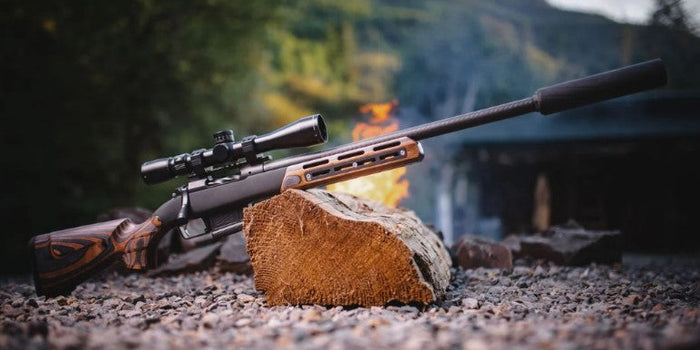
The WOOX Elegante Sporter uses selected Claro American Walnut around an integrated aluminum mini-chassis while keeping the listed stock weight at approximately 30 ounces.
That matters because it breaks an old assumption without asking the hunter to abandon wood.
The exterior remains walnut.
The internal action interface is engineered separately.
The overall form remains that of a field stock rather than a competition chassis covered in adjustments a hunter may never use.
WOOX states that only about one in twenty-five Claro walnut blanks meets its selection standard for an Elegante Sporter.
That is not old construction reproduced for appearance.
It is traditional material being asked to work inside a modern design.
Lightweight Is Only Useful if the Rifle Still Carries Well
Hunters understandably talk about ounces.
Walk far enough uphill and ounces eventually become persuasive.
But scale weight alone does not tell you whether a rifle will feel good in the field.
Where the mass sits matters.
A rifle can be light overall and still feel awkward if too much of that weight is concentrated at one end. Add a large optic, heavier barrel, suppressor, bipod, sling, or other equipment and the balance changes again.
This is why the stock should be considered as part of a system rather than a stand-alone number.
A lightweight walnut stock makes sense when it contributes to the intended rifle.
It is not automatically better because it weighs less.
A mountain rifle, a stand rifle, and a rifle used primarily from supported positions can legitimately want different things.
The hunter should decide what the rifle has to do first.
Then choose the stock.
That order prevents a lot of expensive mistakes.
Walnut Does Not Make a Rifle More Accurate
Beautiful wood has inspired plenty of questionable accuracy claims over the years.
The simpler answer is better.
A walnut stock does not make a rifle accurate because it is walnut.
A synthetic stock does not make one accurate because it is synthetic.
Accuracy belongs to the complete system: barrel, action, ammunition, optic, trigger, action support or bedding interface, installation, environmental conditions, and the shooter behind it.
The stock matters because it is part of that system.
Its geometry affects how consistently the shooter gets behind the rifle.
Its structural design affects how the action is supported.
Its inlet has to match the rifle.
Its barrel channel has to suit the intended configuration.
That is why the internal structure of a modern stock can be more important mechanically than the material you see from the outside.
On Elegante, the walnut provides the traditional exterior and field interface while the aluminum mini-chassis creates a defined internal support structure.
The point is not that walnut suddenly became aluminum.
The point is that it no longer has to perform every job by itself.
That is modern stock engineering.
Why Walnut Can Make More Sense the Longer You Own the Rifle
There is a moment in hunting equipment where specification sheets stop telling the whole story.
A rifle may begin as a list:
- Action
- Barrel.
- Caliber
- Optic.
- Stock.
- Weight
- Length.
Then ten seasons pass.
At that point, the rifle is no longer just the sum of those specifications.
You know where the sling sits.
You know the mark on the fore-end.
You know which cold morning put it there.
You know which screws you check before the season starts and where the finish first needed attention.
That relationship can happen with any rifle.
Walnut simply makes the passage of time more visible.
It can wear.
It can be maintained.
It can be refinished.
It can change without necessarily becoming obsolete.
That is where wood fits naturally into the idea of a rifle being kept rather than cycled through.
Not every rifle has to be an heirloom.
But if someone wants to build one with that possibility in mind, walnut starts making a great deal of sense.
Some Hunting Tools Are Better When They Stay With You
The same idea extends beyond the rifle.
Look at the field tools hunters tend to remember.
A knife that has been sharpened so many times the edge carries its own history.
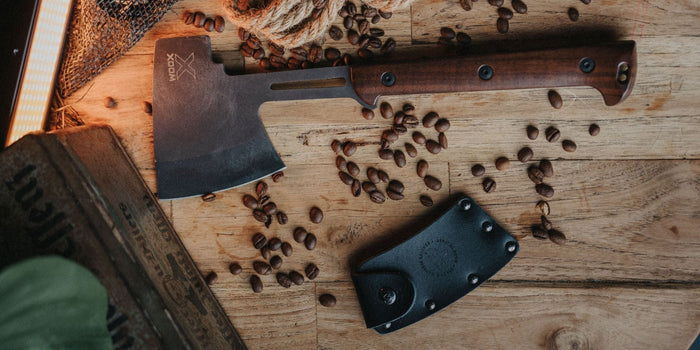
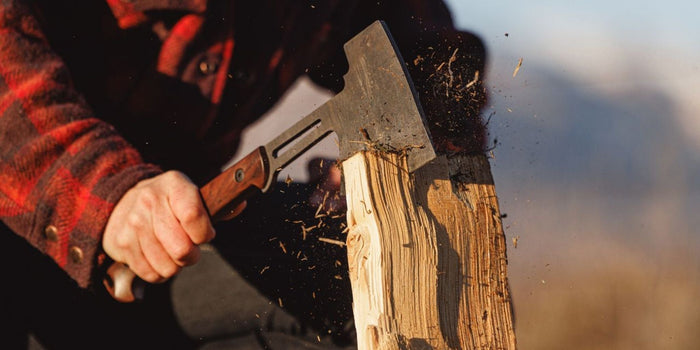
An axe with a handle darkened from use.
A sling that has softened over years.
A rifle that no longer looks new but still belongs exactly where it always has.
There is a difference between equipment designed only to survive and equipment designed to remain worth maintaining.
The best hunting tools often do both.
That is one reason wood, steel, leather, and other traditional materials continue to find a place alongside modern polymers, composites, and aluminum.
New materials did not make the old ones meaningless.
They simply made the choice more specific.
Choose the material for the job.
Then choose whether you want to keep living with it.
When Synthetic Is Probably the Better Choice
Walnut should not be the default recommendation simply because WOOX works with wood.
There are plenty of situations where synthetic makes more sense.
A hunter who expects relentless wet weather and does not want to maintain a wood finish should look seriously at synthetic.
The same applies to rifles treated primarily as hard-use tools, rifles likely to spend long periods in harsh environments, or builds where the lowest possible maintenance burden matters more than material character.
Budget can matter too.
So can replacement cost.
So can the way the rifle is transported and stored.
There is nothing less authentic about choosing synthetic for those reasons.
Knowing when not to use a material is part of understanding it.
So Why Do Hunters Still Choose Walnut?
Because “easier” answers only one part of the question.
Synthetic stocks made hunting rifles more practical in a number of ways. They reduced maintenance concerns, handled environmental exposure well, and gave manufacturers consistent platforms to work with.
Walnut offers a different set of qualities.
It is selected rather than replicated.
It can be maintained rather than simply discarded when its surface ages.
Its grain makes each stock individual.
High-grade blanks can carry natural figure that cannot be reproduced once that particular piece is gone.
And modern engineering means choosing walnut no longer automatically means choosing a heavy, mechanically traditional stock.
That is where products such as Elegante become relevant.
A lightweight hunting stockcan still use real Claro American Walnut.
A traditional exterior can still sit around an engineered internal structure.
A rifle can acknowledge where sporting rifles came from without being built as though nothing has changed since then.
That balance is more interesting than arguing that wood is simply “better.”
It is not better for everyone.
It does not need to be.
For the hunter who values minimal maintenance above everything else, synthetic remains difficult to beat.
For the hunter who wants material character, serviceability, craftsmanship, and a rifle that can remain worth keeping for decades, walnut still has work to do.
And it is still very good at it.
Frequently Asked Questions
Are wood rifle stocks still practical for hunting?
Yes. Properly selected, finished, and maintained walnut remains a practical stock material for hunting rifles. It requires more attention around prolonged moisture exposure than most polymer or composite stocks, so suitability depends on the hunting environment and how the owner intends to maintain the rifle.
Why has walnut traditionally been used for rifle stocks?
Walnut has useful strength, machinability, finishing characteristics, and dimensional behavior when properly seasoned. It can also be shaped through the grip, wrist, comb, fore-end, and action area while providing the natural grain and figure long associated with sporting rifles.
Are walnut rifle stocks heavier than synthetic stocks?
Not automatically. Finished stock weight depends on geometry, internal construction, reinforcement, hardware, dimensions, and the amount of material used. A heavily reinforced synthetic stock can outweigh a carefully designed walnut hunting stock. The WOOX Elegante Sporter, for example, is listed at approximately 30 ounces.
Does walnut improve rifle accuracy?
Walnut by itself does not make a rifle more accurate. Accuracy depends on the complete rifle system, including the barrel, action, action support or bedding interface, ammunition, optic, installation, environmental conditions, and shooter. Stock material should not be used as a stand-alone accuracy claim.
Can a walnut rifle stock be used in rain?
Yes, but wood should not be treated as waterproof. A sound finish helps slow moisture movement. After significant wet-weather exposure, the rifle should be dried correctly and the stock checked for exposed wood, damaged finish, or trapped moisture.
Can an old walnut rifle stock be refinished?
Many walnut stocks can be renewed when the problem is finish wear, handling marks, or surface deterioration. The correct approach depends on the original finish, condition of the wood, checkering, hardware, and whether any structural damage is present.
What makes High Grade walnut different?
High Grade walnut is selected primarily for the rarity and quality of the individual blank—figure, grain character, tone, contrast, balance, density, and overall suitability. Under WOOX’s own High Grade standard, fewer than four percent of harvested blanks qualify. High Grade should not be interpreted as a guarantee of greater rifle accuracy.
What is a lightweight walnut hunting stock?
A lightweight walnut hunting stock controls mass through its geometry and internal construction instead of relying on synthetic material alone. The WOOX Elegante Sporter is one example, combining selected Claro American Walnut with an integrated aluminum mini-chassis at a listed weight of approximately 30 ounces.
The Future of Tradition.
Built to be handed down to those who come next.