Most Ruger 10/22 barrel upgrades appear to be barrel decisions. In practice, they are stock-fit decisions.
While the barrel swap itself can be straightforward on many 10/22-pattern rifles, preserving barrel-channel clearance, receiver support, and long-term stock consistency depends on stock geometry.
Bull and tapered barrel comparisons often focus on performance and handling, but compatibility comes first: the stock must accommodate the barrel profile before the rifle can be evaluated as a complete system.
A properly specified barrel channel should match the intended barrel profile, with enough clearance to avoid unwanted contact. On a Ruger 10/22, barrel selection and stock fit are inseparable decisions.
Treating them separately leads to fitment issues, weight-distribution changes, and avoidable stock modification.
The Ruger 10/22 Receiver Usually Is Not the Problem
Factory tapered barrels, heavy match barrels, and many aftermarket bull barrels share the same general Ruger 10/22 receiver interface. They install using the barrel tenon and V-block arrangement at the front of the receiver.
Aftermarket receivers, non-standard barrels, and 10/22-pattern clones should still be checked against the barrel maker's and stock maker's compatibility notes.
The V-block secures the barrel shank at the receiver, so the main stock-fit question usually becomes barrel-channel clearance, receiver support, and action fit rather than a different receiver interface.
Because the receiver interface is largely standardized on typical Ruger 10/22 builds, stock design focuses on barrel-channel geometry, receiver support, and dimensional consistency.
The barrel channel must provide consistent clearance for the barrel contour. Too narrow, and installation requires modification. Too wide, and the action may still assemble, but excessive clearance creates unnecessary gaps around the barrel.
A stock should match the rifle's actual barrel profile, not just the receiver name.
Barrel Contour Changes More Than Diameter
In many Ruger 10/22 builds, a bull barrel usually refers to a barrel with an outer diameter of approximately .920 inch. That added diameter requires a stock cut for a bull-barrel or match-profile inlet.
A stock inlet for a factory-style tapered barrel usually cannot accept a .920-inch profile without material removal.
Compared with a heavy bull barrel, a tapered barrel usually keeps more weight closer to the receiver, reduces front-end mass, and can make the rifle feel faster to shoulder during field carry.
Stocks machined or specified for tapered barrels maintain closer barrel-channel proportions and avoid the oversized gaps created when a tapered barrel is installed in a bull-barrel inlet.
At a practical level, bull barrels prioritize front-end mass and supported-shooting steadiness. Tapered barrels prioritize lighter handling and reduced carry weight.
Those differences affect more than handling alone. They also influence barrel-channel clearance, stock fit, and how weight loads the rifle during use.
Barrel Fit Changes Both Clearance and Balance
Free-floating helps prevent unintended stock contact that can alter how the barrel behaves during firing. Pressure points may result from uneven inletting, inconsistent action-screw torque, stock movement, or dimensional changes that reduce barrel clearance.
The stock's role is to support the receiver consistently and maintain barrel clearance so one variable in the rifle system stays controlled.
A barrel channel sized for a .920-inch profile will usually clear a tapered barrel, but excessive clearance creates visible gaps and reduces overall fit precision.
On a synthetic utility stock, oversized clearance may be easy to ignore. On an American Walnut stock, where grain, shape, and inletting are part of the finished object, excess clearance becomes immediately visible.
Clearance, however, is only part of the equation. Barrel contour also changes how weight is distributed across the rifle.
In practical terms, a bull barrel can feel steadier during slow, supported shooting because the added front-end mass helps the rifle settle differently on a bench or rest.
A tapered barrel can be entirely suitable for hunting, field carry, and general plinking, but it usually prioritizes lighter handling over sustained bench-style shooting.
The tradeoff is not simply accuracy versus weight. The tradeoff is how the rifle balances, how it carries, and how it settles in the positions where it will actually be used.
Stock geometry determines whether added front-end weight feels stable on the bench or cumbersome during unsupported shooting.
Why Stock Engineering Matters With American Walnut
American Walnut responds to seasonal humidity, temperature changes, handling, and long-term use. That is not a defect. It is the nature of a living material.
That is why the stock's engineering matters as much as the American Walnut itself.
Grain orientation, sealing, receiver support, and barrel-channel geometry work together to preserve the relationship between the receiver, barrel, and stock over time.
Proper grain selection, sealing, and receiver support allow American Walnut to retain its handling character while reducing unnecessary movement across changing field conditions.
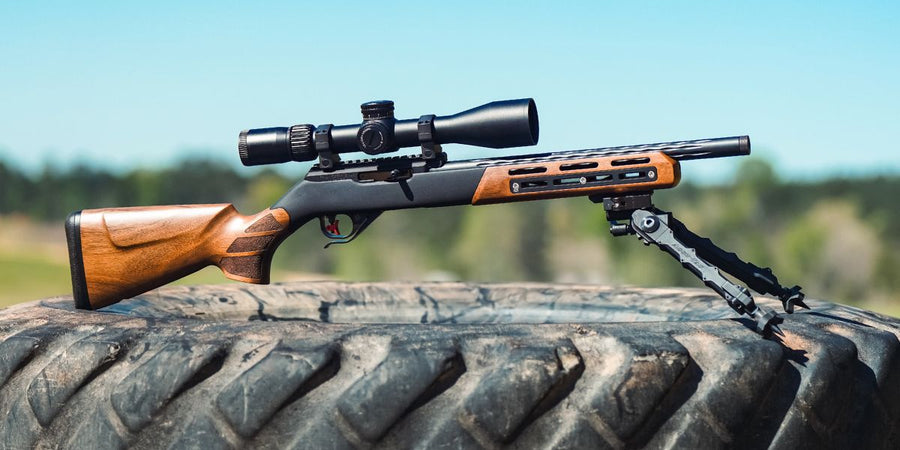
Hybrid stock systems separate structural loads from the walnut itself. The receiver bears against machined aluminum structure while the American Walnut provides exterior geometry, hand feel, and the material character that makes each stock distinct.
Integrating aluminum and American Walnut effectively requires understanding that the two materials respond differently to stress, temperature, and humidity over time. A well-engineered hybrid stock lets each material serve the job it is suited for.
In WOOX Ruger 10/22 stock systems, American Walnut and machined aluminum structure work together so the stock can preserve the feel of walnut while giving the receiver a defined mechanical support interface.
WOOX Ruger 10/22 stocks are built to support pencil, straight, and match barrel profiles, depending on the selected inlet and current product configuration. Confirm the selected inlet and current WOOX Ruger 10/22 stock product page before ordering.
Choose the Stock for the Rifle's Intended Use
Before choosing a Ruger 10/22 stock, confirm four variables:
- barrel contour
- barrel-channel dimensions
- intended balance
- receiver and stock compatibility
Choose a bull-barrel or match-profile inlet for rifles configured around heavy barrels, supported shooting, suppressors, optics-heavy setups, or bench-style use.
Choose a tapered-barrel inlet when preserving factory-style handling, lighter carry weight, and general field use are the priority.
A Ruger 10/22 stock should be selected around barrel contour before purchase. A bull-barrel inlet and a tapered-barrel inlet are engineered for different barrel profiles, and choosing the correct inlet preserves barrel-channel clearance without stock modification.
Barrel contour, stock geometry, and receiver support work as a single system rather than independent components.
Final Fitment Check Before Ordering
Before ordering a Ruger 10/22 stock, confirm the exact rifle and barrel setup.
Check:
- standard Ruger 10/22 receiver or aftermarket receiver
- barrel profile
- tapered, pencil, straight, bull, or match contour
- barrel-channel option on the selected stock
- magazine compatibility
- receiver support and action fit
- whether the build uses clone, custom, oversized, or non-standard parts
A Ruger 10/22 stock should not be selected by model name alone. The receiver may be the familiar part of the system, but the barrel channel determines whether the stock actually fits the barrel in front of it.
Frequently Asked Questions
Which WOOX stock fits a Ruger 10/22 bull barrel?
WOOX offers Ruger 10/22 stock configurations for different barrel profiles, including pencil, straight, and match-profile options. Confirm the correct inlet option on the current WOOX Ruger 10/22 stock product page before ordering to ensure proper barrel-channel clearance.
Why does barrel-channel clearance matter?
Barrel-channel clearance matters because unwanted contact between the barrel and stock can introduce pressure points. Those pressure points can change how the barrel behaves during use and reduce consistency from one setup to the next.
Should I choose a stock before choosing a barrel?
No. Confirm the barrel contour first. Stock selection should follow barrel selection because barrel-channel dimensions are cut or specified around a particular barrel profile.
Can a tapered barrel fit in a bull-barrel stock?
Usually, yes. A tapered barrel will often fit inside a bull-barrel inlet because the barrel channel is wider. However, this can leave visible clearance gaps and reduce overall fit precision.
Does a bull barrel fit in a standard Ruger 10/22 stock?
Usually no. Most factory-style Ruger 10/22 stocks are cut for tapered barrels and do not provide enough barrel-channel clearance for a .920-inch bull barrel without modification.
What is the difference between a tapered barrel and a bull barrel on a Ruger 10/22?
A tapered barrel usually keeps the rifle lighter and easier to carry. A bull barrel has more front-end mass and is often chosen for supported shooting, bench use, or match-style builds. The stock must match the barrel profile.
Does a bull barrel make a Ruger 10/22 more accurate?
A bull barrel does not automatically make a rifle more accurate. It changes barrel mass, balance, and how the rifle settles during supported shooting. Accuracy depends on the complete rifle system, including barrel quality, ammunition, receiver support, optic setup, trigger, shooter input, and stock fit.
What should I check before buying a Ruger 10/22 stock?
Confirm the receiver type, barrel profile, barrel-channel option, magazine compatibility, and whether the rifle uses standard Ruger parts or aftermarket/custom components. If the rifle uses a clone receiver, oversized barrel, or non-standard parts, confirm compatibility before ordering.