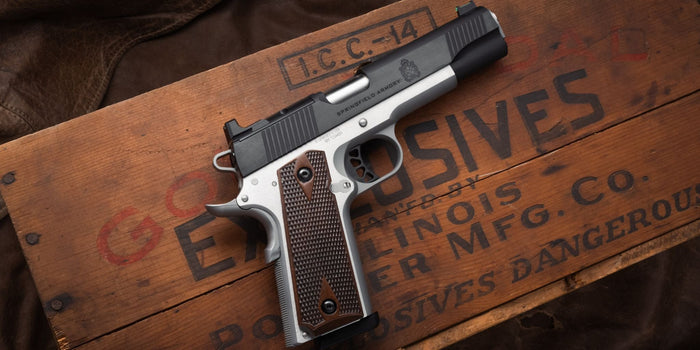
Take two walnut rifle stocks with identical 20 LPI checkering. The diamonds may look almost identical in photographs, yet one can feel noticeably sharper in the hand than the other. The difference could come from the depth of the grooves, the shape of the diamond points, the finish or the way the pattern follows the stock's contours.
For someone choosing a walnut gunstock, those details are worth understanding. Checkering is often advertised by its lines-per-inch measurement, but a finer pattern is not necessarily better, and a more aggressive texture is not automatically more useful.
Gunstock checkering is a pattern of intersecting grooves that creates a diamond-shaped gripping texture, typically on a rifle or shotgun's pistol grip and fore-end. It provides a defined contact surface for the hands while also contributing to the appearance of the stock.
The quality of that texture depends on several things working together: the pattern, the condition of the wood, the manufacturing method and the geometry of the finished component.
At WOOX, these distinctions matter because walnut is a working material. Whether we're making a traditional rifle stock or a modern wooden grip, the texture has to suit the wood and the part it belongs to.
What Is Checkering on a Gunstock?
Traditional gunstock checkering consists of two sets of parallel grooves crossing at an angle to create a repeating diamond pattern. In cut checkering, material is removed to form the grooves and leave small raised diamonds between them.
Other processes, including pressing and laser texturing, can produce similar patterned surfaces through different manufacturing methods.
Checkering serves two purposes.
The first is functional. The texture provides a more defined gripping area than a smooth, finished surface. On sporting rifles and shotguns, those areas are usually located around the pistol grip and fore-end, where the hands naturally contact the wood.
The second is visual. A well-designed checkering panel follows the shape of the stock, introduces an orderly pattern against the natural walnut grain and creates a deliberate transition between smooth and textured surfaces.
Both are legitimate reasons to use checkering. In traditional stockmaking, the quality of the work is evident in the consistency of the pattern, the treatment of its boundaries and how naturally it follows the stock.
The Sporting Arms and Ammunition Manufacturers' Institute (SAAMI) defines checkering as a diamond-like pattern on firearm components used for grip or ornamentation.
That definition is straightforward. Judging the quality of the finished pattern requires a closer look.
What Does LPI Mean in Gunstock Checkering?
LPI means lines per inch. It describes how closely the parallel grooves in a checkering pattern are spaced.
The measurement is taken perpendicular to a set of parallel lines.
For example, a 20 LPI pattern has 20 lines per inch measured across that set of grooves. A 24 LPI pattern has more closely spaced lines and therefore produces smaller diamonds when the underlying pattern geometry is otherwise comparable.
A higher LPI number means finer checkering. A lower number means a coarser pattern with larger diamonds.
SAAMI's checkering line count definition confirms this distinction.
16 vs 18 vs 20 vs 22 vs 24 LPI checkering
| LPI | Pattern appearance | Practical consideration |
|---|---|---|
| 16 LPI | Coarse, relatively large diamonds | Offers a pronounced texture; the finished point shape affects how aggressive it feels |
| 18 LPI | Coarse sporting-stock pattern | Often encountered in traditional checkering, particularly on more open-grained walnut |
| 20 LPI | Moderately coarse, well-defined diamonds | A familiar sporting-stock reference that balances visible detail with practical spacing |
| 22 LPI | Finer diamonds and closer spacing | Requires consistent execution and suitable wood |
| 24 LPI | Fine, closely spaced diamonds | Smaller points demand greater care in material selection and execution |
| 26 LPI and above | Very fine pattern with intricate detail | More demanding of the material; not automatically better for field use |
These descriptions are illustrative, not standardized performance ratings. The feel of a pattern also depends on its point profile, groove depth, finish and placement.
Is 24 LPI checkering better than 20 LPI?
Not necessarily. 24 LPI is finer than 20 LPI, but finer does not automatically mean better workmanship or a more comfortable gripping surface.
A cleanly executed 20 LPI pattern on suitable walnut can be preferable to a 24 LPI pattern with poorly formed or damaged diamond points.
The additional fineness also places greater demands on the material. As diamonds become smaller, their tips can become more vulnerable to chipping if the grain and pore structure do not support that level of detail.
This is why experienced stockmakers consider the individual wood before deciding how fine a pattern should be.
The goal is a properly formed, consistent texture suited to the material, rather than achieving the highest possible LPI number.
Why Two Checkering Patterns With the Same LPI Can Feel Different
Lines per inch tells you how fine the spacing is. It doesn't tell you the complete shape of the texture.
Two 20 LPI patterns can look and feel different because the diamond geometry, point profile, groove depth and finish are not necessarily identical.
Diamond shape matters
Traditional gunstock checkering usually uses elongated diamonds rather than square ones.
Common length-to-width proportions include approximately 3:1 and 3½:1. These describe diamonds around three to three and a half times longer than they are wide.
The proportions influence the shape of the finished pattern independently of its LPI.
For instance, two patterns may have identical line spacing but different angles between the crossing grooves. One produces longer, narrower diamonds; the other produces relatively broader diamonds.
That changes the visual character of the checkering and can influence how the textured surface feels.
The diamond points matter
Look closely at the top of a checkered diamond.
Some patterns have sharply defined points. Others have flatter or slightly rounded tops. The difference affects how pronounced the texture feels against the hand.
A sharply pointed pattern can feel aggressive, especially during repeated handling with bare hands. A flatter profile may feel more restrained even when the LPI is the same.
Sharpness alone is not a reliable quality indicator. The pattern should have a consistent point profile appropriate to its intended use.
Groove depth and finish matter
Deeper or more clearly defined grooves can produce a different surface feel from shallow grooves with the same spacing.
Finish also influences the result.
If a heavy finish partially fills the grooves or builds up around the diamond points, a pattern can lose some of its definition. A carefully finished panel preserves the intended texture without leaving unwanted buildup.
These differences are one reason photographs and LPI specifications cannot tell a buyer everything about a checkered stock.
Panel placement matters
The location of the checkering is just as important as the pattern.
A beautifully executed panel contributes little if it falls outside the natural contact area of the hand. Its shape should work with the grip, wrist and fore-end rather than appearing as a decorative addition unrelated to the component.
This is also where checkering and stock geometry meet.
Grip circumference, wrist angle and fore-end profile determine the underlying contact surface. Checkering adds texture to that surface; it cannot compensate for fundamentally unsuitable geometry.
For a closer discussion of those relationships, see WOOX's guide to rifle stock contact points.
Hand-Cut vs Machine-Cut vs Pressed vs Laser Checkering
Gunstock checkering has traditionally been associated with skilled handwork, but modern manufacturing provides several ways to produce textured patterns.
The method matters because it influences how the surface is formed and what kinds of detail can be produced consistently.
It does not, on its own, establish whether the finished result is good.
| Method | How the pattern is produced | Distinguishing characteristic |
|---|---|---|
| Hand-cut checkering | Specialized hand tools cut intersecting grooves into the wood | Traditional craft method; quality depends heavily on execution |
| Machine-cut checkering | Powered or computer-controlled cutting equipment removes material | Consistent, repeatable line spacing and surface geometry |
| Pressed checkering | A patterned die impresses texture into the surface | Forms the texture primarily through material displacement |
| Laser checkering | Controlled laser energy patterns or removes surface material | Allows precise, repeatable designs with varied surface characteristics |
Hand-cut checkering
Traditional hand-cut checkering is one of the more demanding finishing disciplines in custom stockmaking.
The work involves establishing an appropriate pattern and maintaining consistent grooves over the stock's curved surfaces. The quality becomes particularly visible near borders, corners and the pointed ends of a panel, where irregularities are difficult to conceal.
Well-executed hand checkering remains highly valued, especially on custom sporting rifles and shotguns.
However, hand-cut does not automatically mean better. Inconsistent spacing or damaged diamond points remain defects regardless of how the pattern was made.
Machine-cut checkering
Machine-cut checkering uses powered equipment to remove material in controlled patterns.
Modern machining allows manufacturers to reproduce detailed geometry across multiple components. That repeatability is useful when producing consistent stock designs.
The final quality still depends on the original pattern, machining process, material condition and finishing.
A well-executed machine-cut pattern can be clean and consistent without relying on the same labor-intensive methods as traditional hand checkering.
Pressed checkering
Pressed checkering forms a pattern by applying a shaped die to the wood surface.
Unlike conventional cutting, which removes wood to establish the grooves, pressing primarily displaces the material.
Pressed patterns have appeared on many factory-produced firearms because the method allows repeatable texturing.
Under close examination, pressed checkering may differ from cut checkering in the relief and definition of its diamonds. The two processes should not be presented as identical simply because the resulting patterns appear similar at a glance.
Laser checkering
Laser checkering uses controlled laser energy to create precise surface patterns.
Depending on the material and process settings, laser texturing can produce different depths, surface profiles and visual effects.
It is particularly useful where manufacturers want repeatable patterns on shaped components without relying on traditional mechanical cutting tools.
WOOX uses precision laser checkering on products including its Vigilante and Forty Seven wooden grips. Those products are practical examples of how modern manufacturing can be applied to natural materials without changing the fundamental purpose of checkering.
When comparing manufacturing methods, the useful question is whether the resulting surface suits the material and design. A particular process is not automatically superior merely because it is older, newer or more expensive.
Traditional Gunstock Checkering Patterns Explained
Most traditional checkering begins with a diamond-shaped grid. The visual differences between patterns come largely from how that grid is arranged, bordered and combined with decorative features.
Point-pattern checkering uses pointed ends where the checkered panel narrows toward the surrounding smooth wood. The quality of the layout is particularly noticeable where the lines converge.
Bordered checkering frames the textured panel with a defined outline. A clean border helps separate the pattern from the surrounding walnut and can give the finished stock a more formal appearance.
Borderless checkering avoids a prominent decorative border, allowing the texture to terminate more directly against the surrounding surface.
Fleur-de-lis checkering incorporates ornamental motifs into or around the textured areas. It is associated with traditional sporting-gun decoration, where the pattern serves an obvious aesthetic purpose alongside its gripping function.
Skip-line checkering introduces deliberate interruptions into the regular grid to produce a distinctive repeated pattern. It is recognizable on some older sporting firearms.
The style of the panel should complement the overall stock design.
A traditional walnut sporter may suit a restrained point-pattern layout. A custom sporting shotgun might use a more decorative bordered design. A modern wooden grip may use a repeatable laser-textured panel shaped specifically for that component.
The patterns are different because the designs and applications are different.
What Makes Good Checkering on a Walnut Stock?
The quality of the underlying walnut matters more as a pattern becomes finer.
Wood is not perfectly uniform. Grain direction, density, pore structure and local irregularities vary between blanks, even within the same species.
These characteristics affect how cleanly a pattern can be formed.
American black walnut, for example, is commonly described as relatively open-grained compared with some woods used in fine stockmaking. Traditional checkering specialists often consider approximately 18–22 LPI a practical range for many pieces of American black walnut.
That range is a guideline, not a universal specification.
Some individual blanks can support finer work, while others are better suited to coarser spacing.
Why very fine checkering can be unsuitable for some walnut
As LPI increases, the individual diamonds become smaller.
If the wood is too open-pored or its local grain structure is unsuitable, the narrow diamond tips may chip or break rather than forming clean, durable points.
This is a material limitation rather than an indication that the craftsperson simply needs to choose a finer pattern.
A tighter, more uniform piece of stock wood may support small diamonds that a more porous piece cannot hold as reliably.
Traditional checkering references, including Gunstock Checkering: Beyond the Basics and specialist gunsmithing guidance on checkering tools, discuss this relationship between wood characteristics and achievable line density.
It also explains why the finest possible pattern is not necessarily the most appropriate pattern for a given stock.
Highly figured walnut can present additional variation in fiber orientation, but it would be inaccurate to say that all highly figured walnut is unsuitable for fine checkering. The individual material and the position of the intended panel have to be considered.
How to recognize good checkering
A buyer can learn quite a lot by examining the finished surface rather than relying on the LPI number.
On cut checkering, look for regular spacing and consistent diamonds. The pattern should not appear crowded in one area and widely spaced in another without a deliberate design reason.
Inspect the panel boundaries. The pattern should follow the stock's shape cleanly, without awkward lines extending beyond the intended border.
Look at the condition of the diamond points. Extensive chipped or flattened areas in a new, pointed checkering pattern may indicate problems with the material or execution. However, intentionally flat-topped checkering should not be judged by the same appearance standard as sharp-pointed work.
Finally, consider the complete component. The checkering should be located where it has a meaningful relationship with the hand-contact areas, and the finish should preserve the intended texture.
These observations are more useful than treating 24 LPI as inherently superior to 20 LPI.
How should checkered walnut be maintained?
Checkered panels can collect dust and debris in their grooves, but they do not generally require aggressive cleaning.
Loose surface dirt can be removed with a soft brush suitable for the stock's finish. Avoid abrasive cleaning methods and heavy applications of products that can accumulate between the diamonds.
Finish-compatible care matters more than applying oil according to a fixed schedule. An excessive buildup can soften the appearance and feel of the pattern.
Worn or damaged checkering should be evaluated before attempting restoration, particularly on older or valuable stocks.
For detailed material-care guidance, see WOOX's article on common walnut stock care mistakes.
Checkering at WOOX: Where Craft and Modern Manufacturing Meet
At WOOX, the texture is considered alongside the shape and material of the component.
Walnut has its own grain, density and natural character. Checkering introduces another level of detail, but the finished surface still has to suit the part we're making.
That principle applies across different WOOX products, even when their construction and intended applications differ.
WOOX Merica Precision Stock
The WOOX Merica Precision Stock combines wooden stock components with an AA 7075 aircraft-grade aluminum chassis.
Its American Walnut configuration incorporates aggressive checkering on the rear stock's grip, creating a clearly textured contact area within the larger design.
Merica is also offered with a laminated-wood option, so the material should be identified according to the selected configuration rather than assuming every version uses solid American Walnut.
The checkering is part of the walnut stock's intended surface design. It complements the shaped grip rather than determining the grip geometry by itself.

WOOX Vigilante Grip
The WOOX Vigilante Grip is made using Claro Walnut and features precision laser checkering.
The laser-created texture allows the natural wood to retain its recognizable appearance while adding a defined gripping surface.
It's an example of a modern manufacturing process being used for a familiar purpose: creating consistent texture on a carefully shaped wooden component.
WOOX Forty Seven Grip
The WOOX Forty Seven Grip uses American Walnut with precision laser checkering.
Although its geometry differs from the Vigilante, the material and surface-detail considerations are related. The checkering needs to follow the component's shape and remain consistent across the intended contact area.
These three products illustrate different approaches to wooden firearm furniture, but none relies on an unverified LPI claim.
WOOX does not currently publish an exact lines-per-inch specification for these examples in the product information reviewed here. It would therefore be misleading to describe any of them as 18, 20 or 24 LPI without confirmation from the manufacturing team.
Our approach to woodworking goes back to Francesco Minelli's family business in Italy in 1937. Four generations of experience with wood have reinforced a basic understanding: the character of a natural material matters, but so does knowing how that material should be worked.
Good checkering is part of that responsibility. It needs to be consistent, appropriate to the walnut and properly integrated into the finished component.
The point is not to make the pattern as complicated as possible. It is to make the right pattern for the design.
Frequently Asked Questions About Gunstock Checkering
What is the purpose of checkering on a gunstock?
Checkering creates a textured surface, typically on the pistol grip and fore-end, where the hands contact the stock. It also provides a traditional decorative detail through consistent diamond patterns and shaped panels.
What does 20 LPI checkering mean?
20 LPI means 20 lines per inch, measured perpendicular to a set of parallel grooves. It describes how closely spaced the checkering lines are. The number does not independently indicate point sharpness, comfort or workmanship quality.
Is 24 LPI checkering better than 18 or 20 LPI?
Not automatically. A 24 LPI pattern is finer, with more closely spaced diamonds. Whether it is preferable depends on the wood's ability to support the pattern, the point profile, the finish and the intended appearance and feel.
What is the difference between hand-cut and laser checkering?
Hand-cut checkering uses manually operated tools to remove wood and form intersecting grooves. Laser checkering uses controlled laser energy to create surface patterns. Both can produce defined texture, but their manufacturing processes and resulting surface characteristics differ.
What is the difference between checkering and stippling?
Traditional checkering uses intersecting lines to create an organized diamond pattern. Stippling generally creates texture through small marks, impressions or irregular surface features rather than a regular diamond grid.
Can highly figured walnut be checkered?
Yes. Highly figured walnut can be checkered, but the individual wood's grain orientation, pore structure and condition influence how finely and cleanly the pattern can be formed. Strong figure does not automatically prevent good checkering.
Does checkering improve rifle accuracy?
Checkering does not directly improve a rifle's mechanical accuracy. Its primary function is to change the gripping surface, which may affect how the stock feels during handling. Mechanical accuracy depends on the complete firearm system and its condition.
How can you tell if gunstock checkering is good quality?
Look for consistent spacing, appropriately formed diamonds, clean panel boundaries and a finish that preserves the intended surface detail. The pattern should suit the wood and the geometry of the component. LPI alone is not enough to determine quality.
The Difference Is in the Finished Work
Checkering may occupy only a small portion of a rifle stock, but it reveals quite a lot about how the component was designed and finished.
A higher lines-per-inch number can create a finer pattern, although it places greater demands on the material and the execution. A coarser pattern may be more appropriate for a particular piece of walnut. Hand-cut, machine-cut, pressed and laser checkering each offer different ways to produce texture.
What matters is the finished result: clean geometry, suitable material, consistent execution and a pattern that belongs on the stock.
WOOX has spent four generations working with the natural variation of wood. We know that good craftsmanship depends on understanding the material rather than forcing it to meet an arbitrary specification.
Checkering follows that same principle. The right pattern respects the walnut, suits the shape and performs the job it was intended to do.