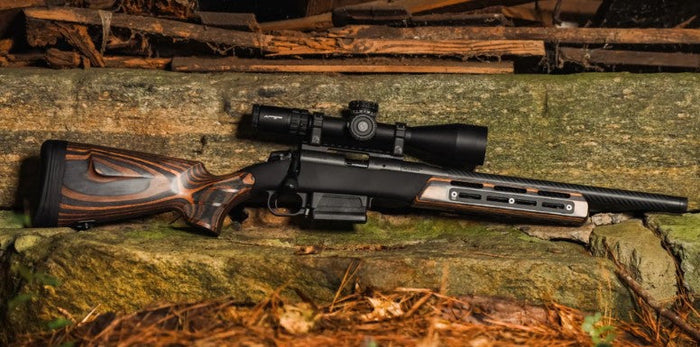
Most Ruger 10/22 walnut stock upgrades begin with appearance and end with fitment.
Some factory Ruger 10/22 rifles ship with lightweight synthetic stocks designed for durability, simplicity, and broad utility, while others use hardwood, laminate, or model-specific stock configurations.
A walnut stock gives the Ruger 10/22 a more traditional silhouette, but it also changes rifle balance, mounting feel, optic positioning relative to the shooter, and how naturally the rifle settles into position once assembled.
What matters in practice is whether the stock matches how the rifle is configured and how it will actually be used.
Fitment Begins With Rifle Configuration
The first fitment question is simple: Is the rifle a standard fixed-barrel Ruger 10/22 or a 10/22 Takedown?
A standard 10/22 and a Takedown system do not use the same stock configuration. Stocks designed for one setup are not automatically compatible with the other.
Many fitment mistakes begin when owners treat every Ruger 10/22 as the same platform.
Barrel Profile Matters More Than Appearance
The second practical fitment check is barrel contour.
Many factory Ruger 10/22 configurations use lighter tapered barrels, while others are commonly upgraded with heavier .920 bull barrels or match barrels for more stable supported shooting.
A barrel channel designed around a factory taper barrel may not properly accommodate a larger .920 bull barrel. Always verify barrel-channel dimensions before ordering, especially when using aftermarket barrels.
On the other hand, oversized channels can leave slimmer factory barrels looking visually undersized or disconnected from the stock profile.
The practical question is whether the stock fits the rifle as currently configured rather than the version of the rifle first imagined.
Common Ruger 10/22 Walnut Stock Fitment Mistakes
Most Ruger 10/22 walnut stock fitment problems appear after the rifle has already changed from factory configuration.
Common causes include:
- Ordering a standard 10/22 stock for a Takedown rifle
- Assuming every barrel channel fits a .920 bull barrel
- Upgrading optics without reconsidering cheek weld and mounting height
- Choosing stock geometry based on appearance rather than shooting style
- Overlooking sling studs, bipod mounting needs, or accessory clearance
A Ruger 10/22 configured for lightweight field carry often benefits from different stock geometry than one built around larger optics or supported shooting.
Stock Choice Starts With the Complete Rifle
A stock should never be evaluated on a bare rifle. Optics, sling hardware, bipods, heavier barrels, and mounting accessories often change rifle balance and mounting feel.
A rifle carried for field use often prioritizes lighter carry balance and faster mounting, while a rimfire configured for supported shooting may prioritize stability and repeatable positioning.
The right stock choice usually reflects how the rifle is carried, mounted, and fired rather than how the rifle looked during the planning stage.
Stock Geometry Starts With Optic Height
Many factory Ruger 10/22 rifles begin with iron sights or low-mounted optics.
A Ruger 10/22 that felt natural behind factory sights may feel noticeably different after adding a magnified optic, taller rings, or a larger objective lens.
Optic height changes head position.
When stock geometry no longer aligns with optic height, shooters often compensate without realizing it:
- Lifting the head off the stock
- Inconsistent cheek pressure
- Searching for sight picture after mounting the rifle
Consistent cheek weld matters because small shifts in head position often change sight picture consistency.
A rifle that naturally positions the eye behind the optic generally supports more consistent shooting than one requiring adjustment every time it is shouldered.
Walnut Changes More Than Appearance
A Ruger 10/22 walnut stock is often framed as a traditional-versus-modern decision. That framing misses what matters once the rifle returns to use.
Once optics, sling hardware, and barrel changes enter the buaild, the material choice is only one part of how the rifle feels.
Once the rifle is configured, weight distribution, rigidity, positional stability, and carry balance matter more than nostalgia.
Within a modern walnut stock system, the material is only part of the build. Fitment tolerances, bedding interface, stock geometry, and rifle balance shape how the rifle behaves once assembled.
Stock Geometry Should Reflect Rifle Configuration
Once fitment is confirmed, stock choice becomes less about material and more about intended use.
Rifles configured for lighter carry and faster mounting often benefit from stock geometry preserving more traditional proportions. Rifles built around larger optics, supported shooting, or heavier barrels often benefit from geometry emphasizing greater positional stability.
Once rifle configuration is understood, stock geometry becomes easier to narrow.
Within the WOOX Ruger 10/22 lineup, traditional-profile stocks such as the Elegante Sporter, Merica, or Wild Man generally align more naturally with lighter field setups, while chassis-oriented systems such as the Exactus or Furiosa more commonly suit rifles configured around larger optics, supported shooting positions, or heavier barrel profiles.
Before ordering a WOOX stock or chassis for a Ruger 10/22, verify that the rifle uses a supported Ruger 10/22 action or compatible factory-style clone with a single action screw, .22LR configuration, compatible Ruger 10/22 magazine pattern, and a supported straight, pencil, or match barrel profile. WOOX compatibility notes exclude Bergara BXR actions, KIDD actions with a tang, banana magazines, unsupported bolt-release configurations, and bottom-metal setups, so the current product page should be checked before purchase.
Installation Is Not the Final Step
A stock upgrade is not finished when installation ends. A stock upgrade may alter rifle balance, eye alignment behind the optic, natural point of aim, sling position, shooting posture, and overall handling.
Bench shooting confirms zero. It rarely confirms handling.
Walking with the rifle, shooting from supported positions, repeated mounting, and carrying the rifle as configured reveal whether the stock still feels natural after installation.
The better upgrade is the one that still feels predictable once the rifle returns to field use, range sessions, or repeated carry.
FAQ
1. Will any Ruger 10/22 stock fit every 10/22 rifle?
No. Ruger 10/22 models can differ in configuration, including standard fixed-barrel receivers, Takedown systems, barrel profiles, magazine setups, and accessory layouts. Stock compatibility should be checked against the actual rifle configuration.
2. Does barrel contour matter when choosing a Ruger 10/22 stock?
Yes. The barrel channel must provide the correct clearance for the barrel profile. A stock designed for a lighter factory taper barrel may not accommodate a larger .920 bull barrel or heavier match barrel.
3. Can a Ruger 10/22 walnut stock improve accuracy?
A stock does not automatically increase mechanical accuracy. However, proper fit, consistent shooting position, stable rifle support, and improved rifle balance can help create a more repeatable shooting experience.
4. What is the difference between a standard 10/22 and Takedown stock?
A standard Ruger 10/22 and a Takedown model use different stock configurations. Stocks designed for one system are not automatically compatible with the other.
5. Does changing the stock affect optic alignment?
It can. Stock geometry influences cheek weld, eye position, and how naturally the shooter aligns behind the optic, especially after adding higher-mounted or larger optics.