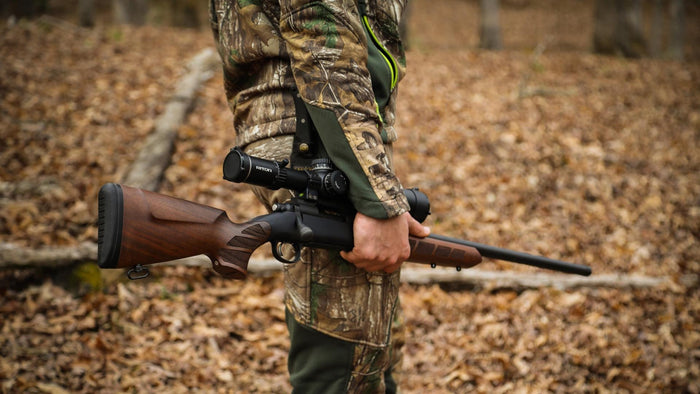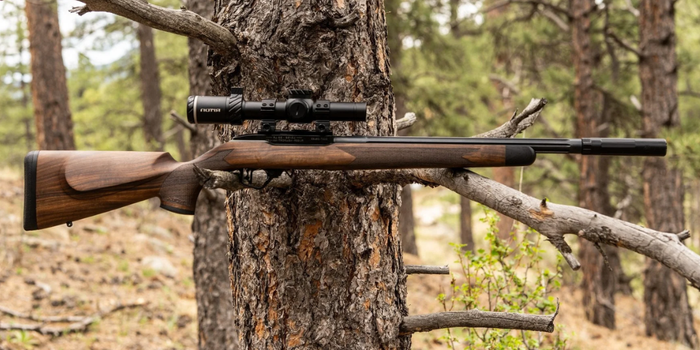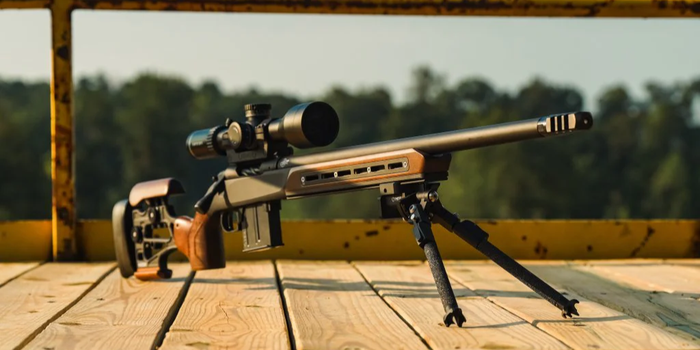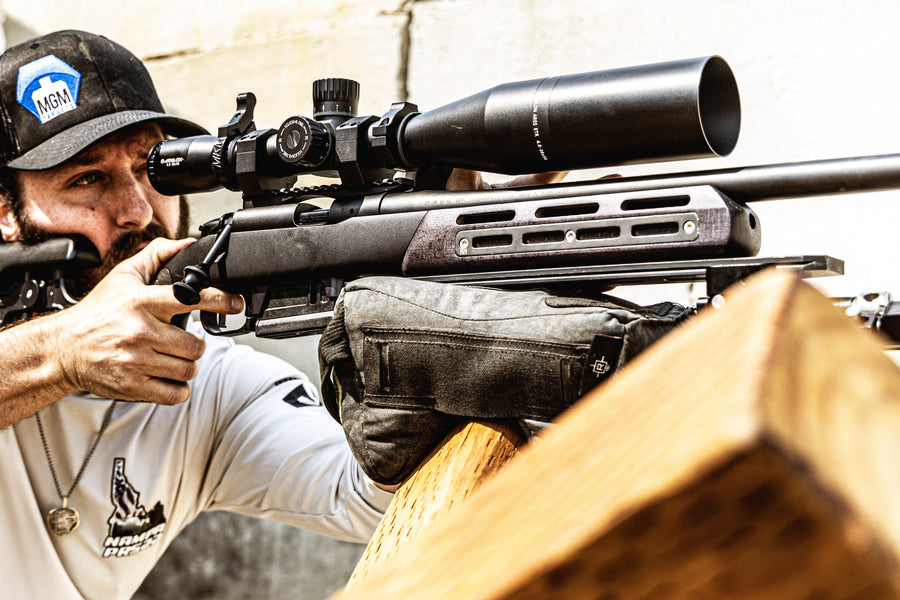
Mounting a riflescope changes more than magnification. It changes how the rifle moves. Adding glass increases total weight, but the bigger change is often balance. A scope adds weight above the receiver and may shift the rifle's balance forward, depending on the optic's weight and mounting position.
A rifle that previously mounted naturally can begin to dip toward the muzzle. It may feel slower during offhand movement, slower to settle after the mount, and harder to hold steady without support. The optic is rarely the only cause.
Balance depends on where mass is added relative to the rifle’s center of gravity. Scope weight, ring height, barrel contour, stock geometry, rail length, bipod placement, and accessory layout all influence how the rifle feels once glass is installed.
Understanding that mass distribution makes it easier to correct balance without replacing otherwise useful components.
Balance Is About Mass Distribution, Not Weight Alone
Two rifles can weigh the same and still handle differently. The difference is where the weight sits. When additional mass is positioned farther from the shooter’s shoulder, the rifle can feel heavier than its measured weight suggests. The shooter feels leverage, not only ounces.
Engineers describe this relationship through the idea of a moment arm: weight placed farther from the support point creates more rotational effect. In practical field language, weight placed forward of the action makes the muzzle feel heavier.
That is why a rifle can feel manageable on a scale but front-heavy in the hands. Many hunting scopes add noticeable weight before rings, rails, and mounts are included. Larger long-range optics can add substantially more. The additional weight matters, but the location of that weight matters just as much.
The number on the scale tells only part of the story. The rifle’s balance point tells the part the shooter actually feels.

What Changes When Glass Is Added
Installing a scope changes rifle handling in several ways. First, it increases total rifle weight. Second, it raises the rifle’s center of gravity because the optic sits above the bore line. Third, it may shift the balance point forward depending on the optic's weight, mounting position, and overall setup.
Those changes influence how the rifle mounts, how naturally it settles, how much effort is required during unsupported shooting, and how easily the muzzle tracks through a field position.
A compact hunting optic may create only a modest balance change. A larger long-range optic can change the rifle’s feel more noticeably, especially when paired with a heavier barrel or forward-mounted accessories.
Neither setup is automatically wrong. The correct optic depends on how the rifle will be used. A rifle carried through timber, ridges, or steep terrain has different balance priorities than a rifle built primarily for prone shooting, range work, or supported long-distance use.
Barrel Contour Compounds the Effect
Scopes rarely make a rifle front-heavy by themselves. Barrel contour often determines how noticeable the optic change becomes.
A heavier barrel already places more mass forward of the receiver. When a larger optic is added above the action and forward of the receiver, both components can push the rifle’s balance forward. A lighter sporter barrel distributes mass differently. Adding glass still changes the rifle, but the effect may be less pronounced because the barrel contributes less forward weight.
This is why the same optic can feel acceptable on one rifle and front-heavy on another. The scope did not change. The rifle underneath it did.
A front-heavy feel usually comes from the combined relationship between barrel contour, optic mass, mount position, stock geometry, and accessory placement.
The optic amplifies the rifle’s existing balance characteristics rather than creating them from nothing.
Stock Geometry Determines How Weight Feels
Stock geometry does not erase scope weight. It determines how the shooter experiences that weight.
The grip, comb, fore-end, toe line, and length of pull influence how the rifle mounts, where the hands naturally support it, and how the muzzle settles once the rifle is shouldered.
A rifle with forward weight may still feel manageable if the stock gives the shooter a stable, repeatable contact relationship. A lighter rifle can still feel awkward if the weight is poorly distributed or the stock geometry forces the shooter to fight the mount.
This is why balance is not only a scope problem. It is a rifle-system problem.
A stock should be evaluated by how it positions the action, supports the receiver, carries weight through the hands, and gives the shooter consistent contact points.
When glass changes the rifle’s balance, stock geometry determines whether that change feels controlled or awkward.
Where Superleggera Fits Into the Balance Discussion
Superleggera is not a heavy adjustable competition chassis. It is a lightweight field stock built for hunters who care about carry weight, handling, and defined contact geometry.
The stock combines High-Grade American Walnut with a Carbon Core and WOOX’s V-Block Mini Chassis in Carbon Nylon.
The V-Block Mini Chassis in Carbon Nylon provides receiver support inside the stock. The High-Grade American Walnut forms the shooter-facing grip, comb, fore-end, and shoulder interface.
That matters when a scope is added because the stock cannot cancel the physics of extra glass. It can give the rifle a defined structure around the receiver and clear contact points for the shooter to evaluate balance from the action outward.
Superleggera is designed around low carry weight and field handling, not around adding adjustable ballast to compensate for every optic and accessory choice.
That distinction matters. A hunting stock should help the rifle remain practical to carry, shoulder, and control in real field positions. It should not become heavier than the problem it is trying to solve.
American Walnut and Carbon Structure Serve Different Roles
For WOOX, material selection begins with function. High-Grade American Walnut gives the shooter the exterior field interface: the grip, comb, fore-end, and shoulder contact surfaces.
The Carbon Core and V-Block Mini Chassis in Carbon Nylon carry the internal receiver-support role while keeping the stock focused on low weight. Those materials do not do the same job.
The walnut is the part the hunter touches, carries, mounts, and controls. The carbon-reinforced internal structure gives the rifle a defined support system around the action without the mass of a heavier aluminum competition chassis.
That separation of roles is important in a balance article. A stock does not need to be heavy to be structured. It needs the right material in the right place.
Why a Front-Heavy Rifle Feels Slower
A front-heavy rifle often feels slower because the shooter must control more leverage ahead of the support hand and shoulder.
That can show up in several ways:
- the muzzle dips after the rifle is mounted
- the rifle feels slower to start and stop during movement
- the support hand works harder during offhand shooting
- the shooter needs more muscular effort to hold the rifle steady
- transitions between field positions feel less natural
- the rifle feels heavier than its measured weight suggests
These are handling issues, not automatic accuracy problems. A heavier scope does not reduce the rifle’s mechanical accuracy by itself. It changes how the shooter manages the rifle. That distinction matters. The rifle may still be mechanically capable. The question is whether the shooter can mount, hold, and control it consistently in the positions where it will be used.
How to Evaluate Rifle Balance After Adding a Scope
Start with the unloaded rifle. Confirm the firearm is unloaded, visually inspect the chamber, and keep ammunition away from the fit-check area. Then hold the rifle as it will be carried and used.
Do not evaluate balance only from a bench. A bench hides many handling problems because the support surface carries the weight.
Check the rifle from the positions that matter:
- standing offhand
- kneeling
- seated
- prone
- over a pack
- from shooting sticks
- from a field rest or natural support
Watch what the muzzle does after the rifle is mounted. If it immediately drops, the balance point may have shifted too far forward for the intended use.
Check where the support hand naturally wants to sit. If the hand keeps moving farther forward to control the muzzle, the rifle may be asking the shooter to compensate for balance. Then check head position and cheek weld. A heavier optic mounted high can make the rifle feel top-heavy and may require a different cheek relationship than the previous setup. Balance is not only front to back. It is also vertical.
Restoring Balance Without Replacing the Scope
Replacing the optic is often the first solution shooters consider. It is not always the only solution. If the optic is appropriate for the rifle’s intended use, balance should be evaluated as a system before glass is replaced.
Possible checks include:
- choosing lighter rings where appropriate
- using aluminum rings when the application allows
- avoiding unnecessary rail length
- removing unused forward accessories
- checking whether a shorter or lower optic mount still provides proper eye relief and bolt clearance
- selecting a stock that matches the rifle’s field use instead of adding unnecessary forward weight
These changes do not make scope weight disappear. They reduce unnecessary leverage and help the rifle carry its mass more deliberately. The goal is not to make every rifle as light as possible. The goal is to place weight where it supports the rifle’s purpose.
When a Heavier Setup Still Makes Sense
A front-heavy feel is not always a mistake. Some rifles are built to be used from stable support. A heavier barrel, larger optic, bipod, and longer rail may make sense for a rifle used primarily from prone, barricades, or fixed positions. That same setup may feel wrong on a rifle carried for miles through steep country. The intended use decides whether the balance is acceptable.
For a hunting rifle, balance usually has to serve carry, mount, field movement, and supported shots from imperfect positions. For a range or competition rifle, weight may be accepted because the rifle is used differently.
A good setup is not universal. It is honest about the job the rifle is built to do.
Engineering Means Managing Trade-Offs
No rifle balances perfectly in every application. A lightweight hunting rifle optimized for carry will behave differently from a rifle designed for prone stability, barricade use, or long-range range work.
A compact 2-10x hunting optic changes balance differently than a large high-magnification optic with a larger objective lens. A sporter barrel changes the feel differently than a heavy-contour barrel. Every part added to the rifle changes the system.
The engineering question is whether each component contributes to the rifle’s purpose without creating unnecessary compromise somewhere else.
Superleggera reflects one WOOX answer to that question: High-Grade American Walnut where the hunter contacts the rifle, a Carbon Core and V-Block Mini Chassis in Carbon Nylon where the rifle needs internal receiver support, and low carry weight where field use demands it. The stock does not cancel the weight of glass. It gives the rifle a defined structure and contact geometry so the shooter can evaluate balance clearly once the optic, mounts, barrel, and accessories are in place.
A rifle feels front-heavy after adding a scope because the optic changes where mass lives. The farther that mass moves above and forward of the receiver, the more the shooter feels it during carry, offhand shooting, and unsupported movement. The solution is not always a smaller scope. It may be better ring choice, shorter rail length, cleaner accessory placement, improved stock selection, or a more honest match between the rifle and its intended use. A balanced rifle is not simply the lightest rifle. It is the rifle whose mass is placed where the shooter can carry it, mount it, and control it without fighting the muzzle.
FAQs
Why does my rifle feel front-heavy after adding a scope?
A scope adds mass above the receiver and may place some of that mass forward of the rifle’s original balance point. The farther that weight sits from the shooter’s shoulder and support hand, the more leverage the shooter feels during carry and unsupported shooting.
Does a heavier scope always make a rifle less accurate?
No. A heavier scope does not reduce mechanical accuracy by itself. It changes rifle balance, which can affect how naturally the shooter mounts, holds, and controls the rifle.
Can stock design reduce a front-heavy feel?
Stock design can influence how weight feels by changing the shooter’s contact points, support-hand position, and receiver support structure. It cannot erase optic weight, but it can help the rifle feel more controlled when the setup matches the intended use.
Is a lighter rifle always better for hunting?
Not always. A lighter rifle is easier to carry, but a poorly balanced light rifle can still feel difficult to hold steady. For hunting, low weight matters, but balance and stock geometry also affect how the rifle mounts and handles.
Should I replace my scope if my rifle feels front-heavy?
Not immediately. First evaluate optic placement, ring choice, rail length, barrel contour, stock geometry, and accessory layout. If the optic suits the rifle's intended purpose, adjusting the overall system may improve handling without replacing the scope.
What makes Superleggera relevant to rifle balance?
Superleggera is a lightweight field stock built with High-Grade American Walnut, a Carbon Core, and WOOX’s V-Block Mini Chassis in Carbon Nylon. It does not cancel scope weight, but it gives the rifle defined receiver support and shooter-facing contact geometry for field handling.