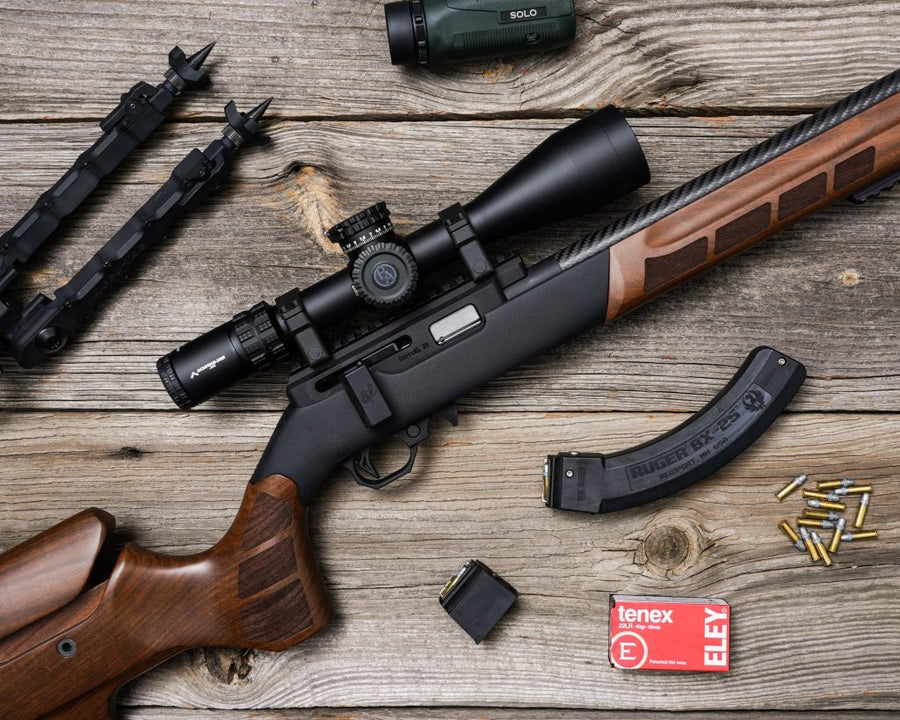
The Ruger 10/22 is one of the most modified rimfire rifles in America — and for good reason. Its simple blowback design, modular aftermarket, and proven reliability make it an ideal platform for precision refinement. But here’s the truth most shooters eventually discover: The factory 10/22 is rarely shooting to its full potential. Not because the design is flawed — but because consistency hasn’t been optimized.
Improving Ruger 10/22 accuracy isn’t about one “magic” part. It’s about eliminating variables that affect repeatability: receiver positioning, torque consistency, harmonic stability, and shooter interface. On the 10/22 platform specifically, the single action screw mounting system makes torque repeatability and receiver indexing especially critical. Minor variations in screw tension (even within a few inch-pounds) can alter receiver seating pressure and influence point-of-impact shift over time.
Let’s break down what actually matters.
Accuracy in a Rimfire Platform: Understanding the System
Rimfire accuracy is driven by repeatability. Every shot must leave the barrel under nearly identical conditions:
-
The receiver must return to the same position.
-
Action screw torque must remain consistent.
-
Every time, the barrel must vibrate in the same pattern.
-
The shooter must interact with the rifle identically shot-to-shot.
Any inconsistency — even small ones — opens groups. Unlike dual-lug bolt-action systems, the 10/22 relies on a single forward action screw and rear V-block barrel retention. That architecture places greater emphasis on bedding surface uniformity and torque control for repeatable alignment. Accuracy gains don’t come from “controlling recoil.” They come from controlling:
-
Torque changes
-
Handling-induced shifts
-
Disassembly and reassembly repeatability
-
Stock compression
-
Harmonic disruption
This is where serious improvements begin.
The Stock Upgrade: The Foundation of Ruger 10/22 Accuracy
If you want to improve your Ruger 10/22 accuracy, the stock is often the most overlooked and most important upgrade. Factory stocks are designed for weight savings and general-purpose use. They work. But they are not optimized for precision stability.
Common limitations include:
-
Flex under support pressure
-
Compression around the single action screw
-
Inconsistent receiver indexing after removal
-
Variable torque return during reassembly
When the action screw compresses polymer or untreated wood unevenly, micro-movement can occur during torque cycling, handling transitions, and repeated disassembly. While imperceptible to the shooter, even slight receiver torsion can influence harmonic consistency at 50–100 yards. A rigid, well-machined stock improves:
-
Repeatable receiver positioning
-
Torque consistency
-
Bedding compatibility
-
Ergonomic stability
This is where premium engineered stocks — like those in the WOOX Ruger 10/22 collection — provide real performance value.
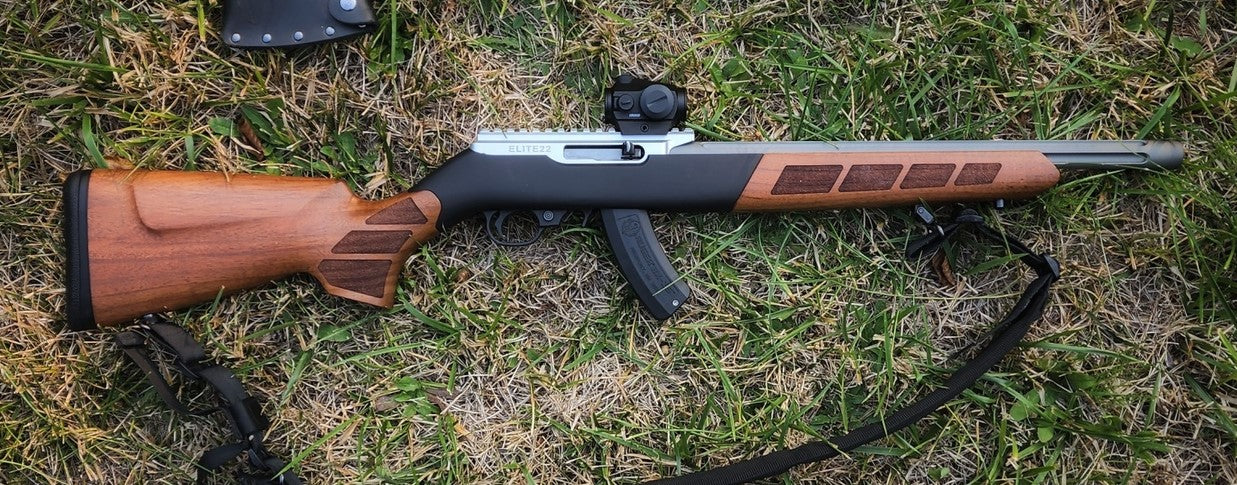
WOOX stocks are not cosmetic upgrades. They combine precision-machined aluminum bedding blocks with hardwood structural rigidity, creating a stable interface between receiver and stock. The benefit isn’t recoil control. The benefit is consistency under torque changes, handling, and reassembly. That consistency is the foundation of tighter groups. Across long-standing rimfire enthusiast communities and gunsmithing discussions, torque repeatability and rigid bedding surfaces are consistently identified as foundational accuracy upgrades before barrel replacement.
The integration of a precision-machined aluminum bedding block within hardwood architecture allows structural rigidity while maintaining vibration-dampening characteristics inherent to dense wood — balancing mechanical stability with refined aesthetics.
Bedding: Eliminating Micro-Movement
The Ruger 10/22 uses a single action screw to secure the receiver. While simple and effective, this system can allow minute shifts if the receiver-to-stock interface isn’t perfectly fitted.
Bedding addresses this directly.
-
Glass bedding creates a custom-fit contact surface.
-
Pillar bedding prevents stock compression and stabilizes torque values.
Proper bedding ensures the receiver returns to the exact same position every time the rifle is assembled. Shooters often notice measurable improvements in group consistency after bedding — even with the factory barrel and trigger unchanged. Not because recoil is being “absorbed.” But because the receiver stops shifting under torque changes, handling, and disassembly/reassembly. In a rimfire rifle, that distinction matters.
Barrel Harmonics and Free-Floating
The factory 10/22 barrel is more capable than many assume. Many well-set-up rifles shoot extremely well without replacing the barrel — provided harmonics remain consistent. Two major factors influence rimfire barrel performance:
Contact Pressure
If the stock contacts the barrel unevenly, harmonic vibration changes from shot to shot.
Barrel Rigidity
Heavier barrels generally exhibit reduced harmonic amplitude and slower heat shift. Free-floating the barrel ensuring no forward stock contact often improves consistency. But free-floating only works when the receiver itself is stable. This is why stock rigidity and bedding typically deliver more improvement than immediately replacing the barrel.
Trigger Refinement: Mechanical vs Practical Accuracy
Mechanical precision means little if the trigger disrupts the shot. The factory Ruger 10/22 trigger is reliable, but it often breaks between 5–7 pounds. Creep and overtravel introduce shooter-induced movement. Reducing pull weight and improving break consistency:
-
Minimizes sight disturbance
-
Reduces anticipation
-
Enhances shot release control
This doesn’t change the rifle’s inherent precision, it reduces the shooter’s interference with it. And that often results in tighter practical groups.

Ammunition Testing: The Variable Most Shooters Ignore
Rimfire rifles are ammunition-sensitive by nature. Velocity spread, bullet lubrication, and lot variation all affect group size. With bulk ammunition, many factory 10/22 rifles produce roughly 1.5–2 inch groups at 50 yards, though results vary significantly by lot and setup.
With careful tuning and ammunition testing, many well-set-up rifles can shoot 1-inch groups at 50 yards with ammunition they prefer; some do better.
The key is consistency testing:
-
Shoot five-shot groups
-
Test multiple brands
-
Log results
-
Confirm across multiple sessions
Match-grade ammunition often improves consistency — but the “best” load is simply the one your individual rifle prefers.
Realistic Accuracy Expectations for a Tuned Ruger 10/22 -
-
A rigid stock
-
Stable receiver bedding
-
Proper torque control
-
A floated barrel
-
A refined trigger
-
Matched ammunition
A Ruger 10/22 can deliver highly respectable precision for a semi-automatic rimfire platform. Not benchrest-level custom bolt gun performance. But reliable, repeatable, confidence-inspiring accuracy. The transformation isn’t dramatic. It’s systematic.
Why the Stock Is the First Upgrade That Matters
Many shooters immediately look at barrels. But without a stable foundation, barrel upgrades don’t reach full potential. A precision-engineered stock, particularly one designed with aluminum bedding integration like WOOX addresses the root of the platform’s consistency challenges such as Receiver indexing, Torque stability, Structural rigidity, Shooter interface repeatability.
That’s why experienced builders often upgrade the stock first. Because accuracy starts with the interface.
Frequently Asked Questions about Ruger 10/22 accuracy
How accurate is a factory Ruger 10/22?
Many factory rifles produce approximately 1.5–2 inch groups at 50 yards with bulk ammunition, though results vary by lot and setup.
What’s the most effective way to improve Ruger 10/22 accuracy?
Stabilizing the receiver within a rigid, well-bedded stock typically delivers the most consistent improvement.
Do I need to replace the barrel?
Not necessarily. Many factory barrels perform very well when properly floated and supported by a stable action.
Is bedding worth it on 10/22?
Yes. Bedding improves repeatable receiver positioning and torque consistency — critical factors in rimfire precision.
Will a heavier stock improve accuracy?
Weight alone doesn’t guarantee accuracy. Structural rigidity and consistent receiver interface are what matter.
Building Precision Through Consistency
Improving Ruger 10/22 accuracy isn’t about replacing components randomly. It’s about controlling variables such as Receiver movement, Torque variation, Harmonic disruption, Shooter input.
When those elements are stabilized, the 10/22 reveals its true capability. A properly supported action. A repeatable torque interface. A stable shooting position. That’s how you turn a classic rimfire into a precision platform. And it all starts with the foundation.