Many stock fitment errors occur because "Remington 700" describes a receiver family that includes multiple action lengths, magazine systems, and inlet patterns rather than a single stock-fit specification.
Action length, magazine architecture, barrel contour, and bottom-metal configuration all affect stock compatibility.
Before selecting a stock, verify action length, magazine architecture, barrel contour, and inlet pattern. Fitment depends on geometry rather than model name, and correct fitment establishes the foundation for years of reliable ownership.
American Walnut and Modern Remington 700 Stock Design
American Walnut machines cleanly around receiver interfaces, recoil-lug pockets, and bottom-metal inlets when properly selected and cut, while providing the handling characteristics that have made walnut a preferred rifle-stock material across generations of sporting rifles.
Stock performance begins with precise receiver fit. Modern hybrid stock systems combine American Walnut with CNC-machined aluminum chassis structures that establish a defined receiver interface independently of the walnut.
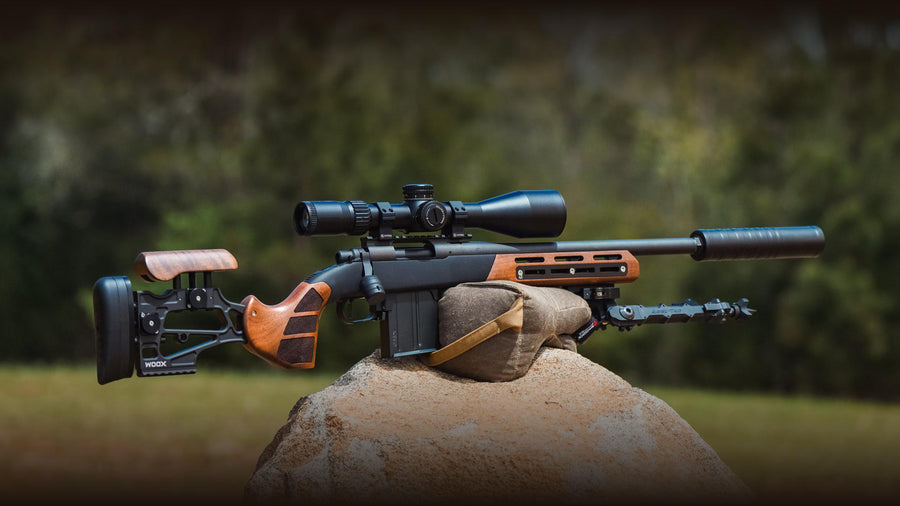
The WOOX Elegante Sporter uses hand-selected American Claro walnut with a precision-machined aerospace-grade aluminum mini-chassis. This hybrid construction is designed to combine walnut’s field feel and long-term ownership character with a modern internal support structure.
Fitment Check #1: Identify ADL, BDL, or DBM Configuration
Before measuring action length, identify whether the rifle uses an ADL, BDL, or detachable box magazine system.
ADL rifles use a blind magazine. Cartridges load from the top and are removed by cycling the action.
BDL rifles use a hinged floorplate assembly that allows cartridges to be unloaded through the bottom of the rifle.
DBM rifles use a detachable box magazine system and require a stock inlet, bottom metal, and magazine pattern matched to that configuration.
This distinction changes bottom-metal dimensions, magazine geometry, and inlet requirements.
The stock inlet must accommodate the correct magazine system, bottom metal geometry, and mounting hardware. A stock cut for a BDL floorplate should not be assumed compatible with an ADL configuration without confirming the inlet dimensions and bottom-metal requirements.
Before ordering any American Walnut stock, confirm the bottom assembly through the rifle’s documentation, current configuration, or a qualified gunsmith if there is uncertainty. Confirm whether the rifle uses ADL, BDL, or an aftermarket detachable box magazine system.
Fitment Check #2: Confirm Short Action or Long Action
Action length determines receiver length, action-screw spacing, magazine length, and stock inlet dimensions.
Short-action receivers are typically associated with cartridges such as .308 Winchester, 6.5 Creedmoor, and .243 Winchester.
Long-action receivers are generally used for cartridges such as .30-06 Springfield, .270 Winchester, and 7mm Remington Magnum, though magnum builds may require additional bolt-face, magazine-length, barrel-contour, and bottom-metal verification.
Receiver geometry and action length determine action-screw location, magazine position, recoil-lug placement, and inlet dimensions. Long-action receivers require a longer inlet and different screw spacing than short-action receivers.
A stock machined for a short action assumes specific distances between the recoil lug pocket, magazine well, and rear tang.
When a long-action receiver is forced toward a short-action inlet, those dimensions no longer align.
The most reliable verification method is measuring action screw spacing rather than relying solely on chambering.
Remington 700 short-action receivers typically use approximately 6.500-inch action-screw spacing, while long-action receivers use approximately 7.350-inch spacing. Measurements should always be verified against the specific receiver and stock manufacturer specifications.
Fitment Check #3: Verify Barrel Contour Clearance
A correct receiver inlet does not guarantee barrel compatibility. Barrel contour determines the amount of clearance required inside the barrel channel.
Factory Remington 700 rifles may use sporter, magnum sporter, Sendero, varmint, or other contour profiles depending on model.
If the barrel channel does not provide adequate clearance, barrel-to-stock contact may occur. Unless the stock is intentionally designed with a pressure point by the manufacturer, unintended barrel contact can influence barrel harmonics and point-of-impact consistency.
Inspect the barrel profile before purchasing a stock and compare it against the manufacturer's published compatibility specifications. Barrel-channel dimensions should match the intended contour. Do not assume material removal is acceptable unless the stock manufacturer or a qualified gunsmith confirms it.
Fitment Check #4: Evaluate the Recoil Lug and Bedding Interface
The recoil lug is one of the most important contact surfaces in the rifle.
Under recoil, the lug acts as the primary bearing surface that transfers rearward force from the receiver into the stock structure. If the lug does not seat correctly inside the recoil pocket, stress can be introduced into the system before the rifle is ever fired.
Inspect the recoil-lug pocket for debris, finish buildup, or machining burrs before seating the action. The action should seat naturally into the stock without requiring force.
Lug-pocket geometry, receiver seating surfaces, and action-screw alignment all contribute to how consistently the receiver returns to the same position after installation.
In the WOOX Elegante Sporter, the aluminum mini-chassis establishes a mechanical interface between the action and stock structure. By locating critical receiver-contact surfaces within the chassis rather than the walnut itself, the system can reduce dependence on traditional bedding work while maintaining repeatable receiver positioning.
The recoil lug should seat fully within the recoil pocket without inducing stress into the receiver during installation.
Fitment Check #5: Follow Proper Torque Procedures
Action screw torque directly affects bedding pressure and receiver alignment. Uneven torque can alter load distribution between the front and rear action screws, affecting how the receiver bears against the stock.
Insufficient torque can allow movement under recoil. Excessive torque can distort the interface between the receiver and stock.
Action screw torque values vary by stock, chassis, bottom metal, and action manufacturer. Do not use a universal Remington 700 torque number. Always follow the specifications provided for the exact rifle and stock configuration being installed.
Use a calibrated inch-pound torque wrench rather than estimating by feel.
Verify WOOX Compatibility Before Ordering
WOOX inlets are machined around specific Remington 700 action patterns and magazine configurations rather than a universal Remington 700 footprint.
Before ordering, confirm:
- Short Action or Long Action receiver
- BDL or detachable box magazine configuration
- ADL configuration if applicable, including whether bottom-metal conversion or additional verification is required
- Barrel contour compatibility
- Magazine and bottom-metal pattern
- The exact WOOX SKU specified for the rifle
WOOX Remington 700 configurations are separated by action length and magazine pattern, including DBM SA, BDL SA, DBM LA, and BDL LA. ADL owners should not assume compatibility without confirming the current product page, required bottom metal, or WOOX support guidance.
Compatibility should always be verified against the current WOOX product page or compatibility guide before purchase. Proper receiver fit, recoil-lug engagement, and barrel clearance establish the foundation for a stock intended to be maintained, used, and handed down over time.
FAQs
Can any stock fit a Remington 700?
No. Remington 700 stock compatibility depends on action length, magazine configuration, barrel contour, bottom metal, and stock inlet dimensions. Before purchasing a stock, verify the rifle's exact configuration and confirm compatibility with the manufacturer's specifications.
How do I know if my Remington 700 is short action or long action?
The most reliable method is measuring action-screw spacing and verifying the rifle's receiver specifications. Short-action Remington 700 rifles commonly use approximately 6.500-inch action-screw spacing and are often chambered in cartridges such as .308 Winchester and 6.5 Creedmoor. Long-action Remington 700 rifles commonly use approximately 7.350-inch action-screw spacing and are often chambered in .30-06 Springfield and .270 Winchester. Chambering is a useful clue, but receiver geometry should be verified before ordering a stock.
What is the difference between ADL and BDL Remington 700 stocks?
ADL rifles use a blind magazine without a floorplate, while BDL rifles use a hinged floorplate assembly for unloading cartridges through the bottom of the rifle. Because magazine geometry and bottom-metal dimensions differ, ADL and BDL stocks should not be treated as interchangeable unless the inlet, bottom metal, and magazine hardware are matched.
Why does barrel contour matter when choosing a Remington 700 stock?
Barrel contour determines the amount of clearance required inside the barrel channel. A stock designed for a sporter barrel may not provide adequate clearance for a varmint or Sendero contour barrel.
Can I install a walnut stock on any Remington 700 rifle?
Not necessarily. Walnut stock compatibility depends on action length, magazine configuration, barrel contour, and inlet dimensions. Always verify the stock's compatibility specifications before purchase.
What is the most common Remington 700 stock fitment mistake?
One of the most common mistakes is assuming all Remington 700 rifles use the same stock dimensions. Differences in action length, ADL versus BDL versus DBM magazine systems, barrel contour, and bottom-metal configuration can all affect compatibility.