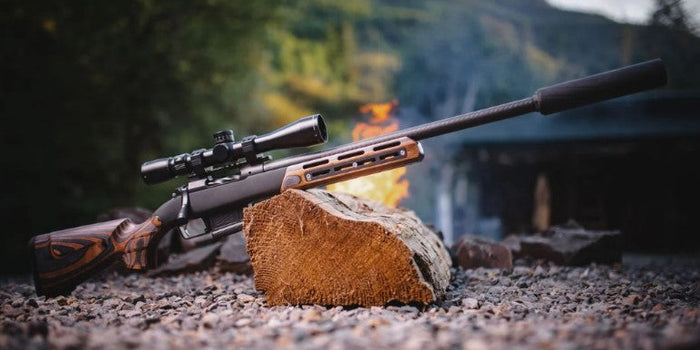
Modern hunting rifles are commonly built around two different stock-material approaches: American walnut and synthetic materials, including molded polymer, fiberglass-reinforced, and carbon-fiber-reinforced designs. Each solves a different problem. The better choice depends on weather exposure, maintenance expectations, long-term ownership goals, and how the rifle will be used in the field.

Understanding American Walnut Rifle Stocks
American Walnut has remained important in sporting rifles because it offers strength, workability, field feel, and natural character. Stock makers can shape it precisely, while its natural strength allows it to withstand decades of normal hunting use when properly selected and maintained.
Unlike synthetic materials, walnut varies from one blank to the next. Grain direction, density, and figure all differ naturally. Stock makers evaluate these characteristics carefully because grain orientation influences both appearance and structural strength. Each blank carries characteristics shaped by the tree from which it was cut.
For that reason, walnut stock production involves selection as well as manufacturing. Two blanks cut from the same tree may appear similar while differing significantly in grain direction and density.
Stock makers evaluate these characteristics because grain orientation influences how forces travel through the stock and how the material responds to years of use. A visually attractive blank is not automatically the best structural choice for a hunting rifle.
American Walnut develops a handling patina that reflects years of field use. Unlike synthetic materials, cosmetic wear can often be refinished rather than permanently accumulated. No two walnut stocks age in exactly the same way.
Handling marks, exposure, and maintenance gradually create a surface character unique to the rifle and the person carrying it.
Understanding Synthetic Rifle Stocks
Synthetic stocks are typically manufactured from molded polymer, fiberglass-reinforced composites, carbon-fiber-reinforced materials, or combinations of these systems designed to resist moisture and dimensional change.
Synthetic stocks became popular because they offer dimensional consistency, moisture resistance, and less material variation than natural walnut.
Compared with walnut, synthetic materials are far less affected by humidity. A properly made synthetic stock generally will not swell or shrink in the same way unfinished, damaged, or poorly sealed wood can when exposed to prolonged moisture.
Modern synthetic stocks can also withstand significant abuse. They are often chosen for rifles expected to encounter harsh weather, rough transportation, or extended exposure to wet environments.

Weather Resistance and Environmental Exposure
Synthetic stocks often offer a practical advantage in environments where moisture exposure is frequent and unavoidable. Rain, snow, humidity, and temperature fluctuations generally have little effect on modern synthetic materials.
Walnut requires more attention because wood naturally exchanges moisture with its environment. Modern finishes reduce this effect but do not eliminate it.
Finish wear, exposed inletting, standing moisture, and neglected hardware can increase the chance of swelling, finish changes, or small shifts around the barrel channel and action fit.
For hunters who regularly pursue game in coastal regions, wet mountain environments, or consistently harsh weather, synthetic stocks often offer greater convenience.
Weight, Balance, and Recoil Behavior
Many hunters assume synthetic stocks are always lighter than walnut stocks. In practice, overall rifle weight depends on the specific stock design, construction method, bedding system, and any integrated chassis components.
Material is only one contributor to weight. Internal reinforcement, bedding systems, barrel channel dimensions, and stock geometry often have a greater influence on final weight than whether the stock is made from walnut or synthetic materials.
Lighter rifles are easier to carry over long distances, while additional weight can reduce felt recoil and improve steadiness. Balance often matters as much as total weight.
The Accuracy Myth: Does Stock Material Make a Rifle More Accurate?
Stock material alone does not determine rifle accuracy.
In reality, accuracy depends on the complete rifle system.
Factors that typically have a greater influence include:
- Barrel quality
- Action consistency
- Bedding quality
- Ammunition selection
- Trigger characteristics
- Shooter technique
The stock's primary job is not to create accuracy but to provide a stable, repeatable interface between the shooter and the action. Whether that structure is walnut or synthetic matters less than how consistently it supports the rifle system.
Modern stock design increasingly combines traditional materials with engineered bedding systems and chassis structures. This is where WOOX’s hybrid approach matters. The Elegante Sporter pairs hand-selected American Claro walnut on the outside with a precision-machined aerospace-grade aluminum mini-chassis on the inside, combining walnut’s field character with a modern internal support structure.
Maintenance Requirements
Walnut benefits from periodic inspection and finish maintenance to help limit moisture intrusion. After wet field use, wipe moisture from the stock and metal surfaces, let the rifle dry at room temperature, and inspect the finish, inletting edges, sling hardware, action fit, and barrel-channel clearance.
Synthetic stocks generally require little beyond routine cleaning and hardware checks. They do not need the same finish care as walnut, but screws, sling hardware, bedding interfaces, and barrel-channel clearance should still be checked after heavy field use or rough transportation.
Long-Term Ownership and Serviceability
Long-term ownership is one of the clearest differences between the two materials. Cosmetic damage on synthetic stocks can be difficult to repair, while American Walnut can often be refinished and restored multiple times throughout its service life.
For hunters who expect a rifle to remain in use for decades, serviceability becomes part of the ownership equation. Wear that might lead to replacement in one material can often be repaired and maintained in the other.
For many hunters, the appeal of walnut extends beyond appearance. The material combines individual character, long-term serviceability, and the ability to remain part of the same rifle through decades of use. Wear becomes maintenance rather than replacement, allowing the stock to evolve alongside the rifle instead of being discarded when its surface shows age.
Choosing the Right Stock for Your Hunting Style
Hunters who prioritize weather resistance, minimal maintenance, and hard field use often prefer synthetic stocks. Hunters who value serviceability, balance, and long-term ownership may find American Walnut more appealing.
The right stock is rarely the one that wins the most categories on a comparison chart. It is the one that matches the rifle's purpose.
Before upgrading, consider where the rifle will be carried, how it will be maintained, and what role it will play over the next decade rather than the next season. The answer often points clearly toward the stock material that belongs on that rifle.
Frequently Asked Questions
Are walnut rifle stocks durable enough for hunting?
Yes. Properly selected and finished American Walnut has been used in hunting rifles for generations. While it requires more care than synthetic materials, it is fully capable of handling normal hunting use.
Do walnut stocks warp in wet weather?
Modern finishes provide significant protection, but walnut remains a natural material that can respond to prolonged moisture exposure, especially if the finish is damaged or moisture reaches exposed inletting. Proper maintenance helps minimize these effects.
Are synthetic stocks more accurate than walnut stocks?
Not necessarily. Accuracy depends more on barrel quality, bedding, ammunition, and the overall rifle system than on stock material alone.
Is a walnut stock heavier than a synthetic stock?
Often, but not always. Actual weight depends on the design and construction of the stock rather than material alone.
Can a walnut rifle stock be refinished?
Yes. One advantage of American Walnut is that it can often be repaired, refinished, and maintained throughout decades of ownership.