1911 wood, G10, and Micarta grips offer different material characteristics rather than a universal ranking in performance. American Walnut provides natural grain and a traditional surface, G10 offers a rigid fiberglass-epoxy laminate, and Micarta combines fabric or paper layers with cured resin.
The material tells only part of the story. A deeply checkered walnut grip can feel more abrasive than lightly textured G10, while two Micarta panels can have noticeably different surface characteristics depending on their reinforcement and finish. The more useful comparison is how each material behaves once texture, maintenance, and mounting construction are considered.
What Is the Difference Between Wood, G10, and Micarta 1911 Grips?
The three materials differ in composition and how their surfaces respond to machining, finishing, and use.
| Feature | Wood (American Walnut) | G10 | Micarta |
|---|---|---|---|
| Construction | Natural hardwood | Fiberglass and epoxy laminate | Fabric or paper resin laminate |
| Surface texture | Smooth or checkered | Smooth to aggressively machined | Smooth, machined, or fabric-textured |
| Moisture resistance | Depends on finish and exposure | High | Generally high |
| Maintenance | Periodic finish care | Usually minimal | Usually minimal |
| Appearance | Individual grain and figure | Uniform or layered colors | Visible laminate structure |
| Common appeal | Traditional and heritage builds | Defined, aggressive texture options | Durable composite with varied tactile finishes |
These differences describe the underlying materials. The final grip profile and surface treatment can produce substantial variation within each category.
1911 Wood Grips: Natural Grain and Long-Term Character
Wood remains closely associated with traditional 1911 construction, particularly on Government-pattern pistols.
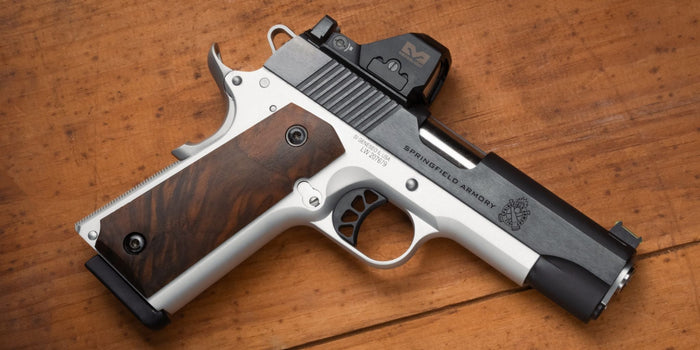
Not all wood grips use the same hardwood or finish. American Walnut is valued for its individual grain patterns, workability, and ability to accept different surface textures. The finished grip's characteristics depend on the wood's grain, machining, and protective finish.
Every walnut panel has an individual grain pattern. Its appearance changes with handling, light, and finish wear. Humidity can also affect the material's dimensions, particularly where the protective finish is damaged or incomplete.
Does Checkering Improve the Traction of Wood Grips?
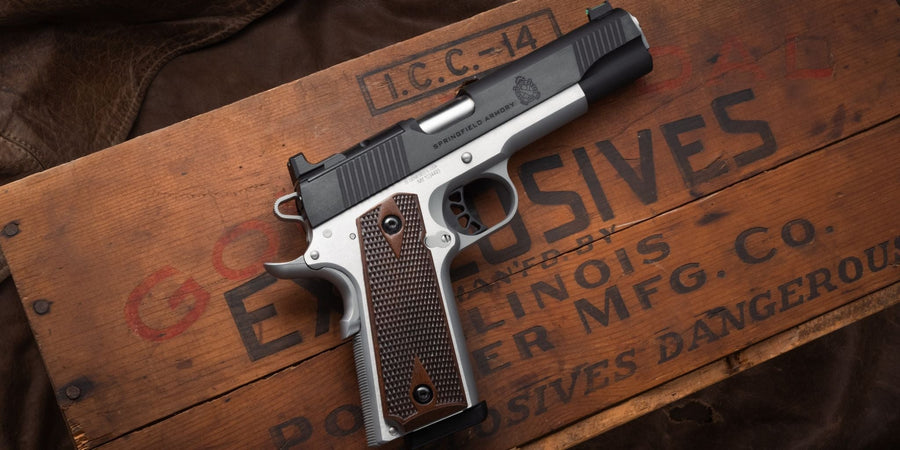
Yes. Checkering creates raised edges that increase mechanical contact between the grip surface and the hand.
However, the effectiveness of a checkered grip depends on pattern geometry, depth, spacing, and surface finish.
Smooth walnut panels emphasize the grain and offer a less abrasive surface. Checkered panels provide additional texture without changing the underlying material.
G10 1911 Grips: Fiberglass Construction and Defined Texture
G10 is a high-pressure laminate manufactured from woven fiberglass cloth impregnated with epoxy resin. The layers are consolidated under heat and pressure to create a rigid composite.
Its construction offers high mechanical strength and resistance to moisture-related dimensional changes.
For 1911 grips, G10's hardness allows manufacturers to machine pronounced surface patterns with relatively sharp edges.
This makes it suitable for grip designs requiring consistent, repeatable texture.
Are G10 Grips Always More Aggressive?
No. G10 can be manufactured with smooth, lightly textured, or deeply machined surfaces.
The distinction demonstrates that surface geometry matters more than the material designation alone.
A lightly textured G10 panel may feel less abrasive than deeply checkered walnut.

Micarta 1911 Grips: Fabric Laminate and Surface Character
Micarta uses layers of fabric or paper bonded with cured resin. Traditional phenolic Micarta differs from fiberglass-reinforced G10. Canvas-based grades can expose a coarser texture when machined, while linen and paper grades generally produce finer surfaces.
The finished texture depends on the laminate grade and machining process.
How Does Micarta Handle Moisture?
Cured Micarta laminates generally resist moisture-related dimensional changes better than unfinished hardwood.
However, moisture behavior varies by laminate formulation and surface condition. Micarta should not be described as universally waterproof.
Its appearance may also change through handling, particularly on exposed fabric surfaces.
Unlike walnut, Micarta does not have natural wood grain. Its visible layers and surface character come from the reinforcing material and resin structure.
Which 1911 Grip Material Has Better Traction?
No single material guarantees better traction under every condition.
Three factors influence how a 1911 grip feels in the hand:
- Texture geometry: Deep checkering and sharp machined patterns create more pronounced contact points.
- Grip thickness: Slim and standard panels change the external grip dimensions and hand contact.
- Surface finish: Smooth, polished, matte, and exposed-fabric finishes produce different tactile characteristics.
Traction comparisons are meaningful only between panels with comparable dimensions and surface textures.
How Do Wood, G10, and Micarta Grips Compare for Durability?
G10 and Micarta generally require less finish maintenance than natural walnut because their cured resin matrices resist ordinary moisture exposure.
Walnut can develop dents, scratches, or finish wear through handling. These marks may be maintained or refinished, depending on the extent of the damage and the manufacturer's recommendations.
Composite panels can also experience surface damage or cracking under excessive localized stress. Neither G10 nor Micarta is indestructible.
Durability also depends on the grip's mounting interface. Screw-hole geometry, bushing alignment, and localized fastening pressure can affect how securely a panel remains seated. Walnut, G10, and Micarta all require correctly matched hardware; none should be treated as immune to damage from improper fastening.
For long-term ownership, durability involves both resistance to wear and the ability to maintain the material appropriately.
Does Grip Material Affect 1911 Compatibility?
Material does not determine whether a grip fits a particular 1911.
Compatibility depends on the frame and panel dimensions, including:
- Government, Commander, or Officer-pattern grip length.
- Grip-screw spacing and bushing configuration.
- Standard or slim panel thickness.
- Required ambidextrous safety clearance.
- Bottom profile and aftermarket magwell compatibility.
Standard Government and Commander frames generally share full-size grip dimensions. Officer-pattern models commonly require shorter panels.
An incorrectly dimensioned G10 panel is no more compatible than an incorrectly dimensioned walnut panel.
For additional details, see the 1911 Ambidextrous Safety Grips Fitment Guide.
WOOX 1911 Grips: American Walnut vs Micarta
WOOX offers 1911 grip panels in American Walnut and Micarta, combining traditional woodworking with contemporary grip construction. Its walnut panels preserve natural grain variation, while Micarta provides a composite alternative for owners who prioritize lower-maintenance materials.
WOOX's Plain, Diamond and X-Grip designs provide different surface treatments within its walnut range. Plain emphasizes the natural grain, Diamond introduces traditional checkering, and X-Grip uses a geometric texture.
WOOX incorporates reinforced, integrated grip-screw bushings into its American Walnut and Micarta 1911 panels. This brings the mounting interface into the material discussion: a grip must withstand ordinary handling while retaining the correct relationship with its screws, bushings, and frame. WOOX specifies these panels for compatible full-size 1911 configurations, making model-specific fitment as important as the material itself.
WOOX does not currently list G10 as a material option in its 1911 grip collection. The choice within the WOOX range is therefore between the natural character of American Walnut and the lower-maintenance characteristics of Micarta.
Final Material Comparison
Choose American Walnut when individual grain character, traditional appearance, and a maintainable finish are priorities.
G10 is suited to owners who prefer a rigid composite with consistent machined texture and limited maintenance.
Micarta offers another durable laminate option, with tactile characteristics influenced by its reinforcement material and surface finish.
The deciding factor should be the specific panel's texture, dimensions, and construction, not a general claim that one material is always superior.
Frequently Asked Questions
Are G10 grips better than wood grips for a 1911?
Not universally. G10 generally offers greater moisture resistance and lower maintenance requirements. American Walnut offers natural grain and a finish that can be maintained over time. Traction depends on the surface pattern.
Do Micarta 1911 grips become slippery when wet?
Not necessarily. Wet traction depends on the laminate's surface finish, exposed fabric structure, and texture pattern. It should not be assumed that every Micarta grip becomes more secure when wet.
Does WOOX make G10 1911 grips?
No. WOOX's current 1911 grip collection lists American Walnut and Micarta, but not G10.
Does grip material affect 1911 frame compatibility?
No. Compatibility depends on the grip's dimensions, mounting arrangement, and required safety or magwell clearance rather than whether the panel is made from walnut, G10, or Micarta.