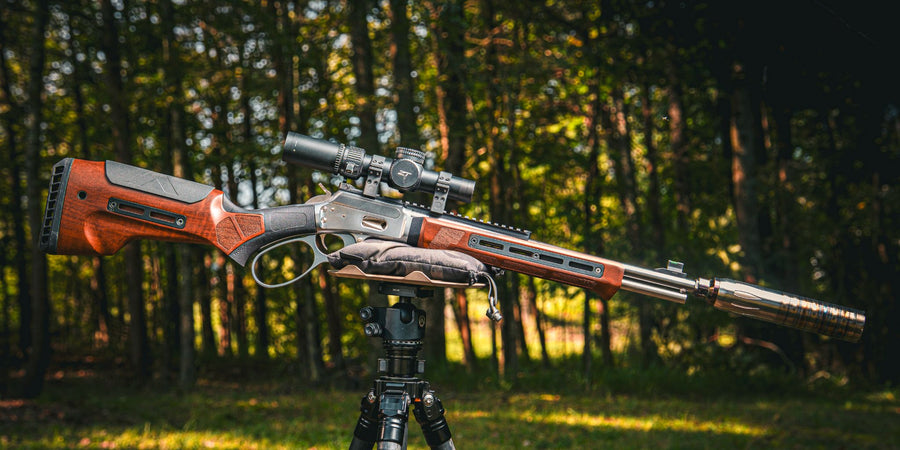
Traditional lever-action rifles typically use separate buttstocks and forearms because their receiver geometry, lever mechanism, and attachment systems were developed around two independent furniture components. Conventional bolt-action rifles usually use a continuous stock that supports the action from below.
The distinction comes from how each action was engineered, not simply from styling or tradition. Lever guns developed around compact receivers, external operating levers, and separate forearm attachments. Conventional bolt-action designs commonly secure the receiver within a continuous stock through action screws and defined bedding surfaces.
Both arrangements remain common because they suit different mechanical layouts.
What Is the Difference Between One-Piece and Two-Piece Rifle Stocks?
A two-piece rifle stock consists of separate rear and front components.
- Buttstock: Attaches behind the receiver and provides the shoulder contact, grip, and comb.
- Forearm: Sits forward of the receiver and provides a supporting surface beneath the barrel.
The receiver separates these components rather than sitting within a continuous stock.
A conventional one-piece stock incorporates the buttstock, grip, receiver inlet, and fore-end into a single structure. The barreled action typically sits within the stock and is secured through mounting points around the receiver.
These terms describe the stock's architecture, not its material. American Walnut, laminate, polymer, and aluminum-based systems can all use different structural arrangements.

Why Do Lever-Action Rifles Use Two-Piece Stocks?
1. Receiver and Lever Mechanism Geometry
Traditional lever-action stock architecture reflects the receiver's geometry, the location of the operating lever, and the separate attachment arrangements for the buttstock and forearm.
On classic Winchester, Marlin, and Henry lever-action designs, the operating lever pivots beneath the receiver. Its movement operates internal components responsible for unlocking, extraction, feeding, and locking.
The trigger assembly and loading mechanism also occupy space around the receiver.
A continuous conventional stock would need substantial openings around these components. Separate rear and front furniture allows the receiver and lever mechanism to occupy the central portion of the rifle without requiring a full-length stock around them.
2. Buttstock Attachment at the Rear Tang
Many traditional lever actions attach the buttstock to the rear of the receiver through a tang arrangement or stock bolt.
The receiver extends into or against the buttstock, establishing the mechanical connection between the metal action and rear furniture.
This differs from a conventional bolt-action rifle, where the receiver generally rests in an inlet within the stock.
The geometry of the rear tang, stock wrist, and attachment hardware influences fit. Even rifles from the same manufacturer may require different buttstock inlets.
3. Tubular Magazine and Forearm Construction
Traditional lever guns frequently carry cartridges in a tubular magazine beneath the barrel.
The forearm must accommodate this arrangement while leaving clearance for the barrel, magazine tube, and associated mounting components.
Depending on the rifle, the forearm may be retained by a barrel band, forearm cap, or other model-specific hardware.
The Henry Side-Gate series, for example, uses a separate buttstock and forearm with a tubular magazine beneath the barrel.
However, the tubular magazine is not the sole reason for two-piece construction. Lever actions such as the Browning BLR use detachable box magazines and still retain separate buttstocks and forearms.
Why Do Bolt-Action Rifles Typically Use One-Piece Stocks?
Conventional bolt-action rifles have a different receiver and stock interface.
The receiver generally sits within a continuous stock inlet, with the action secured through mounting screws and supported at designated contact surfaces.
A Continuous Structure Around the Action
A one-piece stock connects the rear grip and fore-end beneath the receiver.
The action can be supported through bedding surfaces, recoil-lug contact, pillars, or an aluminum bedding structure, depending on the rifle.
On a conventional Remington 700-pattern bolt action, for example, the receiver and recoil lug interact with the stock's bedding arrangement.
Correct bedding helps maintain consistent action support and recoil-load transfer. The stock is one component in that system; it does not independently determine rifle accuracy.
More Control Over Barrel Support
Many modern bolt-action stocks are designed to provide barrel clearance along the fore-end.
This is commonly called a free-floating barrel, meaning the barrel avoids unintended contact with the stock along the designated clearance area.
A continuous stock makes it practical to design the action-bedding interface and barrel channel as parts of the same structure.
Not every bolt-action rifle uses a fully free-floated barrel. Some designs intentionally incorporate pressure points or other bedding arrangements.
How Do Stock Attachment Methods Affect Rifle Performance?
The distinction becomes important when examining how the furniture interacts with the barreled action.
On traditional lever-action rifles, the forearm, barrel bands, magazine tube, and mounting hardware may form a connected assembly. Changes in contact pressure or fit can affect the barrel's mechanical behavior, making consistent attachment important.
On bolt-action rifles, fore-end stiffness, bedding contact, and barrel clearance can influence consistency.
Three concepts should remain separate:
- Mechanical accuracy: The rifle and ammunition system's ability to produce consistent shot placement.
- Point of impact: Where shots strike relative to the point of aim.
- Stock stability: How consistently the stock maintains its intended contact and clearance relationships.
A two-piece stock does not automatically produce inferior accuracy, and a one-piece stock does not guarantee smaller groups.
For a hunter evaluating rifle furniture, the useful question is whether the replacement stock preserves the intended receiver fit, attachment geometry, and barrel or magazine-tube clearances. Those details matter more than assuming a one-piece stock is automatically more accurate.
Does Two-Piece Construction Affect Walnut Stock Durability?
Stock construction also affects how manufacturers select and machine walnut.
A one-piece traditional rifle stock requires a sufficiently long blank with suitable grain orientation through the grip, wrist, and fore-end.
A two-piece arrangement allows the buttstock and forearm to be selected from separate blanks.
However, shorter components are not automatically stronger.
The wrist of a lever-action buttstock remains a critical area because its grain orientation, cross-sectional dimensions, and fit around the receiver influence resistance to cracking.
Walnut also responds to environmental moisture. Changes in humidity can affect dimensions and contact pressure, particularly around closely fitted metal components.
Proper material selection, grain orientation, finish maintenance, and mechanical fit matter more than piece count alone.
How WOOX Approaches Lever-Action and Bolt-Action Stock Design
WOOX develops furniture for both rifle categories while accounting for their different attachment systems.
The WOOX Bravado lever-action furniture is designed around separate buttstock and handguard components for supported Henry and Marlin platforms.
WOOX Bravado uses selected Claro Grade American Walnut in separate stock and handguard components, with features such as a five-position adjustable cheek riser on the applicable stock. The design preserves the lever-action platform's separate attachment architecture while incorporating contemporary ergonomic features.
WOOX also produces bolt-action stocks and chassis that use engineered aluminum structures alongside American Walnut components.
These designs reflect different mechanical requirements rather than an attempt to make the two platforms structurally identical.
For either category, compatibility must be verified against the exact rifle model. Receiver geometry, stock attachment, forearm mounting, and model-specific variants can prevent interchangeability.
Final Design Comparison
Lever guns generally separate their buttstocks and forearms around an exposed central receiver and operating mechanism. Conventional bolt actions usually integrate the rear and forward stock sections beneath a receiver that sits in a dedicated bedding inlet.
For owners considering replacement furniture, the important distinction is not the number of pieces. It is how the stock interfaces with the rifle's receiver, barrel, magazine system, and mounting hardware.
Frequently Asked Questions
Can a lever-action rifle have a one-piece stock?
Yes, unconventional and custom configurations are possible. However, traditional lever-action receivers and operating mechanisms make separate buttstock and forearm components the more common arrangement.
Why do lever-action rifles have separate forearms?
The separate forearm accommodates the rifle's barrel, magazine arrangement, and mounting system without requiring a continuous stock around the receiver and lever mechanism.
Do all bolt-action rifles use one-piece stocks?
No. Modern modular chassis can incorporate separate buttstock, grip, and fore-end components. One-piece construction is typical of conventional sporting bolt-action stocks, not a universal requirement.