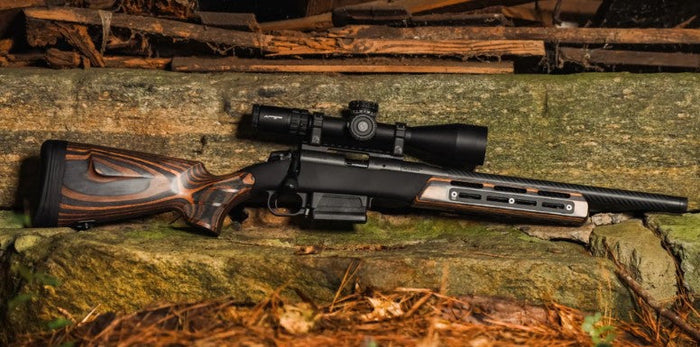
Stock compatibility errors usually begin when rifle names are treated as fitment specifications instead of starting points.
A receiver marked Remington 700, Ruger American, Tikka T3x, Howa 1500, Weatherby Vanguard, or Savage 110 still requires verification of action geometry, action length, magazine system, barrel contour, bottom metal, handedness, and generation before a stock inlet can be matched correctly.
A stock inlet is the machined geometry inside the stock that determines how the receiver, recoil lug, barrel, bottom metal, and feeding system interface together.
Terms such as action footprint, barrel channel, bottom metal, and magazine cut matter because compatibility is determined by physical dimensions, not assumptions.
Correct inlet selection begins with dimensional verification rather than platform names alone.
What Is a Stock Inlet?
A stock inlet is the internal cut or machined shape that allows the rifle’s action and related components to sit correctly inside the stock.
The inlet may need to account for:
- Receiver shape
- Action length
- Action screw spacing
- Recoil lug location
- Bedding surface
- Barrel contour
- Bottom metal
- Magazine system
- Trigger guard
- Safety or control clearance
- Handedness
- Generation-specific features
When one of these areas does not match, the rifle may not install correctly, the magazine may not seat correctly, or the barrel may contact the stock where clearance is required.
That is why a stock can be listed for a general rifle platform and still require a specific inlet configuration.
Action Footprint: The Primary Receiver Interface
The action footprint is the receiver/action geometry the stock is machined to accept. This can include receiver shape, action length, screw spacing, recoil lug location, and bedding geometry.
A short-action inlet will not properly fit a long-action receiver. Screw spacing differences alone can prevent installation, even within rifles carrying similar platform names.
A rifle marked Remington 700 still requires confirmation of:
- Short action or long action
- Magazine configuration
- Bottom metal
- Barrel profile
- Handedness
- Generation-specific differences where applicable
Similar platform names do not guarantee identical receiver/action geometry.
A Weatherby Vanguard and Howa 1500 may share substantial action similarities, but “close enough” is not a compatibility standard. Magazine configuration, barrel contour, bottom metal, and inlet dimensions still determine fit.
Barrel Channel: Why Barrel Shape Matters
The barrel channel is the cut through the fore-end of the stock that provides clearance for the barrel.
Barrel dimensions vary even within the same rifle family. A traditional sporter contour requires a different amount of clearance than a varmint, Sendero-style, heavy, match-style, or bull-barrel profile.
Receiver fit does not automatically confirm barrel-channel fit. A stock may accept the action correctly while still leaving insufficient clearance for a heavier barrel contour.
Free-float clearance depends on the barrel remaining isolated from unintended stock contact along the channel. If the barrel touches the stock where clearance is required, the fit should be checked against the manufacturer’s installation guidance before use.
Before ordering a stock, confirm the barrel contour, barrel diameter where listed, and the barrel clearance described by the stock manufacturer. Barrel channels are often described by contour or maximum barrel diameter because terms such as “heavy barrel” can vary across rifle families.
Bottom Metal: The Part Buyers Often Overlook
Bottom metal is the hardware beneath the action that supports the magazine or floorplate system.
It can include the trigger guard, magazine housing, floorplate, magazine latch, or detachable-magazine assembly, depending on the rifle configuration.
Bottom metal changes more than magazine style. It changes how the stock must be machined beneath the action.
Different bottom metal systems require different stock inlets. That is why stock listings often separate fitment by ADL, BDL, detachable box magazine, or AICS-compatible configurations.
ADL
ADL-style configurations use a blind internal magazine with no hinged floorplate.
Because the magazine remains enclosed inside the stock, the inlet beneath the action differs from floorplate or detachable-magazine systems.
BDL
BDL-style configurations use a hinged floorplate system that allows cartridges to unload from beneath the rifle.
The floorplate assembly changes the inlet dimensions, which means BDL-compatible stocks require different machining than ADL-style variants.
Detachable Magazine Systems
Many precision-oriented rifles use detachable box magazine systems, often based around the AICS magazine pattern.
These systems can alter inlet geometry, magazine-well dimensions, latch placement, and feeding position. A stock cut for one bottom-metal or magazine configuration should not be assumed compatible with another unless the manufacturer clearly states that it is supported.
Bottom metal influences feeding geometry, magazine alignment, and how the action interfaces with the stock inlet.
Magazine Cut: Why Cartridge Length Changes Compatibility
The magazine cut is the portion of the inlet that provides room for the magazine system and cartridge stack beneath the action.
It affects whether the magazine, cartridge length, and feeding system physically fit the stock.
Magazine fitment depends on:
- Cartridge length
- Action length
- Magazine style
- Magazine pattern
- Magazine latch position
- Bottom-metal compatibility
A stock cut for short-action dimensions may not provide sufficient clearance for long-action cartridges or long-action magazines.
Likewise, a stock cut for a blind internal magazine may not accept a detachable-magazine system without a different inlet or modification.
Magazine-system differences can create:
- Feeding interruptions
- Poor magazine seating
- Floorplate interference
- Inconsistent cartridge presentation
- Incorrect latch engagement
Feeding problems rarely begin at the cartridge alone. They often begin in the dimensions beneath it.
Why “Drop-In Fit” Still Requires Verification
“Drop-in fit” does not mean every rifle with the same model name will fit every stock in that product family.
It usually means the stock is designed to accept a specific listed configuration without major custom fitting when the rifle matches the stated compatibility requirements.
Those requirements may include action pattern, action length, bottom metal, magazine type, handedness, generation, and barrel contour.
A drop-in stock should still be matched against the exact product page, compatibility table, and installation notes before ordering.
Common Inlet Mistake
The most common inlet mistake is assuming that one correct detail confirms the whole fit.
A matching action footprint does not automatically confirm barrel-channel clearance.
A matching action length does not automatically confirm bottom-metal compatibility.
A matching rifle name does not automatically confirm magazine cut.
Each inlet area has to match the rifle configuration it is designed to support.
What WOOX Buyers Should Verify Before Ordering
Stock compatibility usually comes down to five major areas:
- Exact action pattern: Know the rifle model, action length, and receiver/action configuration.
- Barrel contour: Confirm whether the rifle uses a sporter, heavy sporter, varmint, Sendero-style, match, or bull-barrel profile.
- Bottom metal type: Identify whether the rifle uses ADL, BDL, factory detachable-magazine hardware, or an AICS-compatible system.
- Magazine system: Confirm magazine style, cartridge-length compatibility, and latch geometry.
- Compatibility notes: Read the full product listing, not only the rifle name.
A replacement stock may be listed by rifle platform, but final fitment may also depend on action length, bottom metal, detachable-magazine compatibility, barrel contour, handedness, generation, and product-specific exclusions.
A rifle name may narrow the options. It rarely confirms fitment on its own.
This is why WOOX fitment should be checked against the current product page, compatibility table, and installation notes for the exact rifle configuration.
Final Fitment Rule
Do not choose a stock by rifle name alone. Choose it by inlet.
That means confirm:
- Action footprint
- Action length
- Barrel channel
- Bottom metal
- Magazine cut
- Magazine system
- Handedness
- Generation
- Product-specific notes
When those dimensions match, the rifle and stock have a clear path to proper fit. When one of them is assumed, the risk of ordering the wrong stock increases.
FAQ
What is a stock inlet?
A stock inlet is the internal geometry machined into a rifle stock to accept the action, recoil lug, barrel profile, bottom metal, and feeding system.
What does action footprint mean?
Action footprint refers to the receiver/action geometry a stock is designed to accept, including action length, screw spacing, recoil lug location, and bedding dimensions.
What is a barrel channel?
The barrel channel is the cut in the fore-end of the stock that provides clearance for the barrel contour.
What is bottom metal on a rifle stock?
Bottom metal is the hardware beneath the action that supports the magazine or floorplate system and affects stock fitment.
What is the difference between ADL and BDL?
ADL-style configurations use a blind internal magazine, while BDL-style configurations use a hinged floorplate system. Because the floorplate changes the hardware beneath the action, ADL and BDL stocks require different inlet geometry.
Why does magazine cut matter?
Magazine cut matters because the magazine system, cartridge length, latch position, and bottom metal must physically align beneath the action for the rifle to feed and function correctly.
Does drop-in fit mean any rifle with that model name will fit?
No. Drop-in fit usually applies only to the exact configuration listed by the stock manufacturer. Action pattern, action length, magazine system, bottom metal, handedness, generation, and barrel contour should still be verified.
How do I know if a stock will fit my rifle?
Check the exact action pattern, action length, barrel contour, bottom metal type, magazine system, handedness, generation, and compatibility notes instead of relying on the rifle name alone.