Precision Rifle Balance: How Stock, Chassis, Barrel, Optic, and Bipod Weight Work Together
Precision rifle balance is not decided by a single component. It is decided by the relationship between material, geometry, weight placement, and the way the rifle is actually used.
Barrel contour, optic selection, bipod placement, stock geometry, chassis design, and accessory weight all influence one another. The rifle only reveals its real behavior once the full system is assembled.
A rifle may have a well-made barrel and still feel difficult to manage on support if the full system is poorly balanced. A larger optic may improve observation while also shifting weight higher on the rifle. A rigid chassis may improve structural consistency while changing balance in ways that affect positional movement.
Experienced long-range and competition shooters often treat rifle setup as a complete system problem because recoil tracking, positional stability, and support behavior interact.
Balance matters because weight distribution changes how the rifle behaves under recoil, on a bag, behind a bipod, and during movement between positions.
Precision Rifle Balance Is About Behavior, Not Static Weight
Two rifles can weigh the same and feel entirely different in use.
One rifle may track predictably through recoil and settle naturally behind the optic. Another may feel reactive, top-heavy, or difficult to control despite having a similar total weight.
Precision rifle balance refers to how mass is distributed across the rifle system and how that distribution influences movement, recoil behavior, and support stability.
Weight positioned forward of the action influences muzzle movement. Weight concentrated closer to the shooter changes handling and transitions. Mass added high on the rifle affects how the platform settles into support and how easily it rolls under positional pressure.
Competitive rifle setups are usually evaluated as systems because recoil management, support stability, and sight picture recovery influence one another.
A heavier barrel shifts weight forward. A larger optic raises mass above the bore line. A bipod changes leverage at the front of the rifle. A different forend shape changes how the rifle interfaces with bags, barricades, and improvised rests.
The number on the scale matters. But the rifle’s behavior matters more.

The Stock or Chassis Establishes the Foundation
Precision balance begins with the stock or chassis because it establishes the rifle’s structural foundation.
The stock or chassis determines how the action is supported, how the shooter interfaces with the rifle, how the forend contacts support, and where some of the rifle’s weight sits before the barrel, optic, bipod, and accessories are added.
Material choice matters here as much as overall weight.
Aluminum, steel, polymer, composite materials, and American walnut all place weight differently within the rifle and influence how the finished system behaves once assembled. Modern hybrid chassis systems often combine materials because rigidity, weight placement, field feel, and support behavior are competing design priorities.
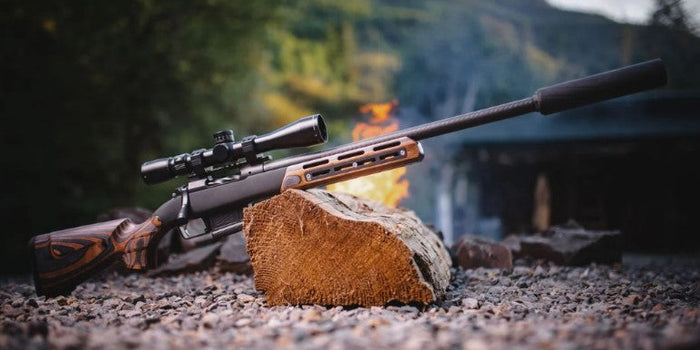
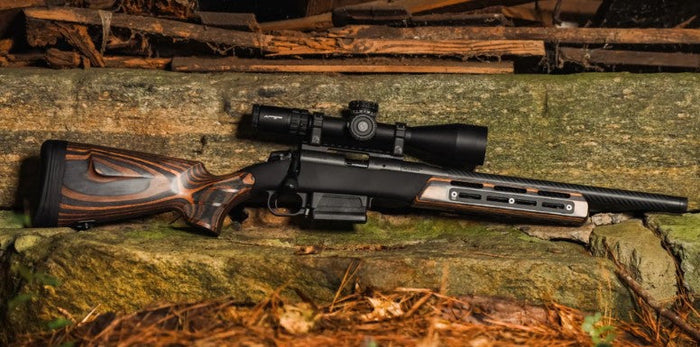
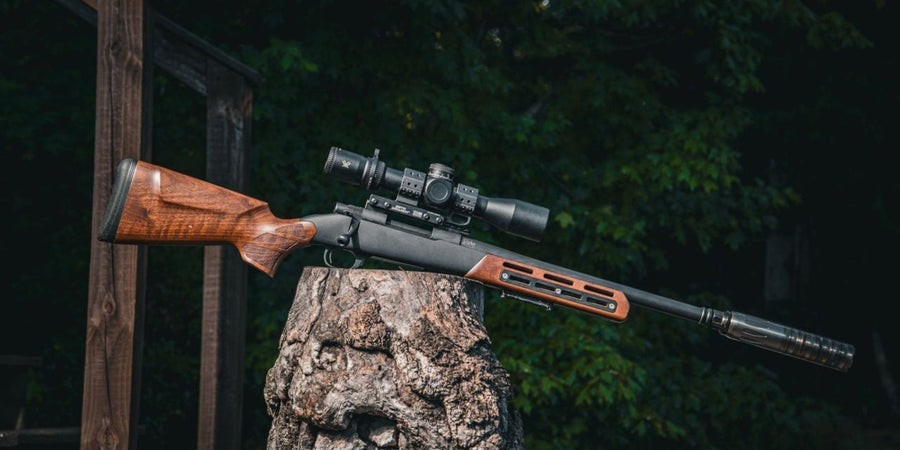
While many modern stocks use polymer or composite materials for weight, consistency, and production efficiency, WOOX continues to build around American walnut and machined metal structure.
That decision matters because material is not decoration. American walnut changes exterior feel, balance, and ownership character, while the machined structure influences action support and support behavior.
For WOOX, that balance between American walnut and machined structure matters. A walnut-and-aluminum chassis system is not just about appearance. It changes how the rifle feels in the hands, how the action is supported, and how the system balances once the build is complete.
Rigidity Changes Consistency
A rigid stock or chassis helps limit unwanted movement in the rifle system.
Under bipod preload, bag pressure, or barricade pressure, the forend and action support area should resist flexing in ways that change how the rifle sits or recoils.
Less unwanted movement at the support interface can help maintain more repeatable contact between the shooter, rifle, and support surface.
That does not mean rigidity alone guarantees accuracy. Barrel quality, bedding or chassis fit, ammunition, optic setup, torque values, shooter input, and environmental conditions all matter.
Rigidity is one part of consistency. It gives the rifle a more stable foundation, but it does not replace the rest of the system.
Forend Geometry Changes Support Behavior
Forend geometry changes how a rifle behaves on bags, barricades, bipods, and improvised rests.
A wider, flatter forend can distribute support pressure more evenly and reduce lateral roll. That can make the rifle feel more predictable when loaded into a bipod or settled onto a shooting bag.
A narrow or rounded forend may carry more naturally in the field, but it may not sit as flat or as consistently on barricades and bags.
Neither shape is automatically better.
The right forend geometry depends on the rifle’s job. A competition rifle often benefits from a flatter, more support-friendly front end. A hunting rifle may need a slimmer profile that carries better over distance.
Support behavior is where design intent becomes visible.

The Stock Also Influences Weight Distribution
A rifle with substantial front-end mass paired with an extremely light rear section may become overly nose-heavy.
Some forward bias can help a supported precision rifle settle and track more predictably. Too much forward weight can slow transitions, increase fatigue during movement, and make the rifle harder to reposition on barricades or improvised supports.
Excessive rearward bias creates a different issue. The rifle may move quickly, but it may feel less settled under recoil and more sensitive to shooter input.
The stock or chassis helps set that balance point before the rest of the build is added. A barrel, suppressor, optic, bipod, rail, magazine, and accessory weights can all shift the rifle’s center of gravity.
This is why precision rifle balance should be checked after the rifle is assembled, not estimated from stock weight alone.
Barrel Weight Changes the Center of Gravity
Few components shift balance as dramatically as barrel contour and barrel length.
The barrel sits forward of the action, so added length or contour can move the center of gravity forward quickly. Even modest increases in barrel weight can change how the rifle settles on support and how the muzzle behaves during recoil.
Heavier Barrels Change Muzzle Behavior
Heavier barrels add mass forward of the action.
That extra forward mass can slow abrupt muzzle movement and make reticle movement easier to observe. For supported shooting, a slight forward bias is often intentional because it can help the rifle settle into the support and move more predictably under recoil.
More forward mass may reduce sudden vertical movement and help the shooter stay closer to the sight picture through recoil.
This is one reason heavier barrel contours remain common in long-range and competition-focused rifle setups.
The tradeoff is handling. A heavier barrel can make the rifle slower to move, harder to carry, and less convenient in unsupported field positions.
Barrel Weight Also Changes Recoil Tracking
Recoil tracking describes how the rifle moves during recoil and whether the shooter can maintain useful visual information through the optic.
Forward mass can make recoil movement feel more linear and less abrupt when the rifle is properly supported and the shooter’s position is consistent.
A rifle that recoils predictably is easier to manage because it is more likely to return toward the original point of aim and allow the shooter to observe impact, miss location, or trace.
That does not mean barrel weight alone creates good tracking. Shooter position, rifle fit, support height, bipod load, cartridge, muzzle device, optic setup, and stock geometry all influence recoil behavior.
Barrel weight is one major variable in a larger system.
Stability Comes With Tradeoffs
A rifle optimized for prone precision may stabilize exceptionally well once supported, but feel slow during barricade transitions or improvised field positions.
A rifle optimized for static shooting may become frustrating when movement and carry requirements enter the equation.
The goal is not maximum weight. The goal is useful weight in the right places.
A rifle that is too light for its purpose may feel jumpy or difficult to track. A rifle that is too heavy for its purpose may become slow, tiring, and awkward outside supported positions.
Balance is the middle ground between stability and mobility.
The Bipod Is Part of the Balance System
A bipod is not just a support accessory. It becomes part of the rifle’s balance system.
Because the bipod usually sits near the front of the forend, it adds weight forward of the action and changes the rifle’s support geometry.
Bipod placement affects how the rifle loads into support, how far apart the front and rear support points sit, and how the rifle reacts under recoil.
A bipod mounted farther forward can increase the distance between front and rear support points, which may help the rifle resist unwanted pitch when supported. It may also make the front of the rifle feel heavier during movement.
A heavier bipod, a long barrel, a suppressor, and a large optic can combine to create a rifle that is very stable from support but noticeably slower in positional transitions.
That may be acceptable for prone precision. It may be less ideal for a rifle that must move quickly between positions or be carried for long distances.

Optic Mass Alters Centerline Balance
Optic weight matters because it sits above the rifle.
Higher magnification scopes, larger objective lenses, steel mounts, clip-on devices, levels, rangefinding systems, and supplemental electronics all add mass above the centerline.
That top-side weight can influence how the rifle settles on support and how it behaves during positional movement.
A heavier optic may help with observation, magnification, and image quality, but it can also make the rifle feel more top-heavy. That becomes more noticeable when the rifle is moved between barricades, carried in the field, or supported on a narrow surface.
Rifles expected to move rapidly between positions often benefit from keeping top-side weight intentional.
That does not mean a lighter optic is always better. It means optic weight should match the rifle’s purpose, not just the highest magnification number available.
How Accessory Weight Adds Up
Precision rifle builds often gain weight gradually.
A heavier barrel may be chosen for stability. A larger optic may be added for observation. A bipod may be mounted for prone work. A suppressor or muzzle device may change front-end behavior. Chassis weights may be added to tune balance.
Each decision can be reasonable on its own.
Together, those choices can create a rifle that behaves very differently from the original plan.
Before adding weight, ask what problem the added mass is supposed to solve:
- Does it support steadier behavior from supported positions?
- Does it help the rifle track more predictably?
- Does it reduce unwanted movement?
- Does it make the balance point more useful?
- Does it help the shooter maintain position?
- Does it make the rifle harder to move or carry?
Precision rifle setup works best when weight is added with a purpose.
Different Shooting Disciplines Require Different Balance Priorities
Different rifle roles require different balance priorities.
A PRS-style rifle, prone precision rifle, and field rifle may all be accurate, but they do not need to balance the same way.
PRS and Barricade Rifles
PRS and barricade-focused rifles are often optimized around positional consistency.
The rifle must remain stable on bags and barricades while still moving efficiently between positions. Shooters may prefer a rifle that settles quickly on support, tracks predictably, and does not require constant correction between shots.
Extremely front-heavy setups may help stability in some positions but slow transitions and make the rifle harder to manage under time pressure.
Many competitors tune balance around controllable recoil, stable support behavior, and positional movement rather than maximum rifle weight alone.
Prone Precision Rifles
Prone-focused rifles can often accommodate additional system mass more easily because positional movement matters less than recoil consistency and reticle stability.
A slightly forward-balanced rifle may be more acceptable in prone shooting because the rifle remains supported for longer periods.
In this role, additional barrel, bipod, or chassis weight may help the rifle settle and remain predictable.
The tradeoff is mobility. A rifle that works well from prone may feel heavy, slow, or awkward when moved through field positions.
Field and Hunting Rifles
A rifle carried for hours solves a different problem than one placed directly onto a firing line.
Forward weight becomes more noticeable during carry and unsupported shooting because front-heavy systems require more effort to stabilize without support.
A field rifle may still benefit from good balance and a stable support interface, but it also has to carry naturally, mount quickly, and work from improvised positions.
The ideal setup becomes a compromise between stability and carry efficiency.
For hunting and field use, the best rifle is not always the heaviest or the lightest. It is the one that balances well enough to carry, settle, and shoot from the positions the field actually provides.
Where WOOX Fits Into Precision Rifle Balance
WOOX builds at the meeting point of American walnut and machined structure.
A WOOX precision stock or chassis is not simply a traditional wood stock, and it is not simply an aluminum chassis with walnut placed around it. The material and the mechanical structure have to work together: the walnut changes the exterior feel, the way the rifle carries, and the character of ownership; the aluminum structure supports the action and gives the rifle a repeatable mechanical foundation.
That matters for balance because material is not decoration. American walnut, forend geometry, action support, and weight placement all influence how the rifle feels once the barrel, optic, bipod, suppressor, magazine, and accessories are added.
For precision rifle builds, the WOOX way to think about balance is simple:
- Not weight for the sake of weight.
- Not lightness for the sake of a lower number.
- Not chassis complexity unless the rifle needs it.
- The rifle should balance around the way it will be used.
If the rifle is built for supported precision, stability and recoil tracking may matter more. If it is built for field carry, balance and movement matter more. If it is a hybrid build, the stock or chassis has to support both.
Final Balance Rule
Precision rifle balance is not one specification.
It is the relationship between stock, chassis, barrel, optic, bipod, accessories, shooter position, and intended use.
A balanced rifle should:
- Settle predictably on support
- Track predictably through recoil
- Carry or move acceptably for its purpose
- Keep the optic usable through the shot cycle
- Match the shooting discipline
- Avoid weight that does not solve a real problem
The best precision rifle setup is not the heaviest rifle.
It is the rifle that places weight where it helps the shooter most.
That is why the stock or chassis cannot be treated as a cosmetic choice. It is the foundation the barrel, optic, bipod, and shooter all work against. Build that foundation around the right material, geometry, and support structure, and the rifle behaves more predictably when it settles back onto target.
In a WOOX build, American walnut is not treated as a cosmetic shell around the engineering. It is part of the system: the way the rifle carries, settles, and becomes more personal with every year of use.
FAQ
Does a heavier rifle always balance better?
No. Total rifle weight matters less than where that weight exists throughout the system. A lighter rifle with balanced weight distribution may handle more predictably than a heavier rifle with poorly distributed mass.
Should precision rifles be front-heavy?
Many supported precision rifles use some forward bias because it can help recoil tracking and stability. Excessive forward weight can slow transitions, increase fatigue, and make unsupported positions harder.
Does optic weight affect rifle balance?
Yes. Large optics, heavy mounts, clip-on devices, and other top-mounted accessories add mass above the rifle centerline. That can influence how the rifle settles into support and behaves during positional movement.
What component changes rifle balance the most?
Barrel contour and barrel length often produce the largest balance shifts because weight added forward of the action moves the center of gravity significantly. Bipod placement, optic weight, suppressors, chassis weights, and stock design also matter.
Is a heavier barrel better for precision shooting?
A heavier barrel can support steadier behavior from supported positions and make recoil movement easier to observe, but it is not automatically better for every rifle. Heavier barrels add forward mass, which can slow movement and increase carry fatigue.
How does a bipod affect rifle balance?
A bipod adds weight forward of the action and changes how the rifle interfaces with support. Bipod placement can affect pitch control, preload behavior, and how the rifle settles during recoil.
What matters more: rifle weight or rifle balance?
Both matter, but balance often explains rifle behavior better than total weight alone. A rifle with useful weight distribution may feel steadier and more predictable than a heavier rifle with poorly placed mass.