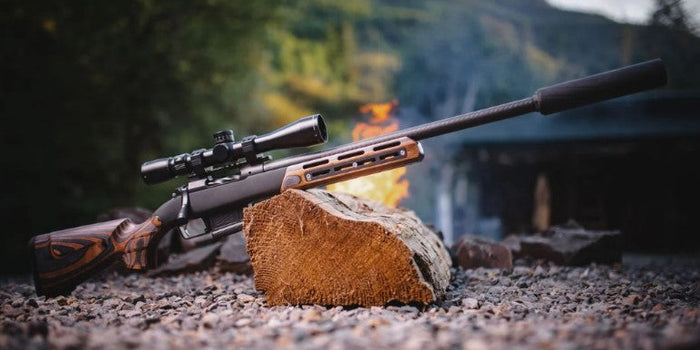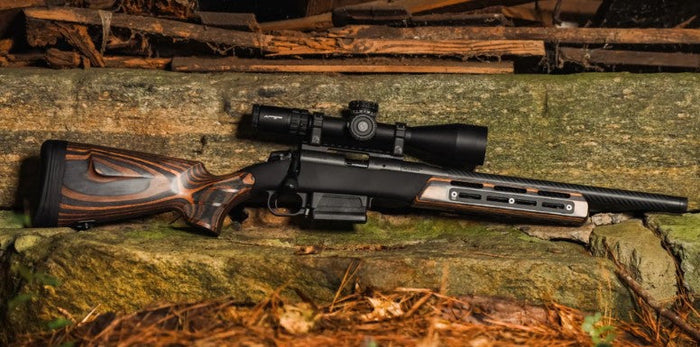
M-LOK on a lever-action rifle often begins as a question of flexibility and quickly becomes a question of balance.
Some contemporary lever-action rifles now accept modular handguards or furniture with integrated M-LOK slots, allowing selective attachment of sling hardware, compact lights, or support accessories without improvised mounting solutions.
On lightweight carbines, additional forward-mounted accessories can slow mounting speed and make a rifle carried all day feel noticeably different by the end of it.
Lever Guns Respond Differently to Added Weight
Lever-action rifles often reveal the effects of added accessories faster than heavier rifles because relatively small increases in front-end weight noticeably alter balance.
Weight added near the muzzle or magazine tube tends to affect handling disproportionately on compact lever carbines because forward-mounted mass changes balance more noticeably. Even small accessories can make a rifle feel slower to mount or noticeably front-heavy during long carry.
Unlike heavier precision rifles, lever guns are often valued for their slim profile, natural balance, and ease of carry. Support-hand placement also tends to remain relatively consistent during cycling, meaning poorly positioned hardware is encountered repeatedly rather than occasionally.
What M-LOK Actually Solves on a Lever Gun
On a lever gun, M-LOK is most useful as a low-profile attachment system that allows selective mounting points without adding the weight, width, or unnecessary rail space associated with full-length Picatinny rail sections.
Most effective M-LOK additions on a lever rifle solve one of three problems:
- improving carry during extended movement
- improving repeatable support-hand placement
- improving stability in supported positions
Accessories that improve one of those functions generally make sense on a lever gun. Additions that primarily add forward weight, unnecessary bulk, or complexity usually work against the platform’s strengths.
M-LOK Accessories That Usually Make Sense
Sling Mounts and QD Hardware
Because lever guns are commonly carried for long periods, sling placement tends to matter more than on rifles used primarily from supported positions. Poor placement can shift carry balance or interfere with support-hand position during repeated movement.
M-LOK attachment points can improve sling flexibility without improvised mounting solutions, but placement matters more than hardware selection. Mounting points that interfere with support-hand position or natural carry often create more frustration than benefit.
Compact Lights
Compact lights tend to work best on lever rifles used for ranch work, predator control, or low-light utility where practical visibility outweighs the handling cost of added weight.
Lever rifles generally benefit from low-profile lights mounted close to the handguard, where they preserve natural handling, reduce snag risk, and avoid unnecessary width. Oversized systems tend to shift handling characteristics without improving utility.
High-Volume Shooting and Heat Management
For shooters who spend extended time on the range, handguard material can influence comfort during long firing strings. Aluminum M-LOK handguards generally dissipate heat more efficiently than many traditional fore-end designs, helping heat spread across the handguard rather than remaining concentrated in one area.
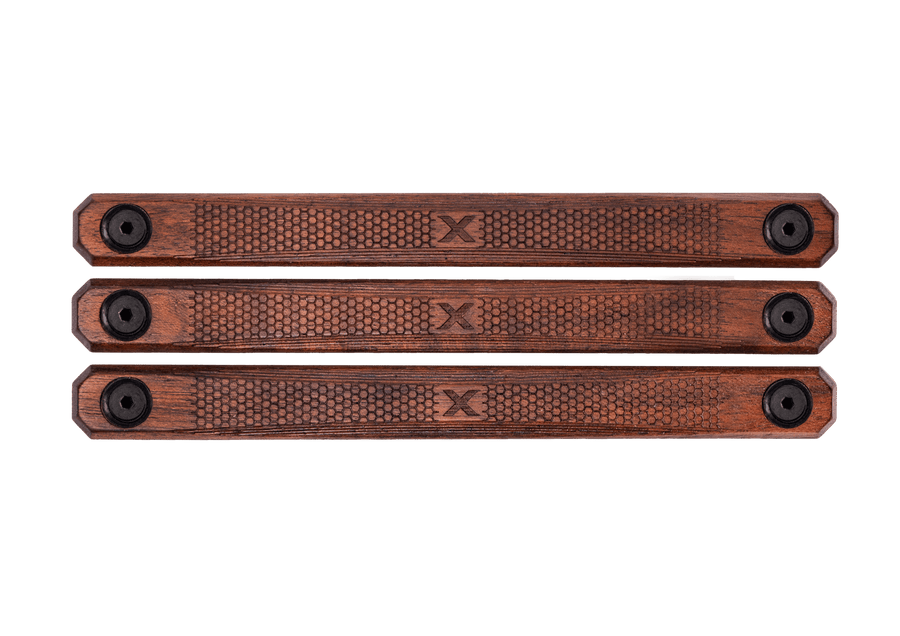
When combined with properly fitted wood grip panels, shooters can retain the modular attachment capability of an aluminum M-LOK system while maintaining a more comfortable support-hand contact surface. The wood panels act as an insulating interface between the shooter's hand and the handguard, helping reduce direct contact with heated aluminum during extended shooting sessions.
This consideration is most relevant for high-volume range use. During typical hunting, ranch, or field carry, where firing is intermittent, heat buildup is generally much less significant.
Hand Stops and Indexing Points
Small hand stops or indexing points work best when they improve repeatable support-hand placement without disrupting the natural grip of a lever rifle.
Low-profile indexing points generally preserve the slim handling characteristics of a lever rifle better than oversized control surfaces.
Barricade Stops or Support Accessories
For some shooters, especially those using a lever rifle in supported shooting positions, small barricade interfaces may improve positional stability.
Barricade interfaces generally make sense only when the rifle is routinely shot from supported positions. Otherwise, they add weight and width to a platform built around mobility.
Accessories That Often Work Against Lever-Action Handling
Most handling problems begin when accessories are added without a defined purpose, gradually shifting a lightweight rifle away from the characteristics that made it appealing.
Oversized Vertical Grips
Large vertical grips often interfere with the forward support-hand position commonly used on lever rifles, complicating carry and making slim carbines feel unnecessarily bulky.
Excessive Rail Attachments
Filling every available mounting surface often adds weight faster than expected.
Additional rails and oversized mounts can make the rifle feel front-heavy while increasing snag risk during carry.
Large Bipods on Lightweight Builds
A bipod may make sense on a highly specialized configuration, but many lightweight lever guns see limited practical benefit from large supported-shooting accessories. The added front-end weight often outweighs the benefit on rifles built around balance and mobility.
Fitment Depends on Rifle Configuration
Compatibility often depends on exact rifle configuration rather than simply whether the firearm is a lever action.
Fitment commonly depends on:
- rifle platform and generation
- receiver/frame size and caliber family
- barrel bands or fore-end cap configuration
- magazine tube setup
- handguard compatibility
- straight-grip or pistol-grip stock configuration
- large-loop lever and stock/grip clearance during cycling
- octagon versus round barrel configurations
Barrel-band, fore-end cap, and magazine-tube configurations frequently determine whether a handguard or mounting interface can be installed at all. Large-loop levers may alter clearance around certain stock, grip, or accessory setups during cycling, while octagon barrels can change how mounting systems interface compared with round-barrel configurations. Compatibility is usually determined by exact rifle configuration rather than brand name alone.
Confirming fitment before ordering accessories usually prevents more problems than adjusting after installation. Exact compatibility varies by rifle configuration and furniture setup, making model-level fitment confirmation worthwhile.
Available mounting space is not always an invitation to add equipment. On many lever rifles, preserving balance often matters more than maximizing attachment points.
How WOOX Approaches Lever-Action Modularity
WOOX approaches lever-action modularity as selective utility rather than maximum attachment space. M-LOK works best when it supports additions that improve carry, control, or practical use without shifting the rifle toward unnecessary front-end weight or excessive bulk.
Within systems such as the Bravado, attachment points are most useful when they preserve the balance and quick handling that define a lever-action rifle.
Before ordering Bravado furniture or M-LOK accessories for a Henry or Marlin lever-action rifle, confirm the exact model, receiver/frame size, stock and handguard configuration, barrel band or fore-end cap setup, magazine tube arrangement, and current WOOX product-page compatibility.
FAQs
Is M-LOK worth adding to a lever-action rifle?
M-LOK can be worthwhile on a lever-action rifle when it solves a practical need such as sling attachment, low-profile lighting, or supported shooting stability. The benefit depends on whether the added accessory improves carry or handling without disrupting balance.
What accessories should you avoid on a lever-action rifle?
Oversized vertical grips, excessive rail attachments, and heavy bipods often work against the handling qualities that make lever-action rifles appealing. On lightweight carbines, unnecessary front-end weight can make a rifle slower to mount and less comfortable to carry.
Does M-LOK change lever-action rifle balance?
Yes. Lever-action rifles tend to respond more noticeably to added front-end weight than heavier rifle platforms. Accessories mounted near the muzzle or magazine tube can change swing characteristics and make compact carbines feel front-heavy.
Can all lever-action rifles accept M-LOK accessories?
No. Compatibility depends on rifle configuration rather than simply whether the rifle is a lever action. Barrel bands, fore-end cap design, magazine tube layout, handguard compatibility, barrel profile, receiver/frame size, and furniture design all affect fitment.
Do compact lights make sense on lever-action rifles?
Compact lights often make sense for ranch work, predator control, or low-light utility where visibility matters. Low-profile lights mounted close to the handguard typically preserve handling better than oversized systems.
Why do lever-action rifles feel front-heavy so quickly?
Lever guns are often lightweight and naturally balanced. Even modest accessories mounted farther forward can noticeably shift balance because the weight sits farther from the shooter’s center of support.