The choice between a cartridge quiver and an ammo pouch is not about storage alone. It determines where ammunition lives in the hunting system and how ammunition access affects reload mechanics, rifle balance, and movement under pressure.
The better choice depends on the distance you expect to cover, the number of cartridges you intend to carry, and whether rifle-mounted access or body-mounted reserve matters more for the hunt ahead.
A cartridge quiver keeps immediate rounds with the rifle. An ammo pouch keeps reserve rounds with the hunter.
That difference changes how the rifle carries, how the hand moves during a reload, and how much ammunition stays on the firearm throughout the day.

A Leather Cartridge Quiver Keeps Ammunition With the Rifle
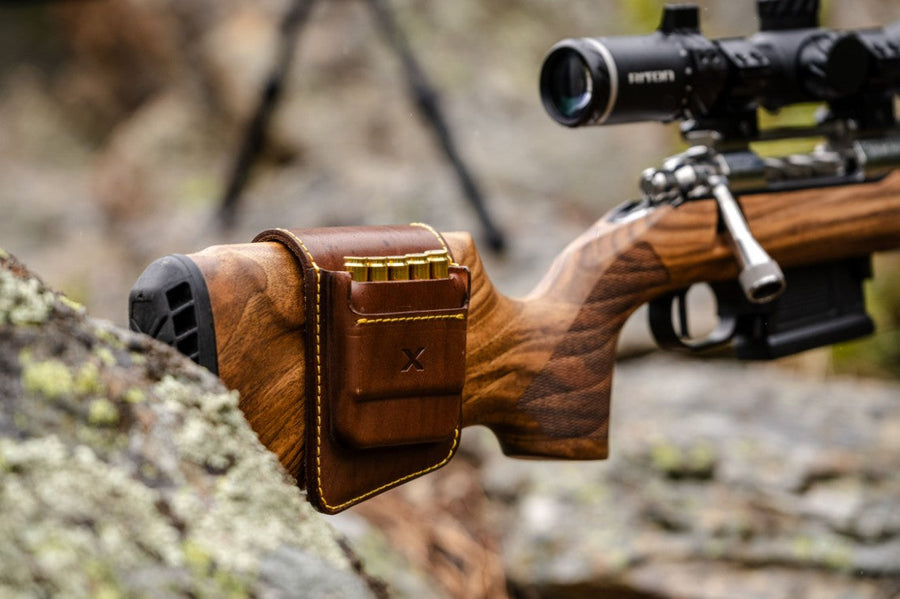
A cartridge quiver mounts cartridges directly to the buttstock, placing reloads at a fixed location on the rifle.
The primary advantage is repeatable cartridge placement. Every reload begins from the same location regardless of whether the hunter is wearing a heavy winter jacket, a rain shell, or a backpack.
Reloading can require less reach because cartridges stay on the rifle instead of in a belt pouch, pocket, or pack.
That placement also shifts several loaded cartridges onto the buttstock, slightly increasing rearward weight. On rifles with suppressors, heavy barrels, or long optics, that rearward mass may help offset a front-heavy feel.
On lightweight hunting rifles, the added stock weight may feel noticeable during long carries.
On compact rifles with shorter length of pull, added buttstock bulk can also affect shoulder pocket placement during rifle mounting.
Premium Italian leather forms the carrier body, while an internal elastic retention system securely holds each cartridge through repeated field use. Over time, the leather conforms to the stock while the adjustable lacing secures the carrier to the rifle stock.
Leather earns its place because it can be cleaned, conditioned, repaired, and kept in service.
Cartridge size also matters. Larger cartridges such as .300 Winchester Magnum or .45-70 Government require more space and create more bulk at the stock than smaller cartridges such as .308 Winchester.
Excessive cartridge height can affect cheek weld consistency, especially on rifles with lower-mounted optics or when the quiver sits on the shooter's cheek side.
WOOX's Leather Cartridge Quiver holds five cartridges using an internal elastic retention system, while the premium Italian leather forms the carrier body and adjustable lacing secures it to most traditional rifle stocks. Fit may vary on stocks with adjustable cheek risers or oversized stock-mounted accessories, so the current WOOX product page should be checked before ordering.
A Leather Ammo Pouch Prioritizes Capacity
A leather ammo pouch shifts ammunition storage from the rifle to the hunter, increasing carrying capacity while preserving the rifle's balance.
A covered pouch can reduce exposure to brush, debris, and weather compared with loose cartridges carried in a pocket or open loop.
Keeping reserve ammunition off the rifle preserves balance during long carries. That advantage becomes more noticeable on mountain hunts or long backcountry walks, where even small weight changes at the rifle can increase fatigue over hours of carry.
That additional capacity comes at the cost of extra movement during a reload because every cartridge must be retrieved from the belt, pocket, or pack before reaching the rifle.
Unlike a buttstock-mounted quiver, a pouch separates reserve ammunition from the firearm. That can be useful for capacity, but it changes the hand path during reloads.
The Decision Is About Access, Not Speed
Speed is often presented as the deciding factor between these two systems. In practice, the more useful question is how each design manages access and movement during a reload.
Reducing unnecessary reach can help the hunter preserve position and awareness during a reload.
The real tradeoff is not speed versus capacity. It is rifle-mounted access versus body-mounted reserve.
That difference changes hand path. A quiver can keep cartridges within reach while the rifle remains closer to the shooting position. A pouch often requires the hunter to lower the rifle, rotate the torso, or reach away from the firearm before retrieving ammunition.
A cartridge quiver minimizes the distance between the rifle and the cartridges most likely to be needed immediately. A pouch minimizes the amount of weight carried on the firearm while increasing the number of cartridges available throughout the day.
Matching the Equipment to the Hunt
A leather cartridge quiver makes the most sense when hunters expect to fire very few shots but want immediate access to additional cartridges.
Whitetail stand hunting, predator hunting, and many spot-and-stalk situations fall into this category. For many stand hunts, five accessible cartridges can be enough for immediate field use.
A leather ammo pouch becomes more practical when reserve capacity matters. Multi-day backcountry hunts, extended tracking sessions, or hunts involving several opportunities throughout the day benefit from carrying additional ammunition without adding weight to the rifle itself.
A cartridge quiver carries the cartridges most likely to be needed immediately, while the ammo pouch carries reserve ammunition for the remainder of the day. Together, they separate immediate access from reserve capacity.
A cartridge quiver suits stand hunting, predator calling, and other situations where immediate cartridge access matters more than reserve capacity.
An ammo pouch is better suited to mountain hunts, long tracking sessions, and backcountry travel where additional ammunition is carried throughout the day.
Many experienced hunters combine both systems by keeping immediate reloads on the rifle while carrying reserve cartridges on the belt or in a pack.
Material Determines Service Life
Premium Italian leather remains part of modern hunting equipment because it offers quiet stock contact, repairability, and long-term service in a material designed to be maintained rather than discarded.
Material matters most when cartridge retention, secure fit, and long-term durability must remain consistent through years of weather, handling, and repeated field use.
Like American Walnut, leather is selected because it can be maintained rather than replaced. Both materials record years of use instead of hiding them, allowing the rifle and its accessories to mature together through decades in the field.
Leather also changes honestly. It darkens, softens, and develops marks from the places it has been carried. That is not decoration. It is use made visible.
For many traditional hunting setups carrying only a few immediate spare rounds, a cartridge quiver makes more sense. An ammo pouch becomes the better choice when reserve capacity matters more than rifle-mounted access.
Hunters covering long distances or carrying larger cartridge counts often benefit from keeping weight off the rifle.
The better system is the one that removes unnecessary movement from the hunt while remaining worthy of the rifle it serves for years of field use.
A cartridge quiver keeps immediate rounds with the rifle. An ammo pouch keeps reserve ammunition with the hunter. The right answer depends on which role matters more.
Frequently Asked Questions
Are cartridge quivers good for hunting?
Yes. Cartridge quivers are practical for hunting situations where immediate cartridge access matters more than carrying large ammunition reserves. They work especially well for stand hunting, predator calling, and other hunts where a few spare rounds need to stay close to the rifle.
How many rounds does a cartridge quiver usually hold?
Many cartridge quivers hold between four and eight cartridges, depending on cartridge size and design. WOOX's Leather Cartridge Quiver is designed to hold five cartridges.
Does a cartridge quiver affect rifle balance?
Yes. A buttstock-mounted quiver adds weight to the rear of the rifle. On front-heavy rifles, such as rifles with suppressors, heavy barrels, or large optics, that rearward weight may help offset a front-heavy feel. On lightweight rifles, the added weight may feel more noticeable during long carries.
Is an ammo pouch better for long hunts?
Usually, yes. Ammo pouches make more sense when reserve capacity matters, such as during multi-day backcountry hunts, mountain hunts, or long tracking sessions. They allow more ammunition to be carried without adding weight directly to the rifle.
Is leather better than synthetic for cartridge carriers?
Leather and synthetic materials solve different problems. Premium Italian leather offers durability, repairability, and long service life. Synthetic carriers may weigh less or dry faster, but leather remains valuable when maintenance, repairability, and long-term ownership matter.
Can a cartridge quiver affect cheek weld?
Yes, depending on cartridge size, quiver placement, stock shape, optic height, and whether the quiver sits on the shooter's cheek side. Larger cartridges can add more bulk to the stock. Always confirm that the quiver does not interfere with cheek placement, shoulder position, or safe rifle handling before using it in the field.