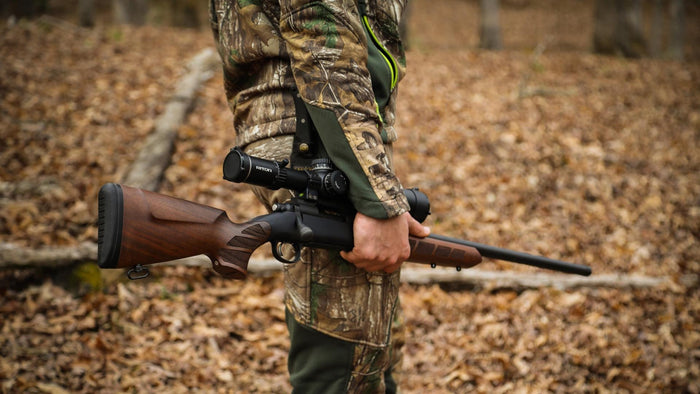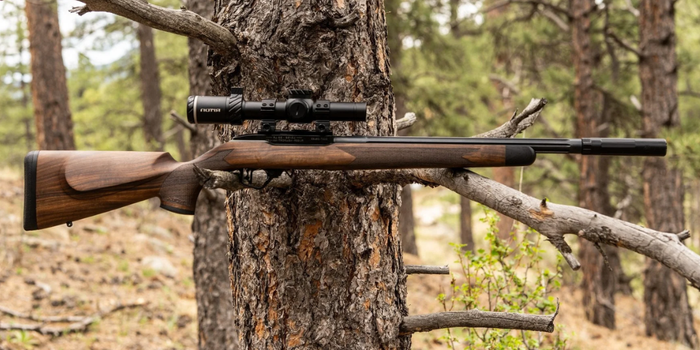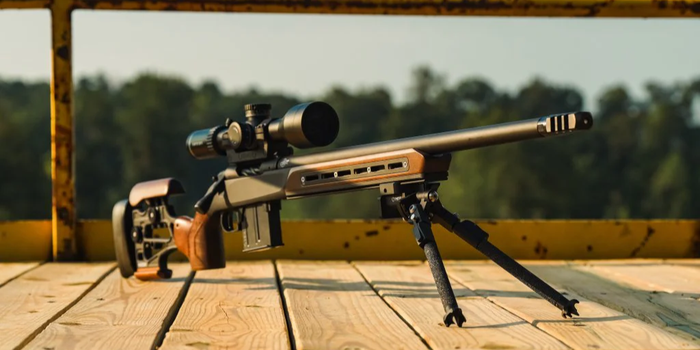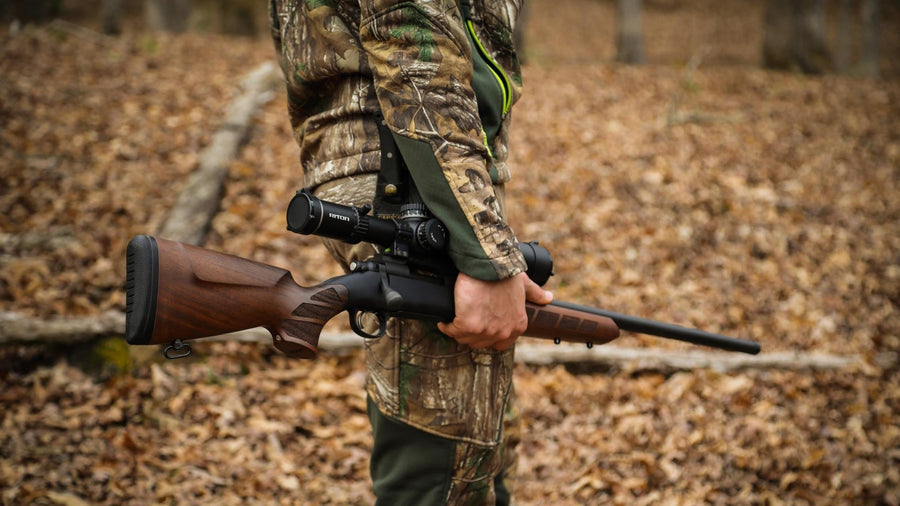
A rifle sling carries the rifle far more often than the trigger is used. During a hunting season, sling hardware supports the rifle through miles of carry, changing terrain, repeated shoulder transitions, and long periods of movement. The mounting system shapes how the rifle hangs, balances, and moves during carry.
A sling mount affects more than comfort. It influences balance, carry position, rifle control, and how naturally the rifle moves with the hunter over a full day in the field.
The best mounting system depends on how the rifle is actually used: carried into a blind, worn across the body through steep terrain, kept close during still-hunting, or repositioned repeatedly throughout the day.

Traditional Sling Studs: Why They Still Matter
Traditional sling studs remain common on bolt-action hunting rifles because they provide a simple, durable mounting solution.
On rifles built around wood, laminate, or composite stocks, a properly installed sling stud adds little complexity while remaining dependable over years of use. A properly installed sling stud creates a simple anchor point with few moving parts and minimal maintenance requirements.
Traditional sling studs remain especially practical on classic hunting rifles carried into blinds, stands, or familiar hunting ground where reliability matters more than quick detachment or frequent sling repositioning. They also work well for hunters who prefer a clean rifle setup with fewer external adapters, rail sections, or moving hardware.
The Limitation of Sling Studs
Sling position changes rifle carry more than many hunters expect.
A rear stud mounted directly underneath the stock carries differently than a rear attachment point positioned slightly toward the side of the stock. A bottom-mounted sling point is traditional and works well for many bolt-action hunting rifles. A side-mounted rear point can help some rifles ride flatter against the torso during cross-body carry, depending on stock shape, sling setup, and carry position.
That difference often becomes noticeable only after miles of uneven terrain, when a rifle that rides naturally demands less adjustment throughout the day.
Sling studs also place the attachment point where the stock maker or installer placed it. Unlike M-LOK adapters or some QD systems, traditional studs usually do not allow quick position changes without changing hardware or modifying the stock.
Installation quality matters. Recoil, vibration, and repeated sling tension can gradually loosen poorly installed hardware. If a sling stud is loose, damaged, or pulling out of the stock, it should be inspected and corrected before field use.
Quick-Detach QD Cups: Faster Transitions, Cleaner Carry
Many modern hunting stocks and chassis systems now integrate flush QD cups directly into the stock. Flush QD cups sit recessed into the stock, reducing protruding hardware while allowing quick sling attachment and removal.
Hunters moving between backpacks, blinds, shooting supports, and storage cases often prefer the ability to remove or reposition a sling without changing permanent hardware.
A QD system uses a recessed socket paired with a push-button swivel. Press the button and the sling detaches. Push the swivel back into the socket and the sling locks into place when properly seated.
QD systems can make sling removal faster when moving between carry and supported shooting positions. They can also help reduce loose sling webbing when the rifle is being shot from a bench, bag, bipod, or other support where the sling is not needed.
The important detail is compatibility. A QD sling swivel must match a QD socket or adapter designed to accept that swivel. A QD sling cannot connect directly to a plain sling stud or M-LOK slot without the correct adapter.
Standard Rotation vs Anti-Rotation QD Cups
QD systems differ more than many hunters realize.
Some QD sockets allow the swivel to rotate freely. Others use limited-rotation or non-rotating designs that restrict movement instead of allowing continuous spin.
Anti-rotation systems mechanically limit swivel movement instead of allowing full continuous rotation. Some designs use limited travel or indexed stops to help reduce sling twisting.
That distinction matters most at attachment points where sling webbing tends to rotate during movement, especially during cross-body carry or long walks with the rifle shifting against clothing, packs, or gear.
A fully rotating rear mount can allow the sling to twist repeatedly during movement. Over time, webbing may bind, fold, or require adjustment.
Anti-rotation QD cups help limit that movement before the sling webbing twists enough to become distracting. For hunting rifles carried across the body or worn for extended periods, anti-rotation at the rear can produce a cleaner, more predictable carry.
The benefit usually becomes noticeable during long days of carry, when reduced sling twisting helps keep rifle position more consistent.
M-LOK Sling Mounts: Adjustable Position Without Permanent Modification
M-LOK systems take a different approach to sling mounting.
Instead of relying only on fixed attachment locations, M-LOK sling hardware attaches to compatible M-LOK slots on a handguard or fore-end. That allows hunters to move sling positions forward, rearward, or laterally as rifle balance and carry style change.
M-LOK is a mounting interface, not a sling type. It can accept different sling-mount adapters, including QD sockets, loop-style mounts, or clip-style mounts, depending on the hardware selected.
Moving a sling attachment point several inches forward or rearward can change how muzzle weight hangs during carry.
On heavier or suppressor-equipped rifles, moving the front sling point forward may help reduce muzzle swing during long carries. In other setups, a more rearward position may help the rifle hang closer against a pack, chest rig, or torso.
A predator rifle used for short walks between stands may need a different sling position than one carried several miles on foot. M-LOK systems allow those adjustments without drilling, relocating fixed hardware, or permanently modifying the stock when the rifle already has an M-LOK-compatible handguard.
Hunters experimenting with positional shooting may also benefit from shifting attachment points until the rifle hangs and settles more naturally.
Sling Mount Compatibility: QD, M-LOK, Picatinny, and Sling Studs
Many sling mounting systems share more compatibility than hunters initially expect, but the interfaces are not the same thing. The sling itself may stay the same while the attachment hardware changes depending on the rifle.
QD refers to the quick-detach sling swivel and socket system. M-LOK refers to a modular slot-based mounting interface. Picatinny refers to a rail interface.
A sling stud is a traditional fixed anchor point used on many hunting rifle stocks.
In practice, a push-button QD sling swivel can lock into a stock-mounted QD cup, an M-LOK QD socket, or a Picatinny-mounted QD adapter if the correct hardware is installed.
Picatinny rails typically require rail-mounted sling adapters. M-LOK handguards require hardware designed for M-LOK slots. Traditional sling studs use stud-compatible swivels unless an adapter is installed.
Understanding that distinction makes it easier to choose compatible hardware without replacing the entire sling. Compatibility depends less on the sling itself and more on the mounting interface installed on the rifle.
Matching Sling Mounts to Hunting Style
The right mounting system depends less on trend and more on how the rifle is used.
A sling system that works well for a compact deer rifle may not be the right answer for a heavier rifle with a large optic, suppressor, bipod, or modular handguard.
The best choice is the mounting system that lets the rifle carry naturally, stay secure, and move predictably through the kind of terrain the hunter actually covers.
Backpack Hunting and Mountain Terrain
In mountain terrain, security and carry control matter more than speed.
A rifle that constantly shifts, rolls, or demands adjustment becomes fatiguing long before the hunt ends. Sling position should help keep the rifle close enough to manage while still allowing the hunter to move through elevation changes, brush, rocks, and pack straps.
Anti-rotation QD cups, side-mounted attachment points, or M-LOK QD mounts can be useful here when they help reduce twisting and keep the rifle position predictable. The key is not the hardware name. The key is whether the rifle stays stable during long carry.
Deer Stand and Blind Hunting
For deer stand and blind hunting, simplicity often matters.
A hunter walking a moderate distance from a truck, cabin, or trailhead may not need a highly adjustable sling system. A straightforward sling stud setup can be enough when the rifle is carried into position, set down safely, and used from a relatively stable location.
Rifles built around traditional hunting ergonomics often continue to favor sling studs because the system aligns with simple field use and minimal adjustment.
On walnut-stocked hunting rifles designed around long-term ownership, a clean sling-stud setup can preserve the classic look and keep the rifle free from unnecessary hardware.
AR-Style and Modular Hunting Rifles
AR-style hunting rifles and rifles with modular fore-ends often benefit from adjustable sling positions.
M-LOK sling points give hunters freedom to experiment with rifle balance, attachment position, and carry geometry without permanent stock changes when the rifle has compatible slots.
Hunters running larger optics, suppressors, bipods, night equipment, or lights may benefit from adjusting sling position as rifle balance changes.
For modular rifles, sling placement is part of the whole setup. It should work with the optic, barrel length, handguard length, support gear, and the way the rifle will be carried.
Sling Mount Comparison
A lightweight mountain rifle, a traditional walnut hunting rifle, and a modern chassis-style rifle place different demands on a sling system.
The most adjustable system is not always the best fit for a hunting rifle. The best system is the one that complements how the rifle balances, how it is carried, and how it will be used over time.
Use this as a practical guide:
| Sling Mounting Option | Best Use | Main Advantage | Main Limitation |
|---|---|---|---|
| Traditional sling stud | Classic bolt-action hunting rifles, blind hunting, simple field carry | Simple, familiar, durable, low-profile | Limited position adjustment |
| QD cup | Modern hunting stocks and chassis systems | Fast sling removal and cleaner transitions | Requires compatible QD swivel and socket |
| Anti-rotation QD cup | Cross-body carry, long walks, backpack hunting | Helps reduce sling twisting | Rotation limits vary by design |
| M-LOK sling mount | Modular handguards and fore-ends | Adjustable position without permanent modification | Requires M-LOK-compatible mounting surface |
| Picatinny sling adapter | Rifles with rail sections | Works with rail-mounted sling hardware | Adds external hardware and may increase bulk |
Where WOOX Fits Into Sling Mounting
WOOX hunting stocks and chassis systems are built around the same principle that applies to sling mounting: the rifle should match the way it is carried and used.
A sling mount is not only an accessory point. It is part of the rifle’s field geometry.
On a classic walnut hunting stock, a clean sling-stud setup may match the rifle’s purpose: simple carry, traditional handling, and long-term ownership. On a more modular rifle or chassis-style build, QD or M-LOK attachment points may make more sense because the sling position can adapt to the rifle’s weight, optic, support gear, and field role. That is the WOOX way to think about the decision. Not hardware for the sake of hardware. Not tactical complexity for a rifle that does not need it.
The right sling mount should support the rifle’s balance, preserve its handling, and fit the way it will be carried.
FAQ
What is the best sling mount for a hunting rifle?
The best sling mount depends on how the rifle is carried. Traditional sling studs suit many simple bolt-action hunting rifles, QD cups suit hunters who want faster sling removal, and M-LOK sling mounts suit rifles with modular handguards or fore-ends.
Are QD sling cups better than sling studs for hunting rifles?
QD sling cups are better when speed, quick removal, or carry flexibility matters. Sling studs are simpler and remain a strong choice for classic hunting rifles that do not need frequent sling removal.
What is an anti-rotation QD sling mount?
An anti-rotation QD sling mount limits swivel movement so the sling does not twist as easily during carry. That can make the rifle hang more predictably, especially when carried across the body or over long distances.
Where should a sling mount be placed on a hunting rifle?
Sling mount placement depends on rifle shape, sling type, and carry method. A bottom-mounted rear point is traditional and works well on many bolt-action rifles. A side-mounted rear point can help some rifles ride flatter against the torso during cross-body carry.
When should a hunter use M-LOK sling mounts?
M-LOK sling mounts make sense on rifles with M-LOK-compatible handguards or fore-ends when sling position may need to change without permanent modification. They are useful when balance, carry geometry, or rifle setup changes over time.
Can a QD sling attach to M-LOK?
A QD sling swivel cannot attach directly to an empty M-LOK slot. It needs an M-LOK QD socket or compatible adapter installed on the handguard first.
Can a sling stud be converted to QD?
Some adapter hardware can add QD capability to a sling-stud location, but compatibility depends on the adapter, rifle stock, and intended use. Always confirm the adapter is designed for that mounting point before relying on it in the field.