A hunting pack rarely gets heavy all at once. It happens one reasonable addition at a time.
Another knife because it weighs almost nothing. A folding saw just in case. An extra tool because the first one might not be enough. Another rifle accessory because there was still room on the rail. Individually, every decision makes sense. Carry all of it far enough, and the field starts editing the list for you.
The equipment that survives season after season is usually the equipment with a clear job. A rifle that fits. A sling you trust. A knife that cuts cleanly. An axe when there is actual chopping to do. A way to maintain an edge. Light, navigation, first aid, game-care equipment, and whatever the specific weather and country demand.
The interesting thing is how little the basic logic has changed. Materials have changed. Optics have changed. Navigation has changed dramatically. But a useful field kit is still built around one simple rule:
Know the work ahead. Carry the right tools for it.
Build the Kit Around the Hunt
There is no useful answer to “What should every hunter carry?” without knowing where that hunter is going. A few hours in a whitetail blind within walking distance of a truck is one kind of hunt. Several days in unfamiliar backcountry is another.
Wet coastal country asks different things of equipment than a dry early-season hunt. Cold changes batteries, clothing, dexterity, and the way equipment feels in the hand. Distance from help changes what counts as optional. Start there.
What jobs will actually need to be done?
A typical field kit might need to cover:
| Field Need | Typical Equipment |
|---|---|
| Carrying and operating the rifle | Proper rifle setup, stock and sling |
| Controlled cutting | Hunting knife |
| Chopping or splitting | Compact axe or hatchet when warranted |
| Edge maintenance | Appropriate sharpening tool |
| Game care | Gloves, game bags and species-appropriate supplies |
| Low-light work | Headlamp or reliable light |
| Navigation | Map, compass, GPS or appropriate combination |
| Equipment problems | Small repair or maintenance kit |
| Personal safety | First-aid and emergency equipment |
| Weather | Clothing and protection matched to conditions |
The table is not a packing checklist. It is a way to think. If an item does not solve a likely problem, it should have to argue for its space.
The Rifle Gets the Attention. The Stock Does the Carrying.
Most rifle conversations begin with the action, barrel, cartridge, optic, or ammunition.
Fair enough. But during an actual hunt, the rifle is carried vastly more than it is fired. That makes the physical interface between hunter and rifle worth thinking about.
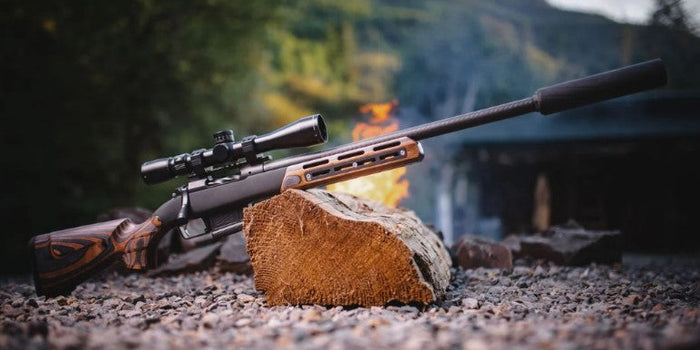
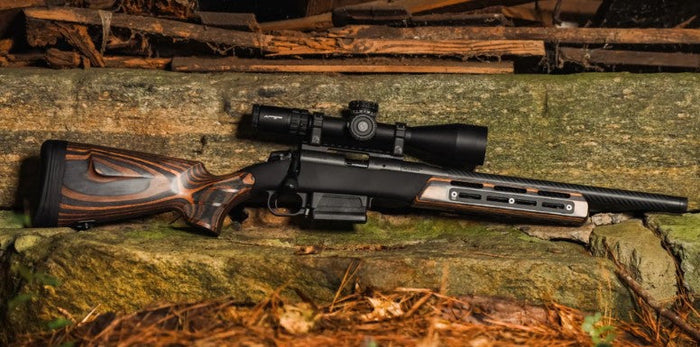
The stock determines where the hand settles, how naturally the rifle comes to the shoulder, where the cheek meets the comb, and how much material has to move through brush, timber, a blind, or uneven country. The sling carries the completed system when both hands need to be free.
A stock intended for a field rifle may therefore prioritize different things from one designed primarily around supported range or competition shooting. A hunter may value a relatively clean exterior, manageable mass, a fore-end that carries comfortably, and geometry that works from improvised positions. None of those characteristics looks particularly dramatic on a specification sheet. After several miles, they become easier to appreciate.

Material Is Part of the Experience
Stock material adds another layer to that choice. A good polymer or composite stock is extremely practical. Environmental moisture is generally less of a concern than it is with wood, and routine finish maintenance is minimal. Walnut asks more of its owner. That is simply true. But the reason hunters continue to choose wood is not that they have failed to discover easier materials. Walnut brings grain, figure, texture, and natural variation into something the hunter handles every time the rifle is picked up.
It also changes with use. A well-maintained wood stock does not have to remain visually frozen in the condition in which it left the factory. The surface can show handling. The finish can be maintained. Depending on construction and condition, refinishing can give a stock another chapter instead of making surface wear the end of its useful life.
That same philosophy appears elsewhere in a traditional field kit.
Wood handles. Working steel. Leather covers and sheaths.
Materials that need occasional attention, but make their condition visible and understandable. There is value in that. Not because maintenance is somehow noble. Because maintainable equipment can remain useful.
The Hunting Knife Still Earns Its Space
Take the rifle out of the pack and the knife is probably the easiest traditional tool to defend.
A hunting knife has a clear job after a successful harvest. It also handles ordinary controlled cutting around camp without asking a larger tool to do delicate work.
The important word is controlled. A good field knife does not need to be enormous.
It needs to suit the task, offer a secure grip, carry safely, and maintain an edge appropriate to the work. A sharp knife also requires less forcing than a dull one. That matters because once a user starts compensating for a poor edge with more pressure, control tends to suffer.
Blade size should still match the animal and the work being performed. There is no single knife dimension that becomes ideal for every form of field dressing, skinning, camp work, or general use.
That is why we prefer to talk about the WOOX Bad Boy Hunterfor what it actually is: a compact fixed-blade hunting knife.
It uses a 3.75-inch D2 steel blade, with WOOX specifying hardness at approximately 60 HRC. Overall length is 7.5 inches, with American Walnut and Micarta handle options.
Those are useful specifications because they tell you what kind of tool you are considering. They matter more than calling a knife “extreme.” A field knife earns respect through work, not adjectives.

A Knife Should Not Have to Pretend It Is an Axe
There is a habit in outdoor gear culture of trying to make one tool do everything. Sometimes that makes sense. Sometimes it is how good tools get abused. A knife and an axe both have cutting edges, but they approach work differently. A knife is suited to controlled cutting. An axe uses head mass, handle length, edge geometry, and momentum to perform chopping and splitting work. There is overlap.
That does not make them interchangeable.
If the job repeatedly calls for chopping, trying to turn a hunting knife into a small axe may put unnecessary stress on the knife while still doing the job poorly.
The opposite is equally obvious. An axe is not the tool for the kind of controlled cutting that a good hunting knife handles naturally.
The lesson is less exciting than “one tool to rule them all.” Use the tool built for the work.
Does an Axe Belong in Every Hunting Pack?
No.
That answer should come before any discussion of axes.
A short hunt close to a vehicle may give a hunter absolutely no reason to carry one. In that situation, even an excellent compact axe may be little more than extra weight.
The calculation changes when camp becomes part of the hunt.
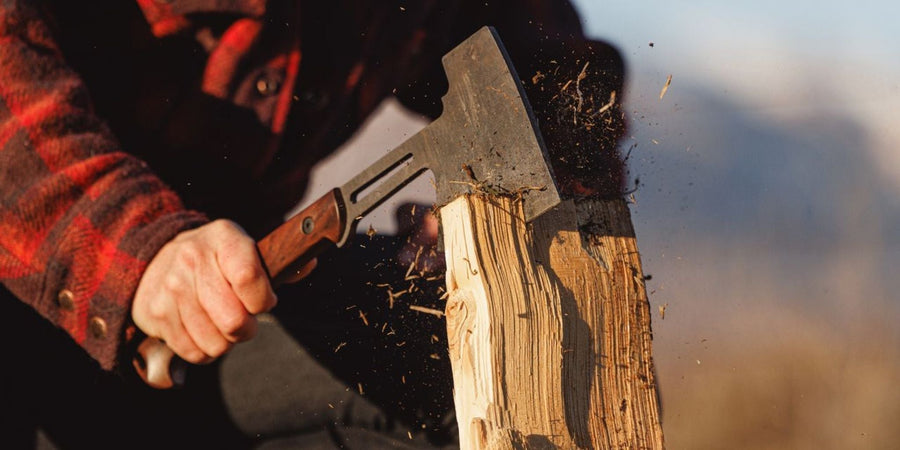
Firewood preparation, light chopping, splitting, or repeated camp work can create jobs that justify carrying something beyond a knife.
That is where a compact hunting axe starts making sense.
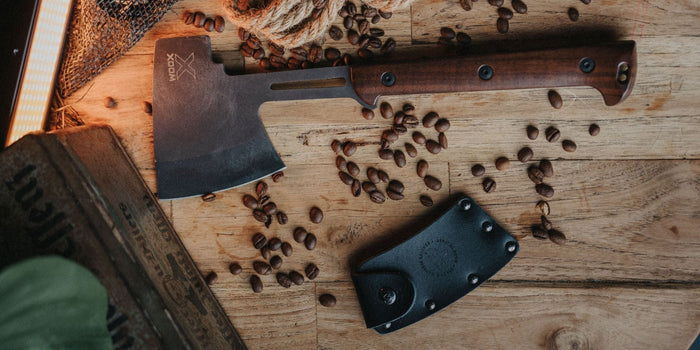
The WOOX TERRA was designed around that kind of role rather than trying to replace a full-size felling or splitting axe.
Its head is machined from 4140 steel. WOOX specifies differential heat treatment and a convex working edge, with American Walnut and Micarta handle configurations available. Current WOOX specifications list total weight at approximately 23 ounces with the Walnut configuration and 25 ounces with Micarta, and the tool is supplied with an Italian leather blade cover.
The numbers tell us something important. TERRA is still equipment you have to choose to carry.
It should be in the pack because there is work for it.
Not because every hunter is supposed to own an axe.
Edge Maintenance Is Part of Carrying a Cutting Tool
There is endless discussion about blade steels.
Eventually, all of them get dull.
That makes edge maintenance part of the ownership equation.
The same principle applies to an axe, but that does not mean the axe should simply be sharpened as though it were a fine knife.
Different tools use different working geometries.
WOOX’s axe-care guidance recommends preserving the intended edge shape rather than chasing the thinnest possible edge. The objective is a clean, functional working edge suited to the job of the axe.
That distinction is worth understanding before arriving in camp.
The time to learn how a sharpening system behaves is not when a knife is already dull and there is an animal on the ground.
Likewise, a field sharpener has limited value if the person carrying it has never practiced with it.
One small piece of equipment, properly understood, can replace a surprising amount of redundancy.
Skill still weighs less than a second knife.
Camp Changes the Equation
The longer the hunt becomes, the more the kit starts expanding beyond hunting itself.
A temporary camp has to function.
There may be wet equipment to manage, food to prepare, firewood to deal with where lawful and appropriate, repairs to make, and repeated work before sunrise or after dark.
A good headlamp suddenly matters more than another pocket gadget.
Dry storage matters.
A small repair kit starts making sense.
A chopping tool may earn a place.
Maintenance also starts before the trip is over.
A wet rifle may need to be wiped down rather than left until the hunter returns home.
A knife used around game should be cleaned appropriately.
An axe should not be sealed wet beneath a leather cover.
A wooden handle deserves an inspection if it has been struck, soaked, or subjected to unusual use.
The same applies to a walnut rifle stock.
Do not trap it wet inside a case and assume the problem will solve itself.
Most equipment failures are less romantic than people imagine.
They usually begin with something small that nobody dealt with.
Wood, Steel and Leather Make Their Condition Visible
One thing traditional materials do particularly well is tell you how they are doing.
A steel edge shows wear.
A wood handle can be inspected.
A walnut stock shows damage to its finish.
Leather visibly dries, stretches, darkens, and changes with use.
That visibility creates responsibility.
It also makes maintenance more intuitive.
A walnut rifle stock may need finish care.
A wooden tool handle should be checked for damage.
Steel needs to be cleaned, dried, and eventually sharpened.
Leather deserves suitable care and should not be used to trap moisture against steel.
None of those materials is maintenance-free.
That is not the reason to choose them.
The more interesting question is whether the object remains worth maintaining.
At WOOX, that distinction matters.
Natural grain is allowed to remain natural.
Working edges are supposed to work.
A tool should not become precious because its owner is afraid to mark it.
A good tool becomes valuable when it has been used hard enough to develop a history and remains sound enough to keep using.
Fewer Tools. Fewer Duplicated Jobs.
There is another way to make a hunting pack lighter that does not involve buying ultralight versions of everything.
Stop carrying three things that perform the same job.
A fixed blade, folding knife, multi-tool, saw, and axe can each make sense.
That does not mean all five belong on every hunt.
Before putting something into the pack, ask:
What job can this tool perform safely and well that the rest of my kit cannot?
If there is no clear answer, leave it home.
The same rule works on the rifle.
Unused rail space does not need to be filled.
Adjustment hardware does not need to exist simply because it can.
Accessories that solve no actual problem are still weight, bulk, snag points, and things that can work loose.
Capability is useful.
Accumulation is not the same thing.
Check the Quiet Equipment Before the Season
Most hunting equipment should be boring when it works properly.
The sling stays attached.
The knife is sharp.
The light turns on.
The optic remains zeroed.
The stock hardware stays where it belongs.
The axe handle is sound.
The emergency kit contains what you thought it contained.
That reliability begins before opening day.
Confirm the rifle setup and zero.
Inspect sling hardware.
Look over the stock for loose hardware, damaged finish, or changes that appeared during storage.
Check knives, edges, and sheaths.
Inspect any wooden axe handle for damage.
Test lights with the batteries you actually intend to carry.
Open the first-aid and emergency kit instead of assuming last year’s supplies are still complete.
Routine inspection can catch missing, worn, or damaged equipment before it becomes a problem in the field.
That is much easier than fixing it miles from the truck.
Heritage Has Limits
An article about walnut, knives, axes, steel, and camp tools can become nostalgic very quickly.
That is not the point.
Some modern equipment is simply better than what hunters carried generations ago.
Use it.
Modern emergency communication can save lives.
Reliable satellite navigation can be extremely valuable.
Technical clothing manages weather in ways older materials often could not.
Modern lights are remarkably capable.
Current medical equipment, sanitation practices, game-care systems, and weather information belong in a serious field kit where appropriate.
Tradition should never become an excuse for refusing a better solution.
The useful part of hunting heritage is not recreating somebody else’s equipment list from 1950.
It is preserving the habits that made good hunters competent in the first place:
judgment, preparation, maintenance, restraint, familiarity with the equipment, and an understanding of the country.
Those ideas have aged well.
Why Certain Tools Become Part of the Hunt
Ask someone about a hunt from twenty years ago and the gear list will probably be incomplete. The important tools are easier to remember.
A rifle.
A knife.
The old sling.
An axe at camp.
A sharpening stone that always seemed to be there. Those objects stay in the story because they stayed in use. They were not necessarily the most expensive things in the pack. They simply kept earning their place. The knife was sharpened. The rifle was maintained. The stock picked up marks. The axe handle darkened from hands and seasons. Something was repaired instead of immediately replaced. That is how a field tool becomes a piece of hunting tradition. You cannot manufacture that part. You can only build something capable of getting there.
Build a Field Kit You Actually Know
The most useful hunting kit is rarely the largest. It is the one where nothing needs an introduction when something goes wrong.
You know the rifle. You know how the stock fits when you’re wearing hunting layers instead of a T-shirt at the range. You know where the sling sits. You know what the knife will and will not do.
If you carry an axe, you know why it is there.
If you carry a sharpening tool, you have already used it.
You know where the headlamp is without emptying the pack.
You have checked the medical and emergency gear.
You know the route.
That kind of familiarity is worth more than another handful of equipment.
The field eventually teaches most hunters to edit.
Things that never solve problems stop coming.
Things that work return next season.
And a small number of tools stay long enough that replacing them starts to feel less like an upgrade and more like starting over.
Those are the tools worth making properly.
Frequently Asked Questions
What should a hunter carry besides a rifle?
There is no universal list. Terrain, game, weather, hunt duration, regulations, and distance from assistance should determine the kit. Common needs include a suitable knife, lighting, navigation, first-aid and emergency equipment, game-care supplies, weather protection, and basic maintenance items. An axe or additional camp tools should be added only when the hunt creates a genuine use for them.
Does every hunter need a hunting knife?
A suitable knife is useful on many hunts, particularly for field and game-care tasks. Blade size and geometry should be matched to the animal and intended work rather than assuming one knife is ideal for every hunting situation.
Why carry a fixed-blade knife?
A fixed blade provides a simple, rigid cutting tool with no folding mechanism. For hunting use, blade geometry, a secure grip, a suitable edge, controllable dimensions, and safe sheath design are more important than simply choosing the largest knife.
Does every hunter need an axe?
No. A compact axe or hatchet makes sense when legitimate chopping, splitting, or camp work is expected. On a short hunt close to a vehicle, it may simply add weight and duplicate other tools.
What is the difference between a hunting knife and a hunting axe?
A knife is primarily a controlled cutting tool. An axe combines head mass, handle length, momentum, and different edge geometry to perform chopping and splitting work. The tools overlap in limited situations, but neither should automatically be treated as a substitute for the other.
Should hunters carry a sharpening tool?
It can be useful, particularly on longer hunts where cutting tools see repeated use. More important is learning to use the chosen sharpening system before entering the field. Knife and axe edges may require different techniques and should generally retain the geometry appropriate to the tool.
Why are wooden handles still used on field tools?
Wood can be shaped comfortably, inspected, maintained and, on many traditional tool designs, refinished or replaced when appropriate. Natural grain also gives each handle its own appearance. Wood is not maintenance-free, and whether a particular handle can be replaced depends on the construction of the individual tool.
What hunting gear is worth keeping for decades?
There is no material that guarantees longevity by itself. Equipment worth keeping tends to combine sound construction, useful design, maintainability, appropriate materials, and a job that does not disappear when trends change. How the owner uses, stores, inspects, and maintains the equipment matters just as much.
The Field Changes. The Standard Shouldn’t.
Rifles have changed. Optics have changed. Navigation, clothing, lighting, communication, and materials have changed. Good hunters should take advantage of that. But the test for a tool has remained remarkably simple.
Does it perform a necessary job well?
If it does, learn how to use it.
Maintain it.
Carry it when the work calls for it.
And when something has served well for season after season, do not assume that newer automatically means better.
Some tools deserve another season.
Some deserve another generation.
Built to be handed down to those who come next.