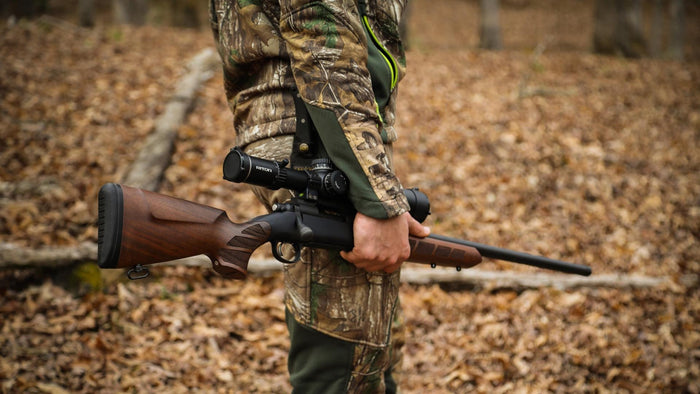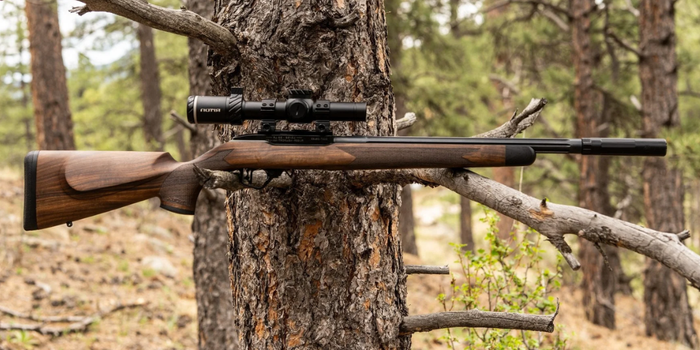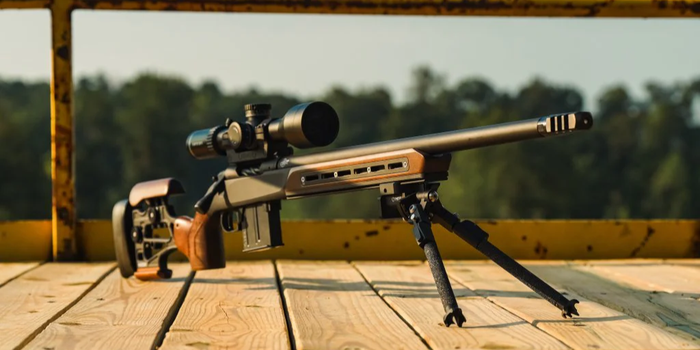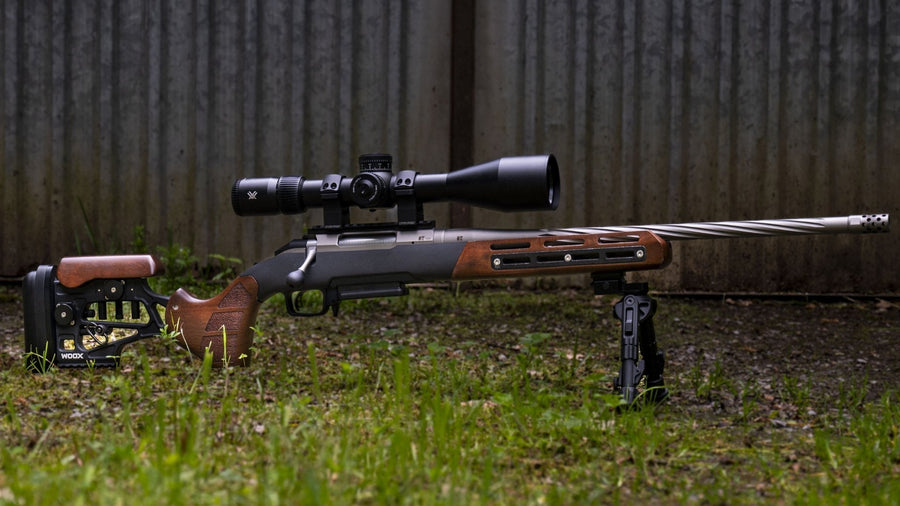
Most discussions about the Ruger American Gen II evaluate bipods, optics, and slings as separate upgrades. In practice, supported shooting depends on how those components interact with the rifle's stock geometry, weight distribution, and support surface. The rifle behaves as a complete mechanical system, not as a collection of independent accessories.
For a hunting rifle like the Ruger American Gen II, supported shooting usually happens from field positions: a bipod, a pack, a shooting bag, sticks, a tree limb, or natural terrain. The stock does not turn the rifle into a bench gun. It helps define how the shooter, action, and support surface meet.
How Support Changes the Rifle System
Support changes more than stability. Once a rifle rests on a bipod, shooting bag, or natural terrain, the support surface becomes part of how the rifle settles before and after the shot.
For the Ruger American Gen II, the setup process begins before selecting accessories. The intended field position, terrain, carry distance, and likely support surface should guide every decision that follows.
A rifle carried through timber, hills, or farm ground needs a different support setup than one expected to spend most of its time prone behind a bipod. A hunting rifle still has to carry correctly before it ever settles into a supported position.
Why Weight Distribution Matters
Reducing weight is often treated as the primary objective when configuring a hunting rifle. Supported shooting shifts part of that discussion toward weight distribution rather than weight alone. Where mass is positioned affects how the rifle balances, how it settles on support, and how easily the shooter returns to the sight picture.
Optics, suppressors, loaded magazines, and bipods add mass in different locations. Forward weight changes how the rifle settles into front support. Weight mounted high above the bore can make the rifle feel more top-heavy and may change how easily the shooter returns to the sight picture.
Overall rifle weight still matters. A light rifle is easier to carry over distance. A heavier setup can feel more planted from support. The decision is not simply light versus heavy. It is where the weight lives and what the rifle is being asked to do.
Bipod Performance Depends on the Rifle Beneath It
During supported fire, pressure applied through a bipod or front support loads the fore-end. The way the stock handles that load can influence how consistently the rifle sits on support. The objective of bipod preload is not maximum pressure. It is repeatable pressure.
That consistency depends on the relationship between the support equipment and the stock. The stock is not simply where the bipod attaches. It is the structure that carries the load before it reaches the action. For this reason, evaluating bipod performance without considering stock geometry provides only part of the picture.
A bipod can give the rifle a stable front point. The stock determines how that front point connects to the action, the shooter's shoulder, and the rest of the rifle system.
Sling Tension Still Influences a Supported Rifle
A sling mounted near the fore-end applies force differently than one mounted closer to the action. Sling tension can interact with bipod pressure and fore-end loading. If that tension changes from shot to shot, the rifle can settle differently on support. The objective is not maximum tension. It is repeatable tension.
Consistency comes from applying those inputs predictably rather than relying on any single accessory to remove them.
For field shooting, the sling is not just a carry strap. It can become part of the support system when used against the arm, shoulder, or body position. That makes sling placement and tension part of the supported shooting setup.
Optic Weight and Mount Height Change More Than Sight Picture
Magnification often dominates conversations about optic selection. For supported shooting, optic weight and mounting position also matter. A heavier optic, especially one mounted high, can raise the rifle's center of gravity and make the rifle feel more top-heavy. That change can affect how the rifle settles on a bag, bipod, or field support. It can also change how naturally the shooter returns to the sight picture.
Mount height determines cheek weld and head position. If the shooter must lift the head to find the optic, repeatability decreases because the shooting position changes from shot to shot. A supported rifle should allow the shooter to settle behind the optic without searching for the sight picture. That begins with stock geometry and optic height working together.
Stock Geometry Is the Foundation of Repeatable Field Positions
Geometry is established during design and machining, but maintaining it depends on the stability of the materials supporting the action over years of field use.
Repeatability depends on the rifle allowing the shooter to rebuild the same position. Stock geometry creates that repeatability by establishing the relationship between the shooter, the action, and the support surface.
Stock geometry should be evaluated as a connected system rather than a collection of dimensions. Comb height, grip angle, length of pull, fore-end shape, and toe profile work together to determine eye alignment, shoulder pressure, trigger control, and how the rifle tracks under recoil.
No single dimension determines how the rifle behaves. Their influence comes from the way they interact to produce the same body position and support relationship from one shot to the next.
The fore-end deserves particular attention on a supported rifle. Bipods, bags, sticks, and natural terrain all contact the rifle through this surface.
A fore-end that presents a stable, repeatable interface makes support placement more consistent and reduces the amount of correction required behind the rifle.
Configuring the Ruger American Gen II for Supported Shooting
A hunting rifle carried through steep terrain benefits from a different balance than a rifle expected to spend most of its time prone behind a bipod. Natural point of aim is one of the simplest ways to evaluate a supported shooting setup. Once the Ruger American Gen II is settled behind a bipod, shooting bag, sticks, or natural field support, the reticle should rest on target with minimal muscular correction.
If maintaining the sight picture requires constant shoulder pressure, lifting the head to find the optic, or repositioning the rifle after each shot, the issue often lies in the relationship between support placement, optic height, stock geometry, and shooter position rather than in the accessory itself.
A supported setup should be evaluated in the positions where the rifle will actually be used. A bench tells part of the story. A field pack, a kneeling position, a tree rest, or a prone bipod position may tell the more useful part.
Where the Stock Fits Into the System
Once the Ruger American Gen II has been configured for its intended use, the stock becomes the structural foundation connecting the shooter, the action, and the support equipment.
The WOOX Elegante pairs Claro American Walnut with an integrated aerospace-grade aluminum mini-chassis, creating a defined structural interface beneath the action while preserving the handling character of a traditional hunting stock.
The aluminum mini-chassis supports action fitment and structural rigidity inside the stock. The Claro American Walnut gives the rifle its exterior geometry, balance in the hands, and field character.
The Elegante Sporter is built as a hunting stock, not a dedicated benchrest chassis. Its slim fore-end, traditional grip geometry, and lightweight 30 oz construction are designed around carry, shoulder mount, and field use.
For the Ruger American Gen II, that matters because supported shooting in the field is not only a question of what bipod or optic is attached. It is a question of how the stock lets the rifle settle into the same relationship with the shooter and the support surface.
Ruger American Gen II Fitment Check Before Ordering
WOOX lists Ruger American Gen II SA as a supported short-action centerfire platform. Before ordering, confirm the exact Ruger American Gen II model, magazine configuration, barrel profile, factory magazine insert requirement, and current WOOX inlet.
Ruger AmericanRimfire rifles should not be treated as the same fitment. WOOX's current Elegante Sporter compatibility information lists Ruger American Gen II SA as short-action centerfire and notes support for common Gen II models including Standard, Ranch, Predator, Scout, Prairie, and Patrol. It also lists supported barrel profiles including straight, pencil, and match.
The fitment check matters because supported shooting only works when the rifle is configured correctly before accessories are added. A bipod, sling, or optic cannot correct the wrong inlet, barrel channel, magazine fit, or stock interface.
Supported shooting becomes more consistent when geometry, material selection, and setup discipline work together rather than independently. The bipod gives the rifle a front support point. The sling can add tension when used consistently. The optic establishes sight picture and head position. The stock connects those decisions to the shooter and the action.
For a Ruger American Gen II hunting rifle, the goal is not to turn the rifle into something it is not. The goal is to make each support position easier to rebuild with less unnecessary movement.
Accessories may change throughout a rifle's life, but a stock built around stable materials and precise geometry provides the foundation every supported field position depends on. That foundation is measured not only across today's range session, but across years of hunting and the generations that follow.
Frequently Asked Questions
Does a bipod improve accuracy on the Ruger American Gen II?
A bipod can improve stability, but it does not automatically make the rifle more accurate. Stock geometry, consistent bipod pressure, weight distribution, optic height, ammunition, shooter input, and field position all influence how predictable the rifle feels from support.
Does optic weight affect supported shooting?
Yes. A heavier optic, especially one mounted high, can make the rifle feel more top-heavy and may change how naturally the shooter returns to the sight picture. Optic weight should be considered alongside bipod placement, sling tension, and overall rifle balance.
How important is stock geometry for supported shooting?
Stock geometry is central because it determines cheek weld, length of pull, grip position, shoulder contact, fore-end support, and how consistently the shooter rebuilds the same position.
Should I use a sling when shooting from a bipod?
A sling can help when used consistently. Sling tension can interact with bipod pressure and fore-end loading. If tension changes from shot to shot, the rifle may settle differently on support.
What is the best supported shooting setup for a Ruger American Gen II?
The best setup depends on intended use. Most supported hunting rifles benefit from balanced weight distribution, a correctly mounted optic, consistent support pressure, repeatable sling tension if used, and a stock that maintains a stable relationship between the shooter, action, and support surface.
Is the WOOX Elegante a precision chassis for the Ruger American Gen II?
No. The Elegante Sporter is a hunting stock built around Claro American Walnut, a traditional hunting silhouette, slim fore-end, and an integrated aerospace-grade aluminum mini-chassis. It supports action fitment and a stable stock interface while preserving the carry and handling character expected from a traditional hunting rifle.