Pick up a poorly set up AR15 and the issue doesn’t announce itself immediately. You can still shoot it. You can still hit targets. But after a few rounds, something feels off.
You start reaching for the optic instead of finding it naturally. The support arm works harder than it should. The reticle lifts and doesn’t quite return to the same place. You correct it, shot after shot, without fully realizing why.
That’s not comfort.
That’s geometry—and more specifically, how that geometry is forcing the rifle to move under recoil.
The AR platform was designed around a straight-line recoil system. Bore axis, buffer tube, and shoulder are meant to align so that recoil travels directly rearward. When that alignment is even slightly off, the rifle stops translating and starts rotating. That rotation is small, but it compounds—and that’s where performance starts to break.
Why AR15 Ergonomics Is a System
Most shooters approach ergonomics one component at a time—adjusting the stock, swapping a grip, or upgrading the handguard. The problem is that the rifle doesn’t behave as a collection of parts. It behaves as a connected system.
A small change at the rear of the rifle alters how recoil travels through the entire structure.
Consider this chain:
A stock set too long pushes the elbow toward extension. That reduces the body’s ability to absorb recoil through the shoulder pocket. Instead of traveling straight back, the rifle begins to rotate slightly upward. That rotation lifts the muzzle, moves the reticle off target, and forces the shooter to correct between shots.
At 25 yards, this is easy to mask. At 100 yards on a small steel plate, it becomes obvious.
The key is understanding that the rifle moves in a predictable arc. Your setup determines that arc.

Stock Length: Where Recoil Enters the Body
Length of pull is the primary interface between shooter and rifle. It defines how recoil is transmitted and how consistently the eye aligns with the optic.
Most setups tend to be too long.
When the stock is extended beyond the shooter’s natural reach, the elbow straightens and loses its ability to act as a shock absorber. On a 16" 5.56 rifle firing standard 55gr ammunition, this creates a repeatable upward displacement of the muzzle.
This effect is subtle in isolation, but across multiple shots it results in vertical stringing and slower recovery.
A stock that is too short introduces a different set of problems. The shooter compresses into the rifle, the elbow flares outward, and the eye moves too close to the optic—especially noticeable with LPVO setups.
When length of pull is correct, the system stabilizes. The cheek weld forms naturally, the optic aligns without effort, and the elbow retains a slight bend—typically around 15–20 degrees. Recoil travels straight back, and the reticle returns without conscious correction.
Grip Angle: Managing Rotation and Trigger Interface
Grip angle defines wrist position, and wrist position determines how the rifle behaves under recoil.
A more vertical grip aligns the wrist with the bore axis, keeping recoil forces in line. This reduces diagonal movement and improves trigger reset consistency, especially during faster shooting.
An angled grip shifts the wrist rearward. While it may feel natural in slower or prone shooting, it introduces slight rotational movement under speed.
The key mistake is evaluating grips statically. What matters is where your hand settles after recoil, not how it feels at rest.
Handguard Length: Leverage and Control
Handguard length changes the effective lever arm of the rifle.
A longer handguard allows the support hand to extend forward, increasing control over muzzle movement. On a 16" rifle, moving from a 9" to a 15" handguard reduces the effort required to manage recoil.
The principle is simple: the longer the lever, the less force needed to control it.
However, longer handguards can be less practical in confined spaces, and shorter shooters may not fully benefit if they cannot extend their support hand.

Ergonomics → Performance
Ergonomics directly impacts shooting performance.
Recoil control: Proper alignment keeps forces linear instead of rotational.
Speed: A well-configured rifle returns to target naturally without correction.
Precision: Reduced muscular tension leads to a more stable sight picture.
At closer distances, these differences may seem minor. Beyond 100 yards, they become measurable.
Real Setup Example
Platform: 16" AR-15, Aimpoint Micro T-2 on 1.93" mount
Shooter: 6'1"
Use: Practical shooting, 7–200 yards
Problem: Stock at mid position, A2 grip, 9" handguard. Hit rate below 70% on 8" steel at 100 yards. Reticle jumping high-right.
Fix: Stock adjusted, vertical grip installed, handguard extended to 15".
Result: Hit rate above 90%, split times improved by ~0.05s per shot. Rifle felt lighter due to corrected geometry.
Where Material Begins to Matter
Once geometry is correct, material characteristics become noticeable.
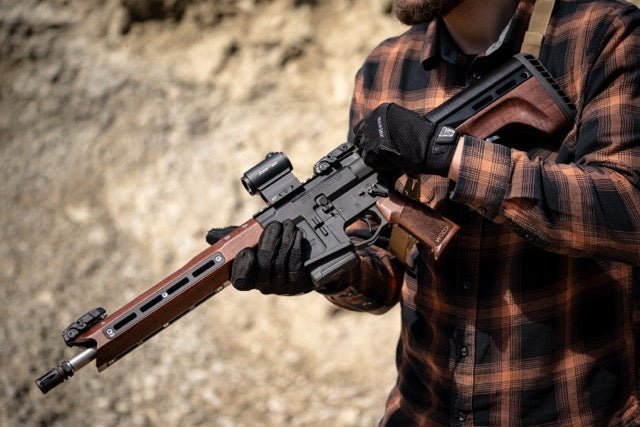
Aluminum structures transmit recoil more directly, while materials like Claro walnut absorb and redistribute part of the impulse. When paired with an aluminum core, this creates a balance of rigidity and recoil moderation.
Bottom Line
AR15 ergonomics is not about comfort. It is about controlling how the rifle moves.
Fix the geometry, and the rifle stops fighting you.
Technical FAQs
What causes an AR15 to feel “off” even if it’s shooting fine?
It usually comes down to geometry, not comfort. If the rifle isn’t aligned properly with your body, recoil starts to rotate instead of moving straight back, forcing you to correct after every shot.
Why does stock length matter so much?
Stock length controls how recoil enters your body and how your eye aligns with the optic. Too long, and the rifle starts lifting under recoil. Too short, and your position becomes cramped and inconsistent
How do I know if my stock length is correct?
When it’s right, your cheek weld feels natural, your optic aligns without effort, and your elbow maintains a slight bend. The rifle should return to target without needing correction.
Does grip angle really affect performance?
Yes. Grip angle determines wrist position, which directly affects recoil control and trigger consistency. A more vertical grip helps keep recoil in line and improves control during faster shooting.
What difference does handguard length make?
A longer handguard gives you more leverage by allowing your support hand to extend further forward. This makes it easier to control muzzle movement and manage recoil.
Why do small setup issues matter more at longer distances?
At close range, small errors are easy to ignore. But beyond 100 yards, even minor inconsistencies in recoil and alignment become measurable misses and slower follow-up shots.
Is AR15 ergonomics really that important for performance?
Absolutely. Proper ergonomics improves recoil control, speeds up target reacquisition, and reduces tension in your body—leading to better consistency and accuracy overall.
Is AR15 ergonomics about comfort?
No. It’s about controlling how the rifle moves under recoil. When the geometry is correct, the rifle tracks predictably and stops fighting you.